
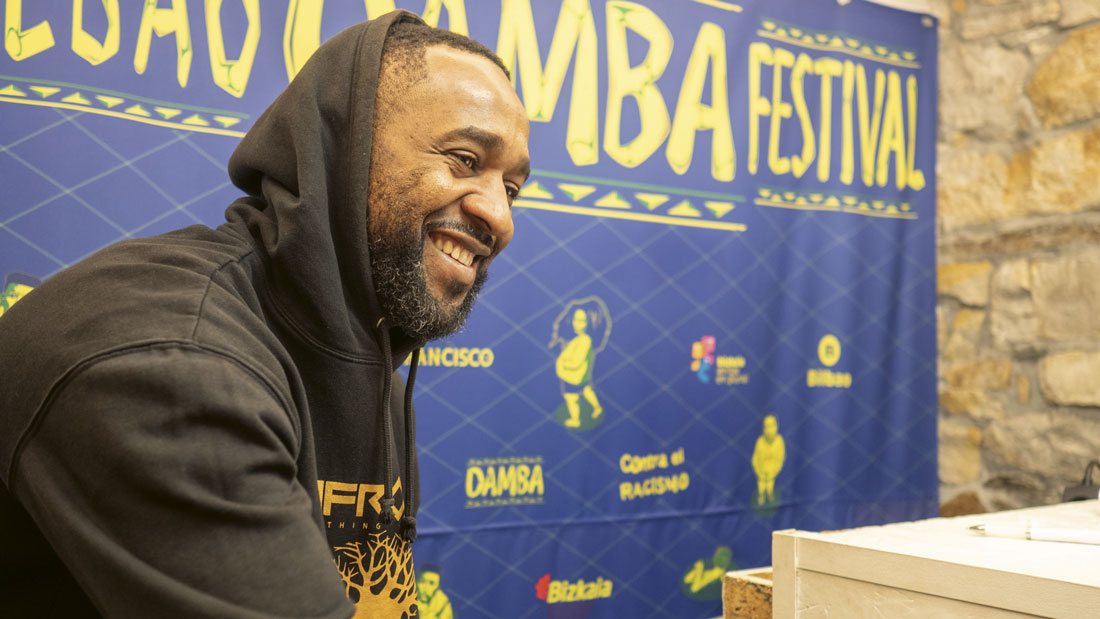
Betto Snay, musician
At the gates of the fifth edition of the Damba Festival (March 21 at the BBK room in Bilbao), we chatted with the rapper of Angolan origin Betto Snay at his venue in the San Francisco neighborhood, Sanfran, as this district of the capital of Biscay is popularly known.
Rapper, activist, designer… How do you define yourself?
Like another human being.
What advice would you give to someone starting out in music?
Believe in yourself and move forward, don’t expect people to do things for you. I keep believing in myself, I keep making my moves and I don’t expect anything from anyone.
What has the Bilbao neighborhood of San Francisco contributed to your music?
Getting to know myself, empathizing with people and understanding the other perspective of life, of the community where I live, something that must be given a lot of value. It has given me what I am. I talk a lot about Sanfran because it has a lot of strength, it is a very sincere neighborhood and that is important in art. The neighborhood has a very marked importance in my career and in my personal life, I know that I am very supported by the neighborhood.
And his music to the neighborhood?
There you have to ask the people in the neighborhood. I do believe that I have contributed my experience as a promoter of musical events. In this neighborhood that no one wants, ugly, sad and decadent, we have brought together many people and the people of the neighborhood are beginning to feel identified, to respond, to understand, to understand that the community is important.
Who are your main artistic references?
More than references are the people with whom I speak every day. There is a phrase from a song I did with Lion Sitté that says: “Yesterday I didn’t eat, today I didn’t eat either.” People think it’s mine, but it’s from a neighborhood figure, a deceased musician who, in quotes, didn’t amount to anything. That for me is a reference, because this man had very beautiful and very nice phrases that he made me see. If we talk about artistic references, Frank T, Chojin, Black Company or Fill Black. I was born in Angola, so Bonga is one of the artists that I also have very much in mind.
He has worked with many artists. Would you like any new collaboration on your next album?
I’m in a phase where I prefer to give more relevance to local artists. There are a lot of young people I would collaborate with, very talented people, and I’m a little afraid that they will go unnoticed like me. It would be cool if one day I could lift them up, elevate them… Look, Joan Manuel Serrat! I would like it with him, because he has quite coherent things.
He is also behind the Damba Festival. What is your main objective?
Give visibility to artists with anti-racist content without the possibility of being in other spaces. On a personal level, they have held me back a lot because I have very radical content, a very political message, and in a way they don’t like that. Maybe it’s because I’m not talented enough, but I think that’s an important point. We set up the festival when I saw that artists who are in my line were undervalued. We’ve realized that people don’t know these artists, but they leave the festival with a smile that says: “Wow, I didn’t know that and it’s brutal.” After five years, it finally coincides with the International Day Against Racism, March 21. It’s going to be very handsome, very pretty, and I hope to enjoy it 100% and that the people who come also enjoy it.
Where does the name Damba come from?
It has different lines. In Basque, danbawith n, is ‘burst’. In Ghana there is also a Damba Festival which, in one of their languages, means ‘to rise’. In Angola it is a municipality. We are a few Pan-Africanists who continue to work hard and in 15 or 20 years we have noticed a change, an evolution. Damba talks a little about it, about that surge of energy in society.
What is Euskal Rap?
It is the association that covers everything. Euskal Rap has different lines of projects. In the musical part there is the Damba Festival and Sildofaya Music, another project that seeks to empower artists by facilitating recording. We now have Damba Cultura, which is another more open tool, which will include an urban school. Euskal Rap was created 20 years ago, when I released an album, Odysseyand it didn’t work. When I went to look for concert halls I only found closed doors, so I thought about creating an artistic association to combat it.
Your last album, Black Mambarefers to Kobe Bryant. What is the place of basketball in your life?
I am basketball, it is the sport I love. I played almost semi-professionally in the old EBA League. Sport is beautiful in all aspects, but for me basketball is the most inclusive on a social level. I have met people from all over the world playing in the street, people who have been in Bilbao for three months and basketball has gotten inside them as if they had been there all their lives. Black Mamba It goes along that line of bringing out the best version of each one.
He has also delved into fashion with Afrook.
Afrook is a brand that seeks to make cultural diversity visible. Everything is connected. San Francisco is diverse, but not everyone wants to be from the neighborhood. There is no identity. Lucía Mbomío is from Alcorcón and is very Alcorcón. He is not from Madrid, he is from Alcorcón. I was in the European Parliament at a talk and people said: “I come from Murcia, I from Bilbao, I am… And you?” “I, from Sanfran.” Today we don’t sell thousands of garments, but the people who buy understand and understand the philosophy, and I find that interesting.
All his work has a strong social component, fighting against inequalities, racism and injustice. Where does that social consciousness come from?
I think from my father. I never had a father, because my mother separated when I was one year old. I met him when I went to Angola and in his neighborhood I only heard nice things about him. I think I have the old man’s genes and, although I could have been half angry with him, that also made me reconcile and understand him. I don’t like injustices at all. We are in a very polarized world at a political level and I would not like my daughter to go through what I am going through, what people in irregular situations go through. I try to contribute my small grain of sand within my community, in this society of which I am a part. If I can make a social impact, I do it. And, in fact, I don’t do it with any personal interest, I lose a lot of money to help. Sometimes my daughter tells me: “You don’t have money and you give money.” Yes, daughter, that’s how it is.
If you had to choose three songs of yours that define you, what would they be?
my music is one of them, Neighborhood is another and Code. It’s special. Code It is a success, an anthem for me, a song that reflects rebellion on my part: “Yes, I am black, but here I am.” Although now I am a little more cautious, it reminds me of my youth and tells me: “Don’t be so politically correct, you also have to be bad.” my music It reflects my personality, understanding the community. I talk about my African continent, which is a source of inspiration, I talk about fighting, running underwater, with my fist in the air. It’s the song I usually open my concerts with. I tell the audience that if they are a listening audience, they will know what the rest of the concert is about. Neighborhood It is vindictive, it is raw, it is very hard, very realistic. It’s about the fact that if a white man kills a black person, nothing happens, but if a black man kills a white person, the world falls apart. Talk about the opportunities of poor people. I am poor, I don’t make 1,000 euros a month. By Neighborhood People have come to tell me: “Hey, you have sung about my life, I live on the street.” From there also came the idea of making cardboard beda topic with considerable relevance at a social level. When I see that the things I sing have a social impact, I say to myself: “I’m not that bad, I’m not that wrong either.”
What three dreams would you like to fulfill in the next ten years?
There are many things. when you are aita You already have other worries. I’m a grandfather and everything! The first is that my daughter understands what I did on a social level and that she takes the baton, because I see that she likes it, that she is understanding, that her speech is in my line. Another, continue making music. And, lastly, continue enjoying and continue impacting, growing the community on a musical level and starting new community projects. Sometimes you talk to other artists and at their concerts they have more white presence than black or migrant presence. The messages that these artists send, in a way, are not suffered by white people. But it’s very good when black people go and begin to understand. Although the community is small, in Bilbao we are having quite a lot of relevance and they go when there are African activities. I would like it to have grown more in ten years.
