
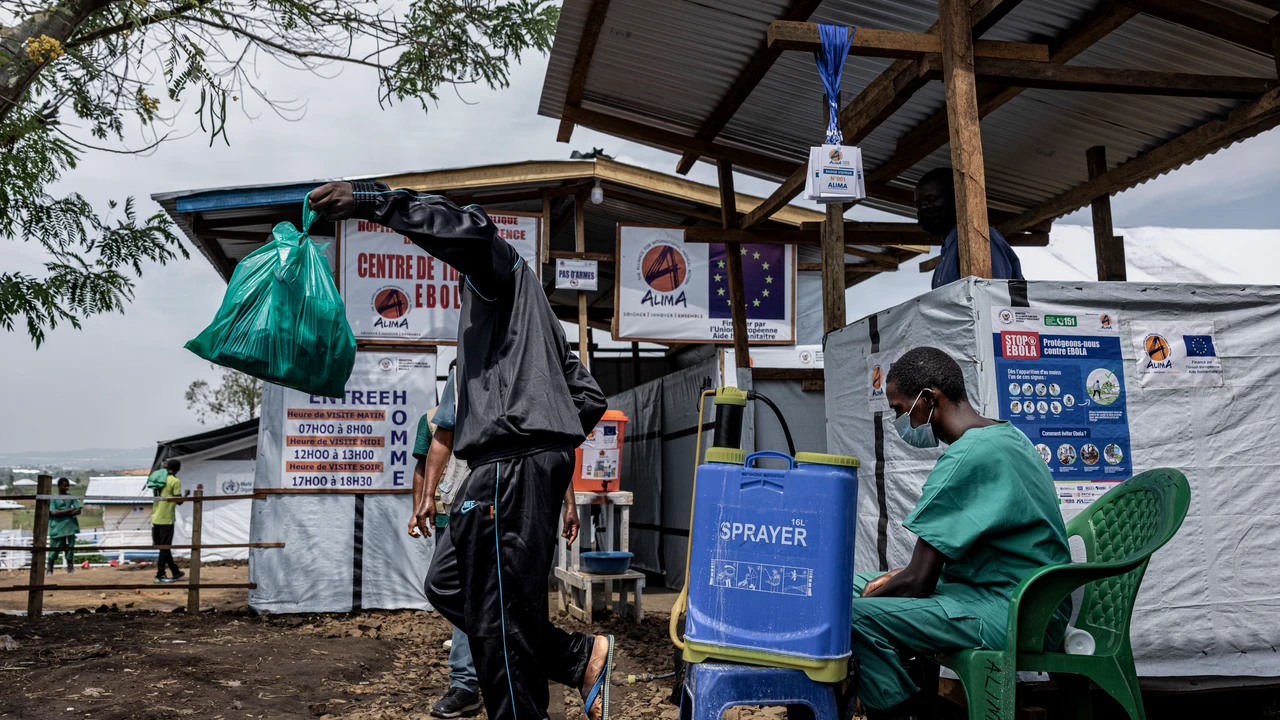
It has been more than three months since the Ebola outbreak was declared in the DR Congo, and the situation continues to worsen. There are already 2,420 deaths since last May 15, making it the second worst outbreak in history and the most serious recorded in the DRC.
However, the news is still not encouraging. And the Government of the Democratic Republic of the Congo (DRC) has recently raised confirmed cases of Ebola to 5,105, also leaving a mortality rate that currently stands at 47.4%. On the other hand, 782 patients are in “isolation or hospitalized” and 1,091 people have managed to recover from the disease, while the contact tracing rate is at 84.1%.
It is a disease caused by the Ebola virus, which is transmitted through contact with infected people and animals and causes severe hemorrhagic fever, vomiting, diarrhea and internal bleeding. In total, five Congolese provinces are affected, including Ituri, North Kivu, Haut-Uélé and Tshopo, in addition to Bas-Uélé.
An epidemic that is not under control
90 days after the first case, the epidemic affecting the DR Congo remains uncontrolled. This was pointed out by the director general of the World Health Organization (WHO), Tedros Adhanom Ghebreyesus, who explained that the outbreak is driven by insecurity and displacement.
On the other hand, the head of the WHO has detailed that the epidemic continues to generate danger. “We have to be honest: the epidemic is by no means under control. The outbreak had a brilliant start and we are still trying to recover from that advantage.”
Security checks continue
Although Ebola is mainly affecting the DR Congo, the truth is that the epidemic can spread beyond its borders. That is why the head of the WHO has warned that the outbreak will not be concluded until all chains of transmission are recorded and broken.
“The risk does not stop at the borders of the Democratic Republic of the Congo. Uganda has already stopped transmission after the initial jump, and I congratulate the government and people of Uganda for their decisive response. Last month, however, a traveler transported the virus to France. Borders may slow down a response, but they do not stop a virus,” he stressed.
However, Tedros has stressed the leadership of the Government of the Democratic Republic of the Congo to elevate the health response together with the WHO and the African Centers for Disease Control and Prevention (CDC).
“We are strengthening community-based surveillance, expanding healthcare capacity, supporting safe and dignified burials, working with communities to build trust and ownership, and promoting clinical trials for vaccines and treatments,” he stressed.
The fastest growing epidemic
The outbreak this Monday became the second worst Ebola outbreak in history, surpassing the one that also hit eastern DRC between 2018 and 2020 and caused 2,299 deaths and 3,481 cases. Even so, the figures still remain far from the most serious case recorded to date, which caused 11,000 deaths and 28,000 infections in West Africa between 2014 and 2016.
However, the current epidemic, which surpassed the barrier of 5,000 cases less than two weeks after exceeding 4,000 infections, is the fastest growing since its declaration compared to any previous outbreak.
