
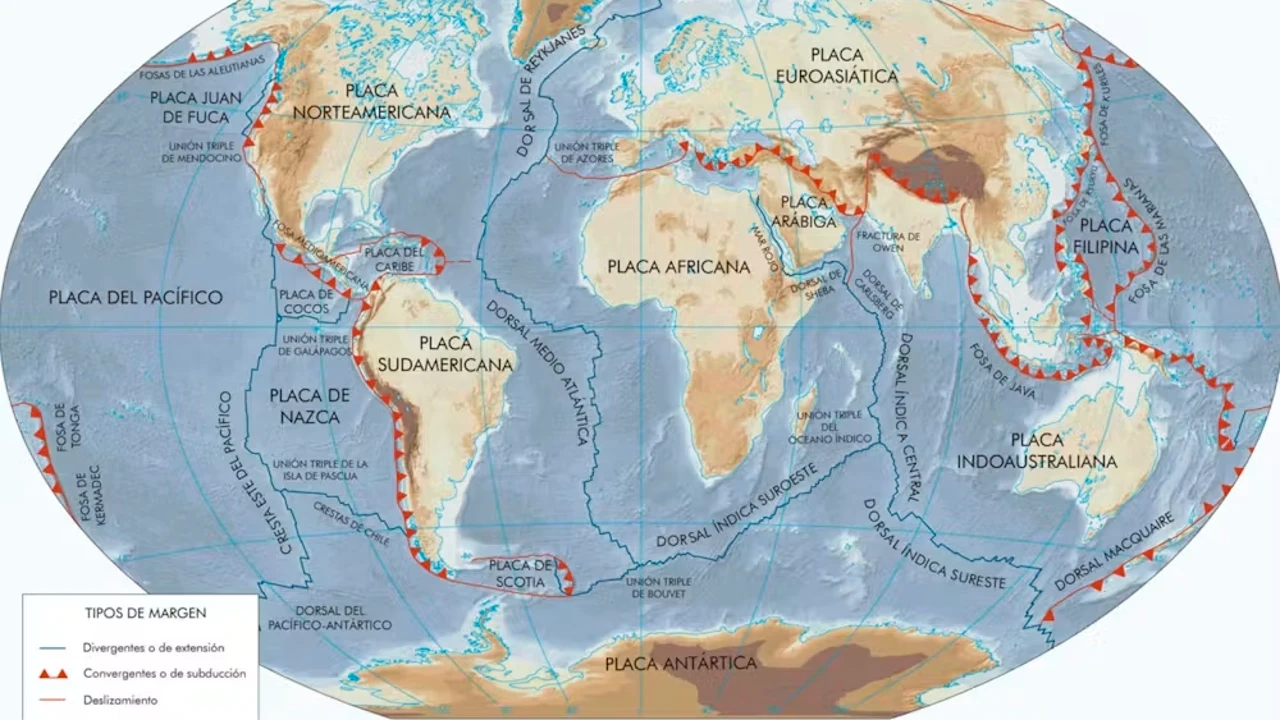
In recent months, several large earthquakes have occurred in different areas of the world. On June 24, two large earthquakes, magnitudes 7.2 and 7.5, shook Venezuela just a few seconds apart. In late July, a 7.1 magnitude earthquake hit southern Japan. On August 10, another magnitude 7.4 was recorded in Colombia.
Just five days later, a 7.7 magnitude earthquake shook the island of Flores, Indonesia. Shortly after, the earth shook again, this time in Granada (Spain), although from an earthquake of magnitude 4.8, much lower than the previous ones. On August 18, three new earthquakes of magnitudes 4.8, 4.2 and 4.0 have once again affected the Andalusian region.
Faced with a succession like this, it is easy to think that something is happening on a planetary scale. Are we going through a time of increased seismic activity?
The short answer is that we have no evidence that the Earth is going through a phase of increased global tectonic activity. The fact that several large earthquakes coincide within a few weeks may be striking, but temporal proximity does not imply that they are physically related.
The movement of tectonic plates and earthquakes
The Earth’s surface is fragmented into tectonic plates that continually move, usually at speeds of a few centimeters per year. At its edges, efforts accumulate for years, decades or centuries until the resistance limit of the rocks is exceeded and a sudden rupture occurs that generates the seismic shock, that is, the earthquake.
But this process is not synchronized on a planetary scale. A fault in the Andes, another in the Caribbean and another in the south of the Iberian Peninsula respond to very different tectonic contexts. We know of no mechanism capable of simultaneously accelerating the movement of tectonic plates on a planetary scale and triggering, in a matter of weeks, a global wave of large earthquakes.
So why do they sometimes seem to temporarily focus? This is fundamentally a matter of chance. Let’s think about the toss of a coin. Although the probability of getting heads is the same as getting tails, we can get several heads in a row. That doesn’t mean the currency has changed.
Something similar happens with earthquakes. There may be periods with several large events and other relatively quiet ones without the rate of global seismic activity having changed. Indeed, statistical analyzes of the global catalog of earthquakes of magnitude 7 or greater show that the apparent global clusters can be explained by random variability, together with local sequences of aftershocks.
But some earthquakes are related
The situation changes when we reduce the scale. After a large earthquake, it is common for numerous smaller earthquakes to occur in the same region: these are aftershocks. The main rupture modifies the stresses of the surrounding rocks and favors new ruptures. Its frequency usually decreases progressively over time.
A different case is seismic doublets, in which two earthquakes of comparable magnitude occur, with epicenters close and separated by a short time interval. Venezuela’s recent double is an example.
When two large earthquakes occur very close together, there can be a relationship between them. The rupture of the first redistributes the stresses in the Earth’s crust and these increase in some areas. If a nearby fault was already close to its rupture point, this increase in stress can favor or advance a new earthquake. This mechanism is known as Coulomb stress transfer.
But this mechanism cannot be extrapolated to distant earthquakes. Static stress changes decrease rapidly with distance and mainly affect the immediate environment of the rupture. Therefore, a possible relationship between the two Venezuelan earthquakes does not imply that they can explain another one that occurred much further away, such as the one in Colombia.
Not all major earthquakes become news
There is another factor that influences our perception: not all large earthquakes have the same impact.
On average, around 16 earthquakes of magnitude 7 or greater occur around the world each year, approximately one every three weeks. However, many go unnoticed because they occur under the ocean, at great depths or far from inhabited areas and do not cause damage.
Nor does magnitude alone determine impact. Two similar earthquakes can have very different consequences depending on their depth, the distance to towns, the characteristics of the terrain and, above all, the vulnerability of buildings and infrastructure.
What makes the recent succession especially striking does not have to be an exceptional increase in seismic activity, but rather the fact that several earthquakes have affected populated areas and caused significant damage. If those same events had occurred in uninhabited regions, they would probably have received much less attention.
Added to this is our tendency to look for patterns. When a destructive earthquake is in the news, we pay more attention to the next one and it is natural to relate them, even though they are geologically independent.
That is why it is important to distinguish between how many earthquakes occur and how many affect populations and become news. The succession of several destructive earthquakes close in time can greatly increase our perception of risk without increasing global tectonic activity.
The recent succession of earthquakes in Venezuela, Japan, Colombia, Indonesia or Granada does not indicate, by itself, that the Earth has entered a phase of greater seismic activity, especially convulsive. Our planet is tectonically active and will continue to generate large earthquakes, but that does not mean that an unexpected “earthquake season” has begun.
María Belén Benito Oterino, Professor in the area of Mechanics of Continuous Media and Theory of Structures at the Higher Technical School of Civil, Canal and Port Engineers, Polytechnic University of Madrid (UPM)
This article was originally published on The Conversation. Read the original.
