
The CfSC is a reference for social research in Malawi
Founded in 2002, the Center for Social Concern seeks to transform Malawi’s unjust structures through social research. Its promoters, the Missionaries of Africa, have made this institution a reference for the social and political actors of the country.
After verifying that the local Church was not doing enough in interreligious dialogue or denouncing the economic and social shortcomings of Malawi before the country’s authorities, the Missionaries of Africa (White Fathers) decided to found the Center for Social Concern (CfSC) in 2002. Since its inception, the goal of this initiative has been to “transform the unjust structures of Malawian society through research and advocacy, as well as ensure sustainable policy changes for the well-being of all people.” Its current director, the Ghanaian priest Mathew Wedamdaga Banseh, indicates that the main motivation was to launch a structure that “would make visible the situation of the poor and vulnerable, who most of the time lack a voice or are silenced.” The initiative, located in the neighborhood known as Area 25, near Kanengo, a town located north of Lilongwe, the country’s capital, “is inspired by the Social Doctrine of the Church and the charisma of the congregation,” emphasizes Wedamdaga Banseh.
A country thermometer
The CfSC articulates its work around four fundamental pillars that constitute the core of its activities: economic justice, social conditions, interreligious dialogue and human and social development. Kondwani Hara is the head of the department in charge of studying the social conditions of rural and urban areas of the country. Hara explains how studies are carried out in the latter: «We carry out research every month in the four main cities of the country: Lilongwe, in the Central region; Mzuzu, in the Northern region, and Blantyre and Zomba, both in the Southern region. There, they go to the markets and collect information on the prices of basic products – corn, beans, eggs or bread –, information that is then used to calculate the cost of living. “We also select homes where we collect information on expenses such as rent or basic public services such as water and electricity.” The purpose of the survey is to know how much a family can spend per month in urban areas of the country.
Agnes Nyirongo, head of the Department of Economic Justice, is also part of the CfSC analyst team. She is the one who explains to us the method of work in rural areas: «The center distributes registration sheets to families chosen at random in various villages. We ask them to strictly write down each food they consume per month and in what quantity. Once the data is collected, the center verifies and contrasts the information with international institutions such as the World Health Organization (WHO) or the UN Food Agency (FAO), among others, before publishing the corresponding report. This research allows the CfSC to “understand the social reality of the Malawian population from the ground up, advocate for higher wages and demand changes in policies and practices that impede good governance,” says Hara.
One of these reports, prepared from research carried out in 2025 in collaboration with MISEREOR – an institution of the German Catholic Church – and published on the CfSC website, looked at the cost of living in Malawi in 2025. The conclusion of the study speaks for itself: “The cost of living has increased by more than 46% in one year, mainly affecting low-income workers,” says Agnes Nyirongo. And he adds: «The Government can launch misinformation campaigns stating that the economy is improving, but the thermometer on the street shows the fever real. And anyone can consult it.
This and other work has turned the CfSC into an attractive space for the country’s unions, where they go every month to obtain data and interpretive keys to the reality of Malawi, as well as to train on how to negotiate with companies. Kondwani Hara details that “one of the unions is located in Dowa, in the Central region, and another in Chikwawa, in the Southern region. “They come to us looking for information that serves as a basis for negotiating salary increases.”
Although the country has a National Statistics Office that publishes annual reports, this body is usually subject to strong political pressure, which is why it tends to disguise the figures so as not to alter public opinion. Meanwhile, “the CfSC maintains its autonomy and publishes the collected data in an accessible format, with full traceability and avoiding any state manipulation,” emphasizes Mathew Wedamdaga Banseh. External interference is not allowed in the project launched by the Missionaries of Africa.
A peaceful coexistence
The Center for Social Concern also stands out for its commitment to coexistence between the different religions present in the country. According to the Statistical Yearbook of the Church 2022, Catholics make up 36% of the population, while Muslims, located mainly in the south of the country, make up 14%. Added to them are 43% of believers of other Christian denominations and 6.5% who practice traditional religions. Tobias Jere, one of the most senior members of the institution and responsible for the Department of Interreligious Dialogue since the center’s origins, affirms that “prevention is cheaper than cure. Working towards this dialogue aims to foster a peaceful society in which people interact and tolerate each other. Convinced of the need to live in harmony, the CfSC has carried out several awareness-raising activities in the Mangochi area, known for being the area with the largest Muslim presence in the country. According to Father Mathew Wedamdaga Banseh, this region presents recurring conflicts between Christian and Muslim communities. For example, during the September 2025 elections, in which the octogenarian Peter Mutharika was the winner – who had lost in the 2020 elections, after his first term –, the CfSC promoted awareness campaigns with great success, which increased awareness about tolerance and peaceful coexistence. Jere recalls an event that took place during a visit to one of the communities where they work: “I was surprised that a traditional chief invited a pastor to say a few words at the funeral of a Muslim”, a gesture that was not common until then.
Academic support
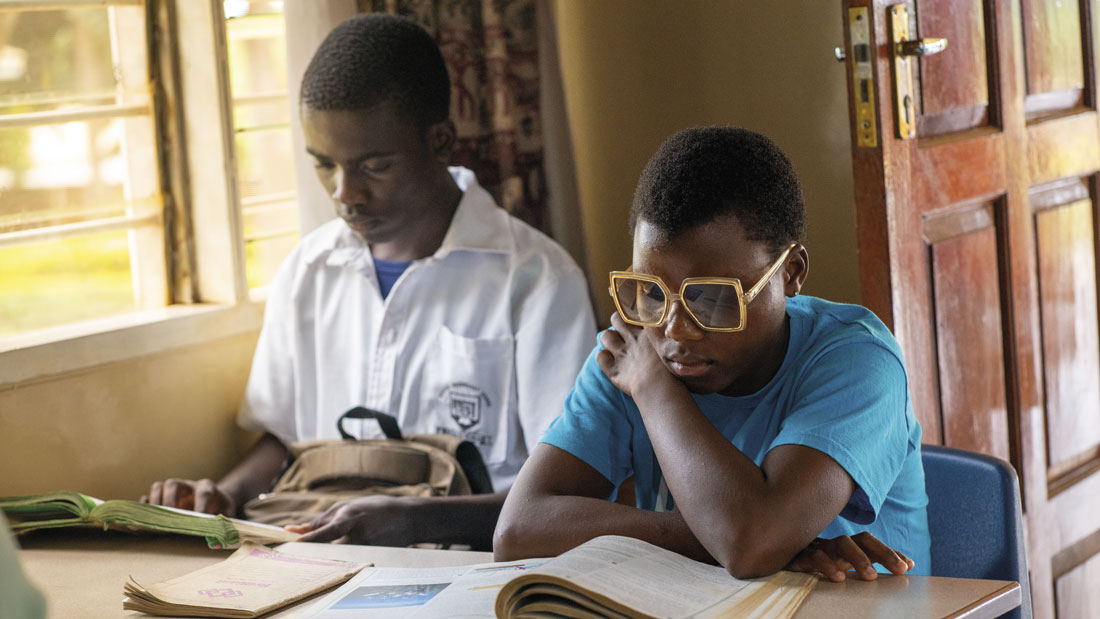
In addition to social research programs, the CfSC has a public access library, the second largest in the capital. Since 2011, the space has opened its doors to young people in the area who do not have a suitable environment in their homes to study or prepare for their exams. From the center they remember that there are 14 secondary schools in the area, but only two of them have a library. The first impression upon entering is silence. Many students are studying with books, laptops and bottles of water by their side. Some look for manuals on the shelves, while others, lacking space inside, sit on the outdoor stairs or in the center’s gardens, where the soft rhythms of the music that some listen to with their headphones can be sensed. Access to the site is not free, as Mathew Wedamdaga Banseh explains: “The library is community-based, but we ask young people to pay a daily fee of 150 kuachas (€0.07) as a gesture of commitment to the center.”
The library is not the CfSC’s only resource. It also has a computer room where young people come to learn how to use the computer with ease. The existence of these community spaces, where students can find information, resources, services and instruction, demonstrates the support and commitment of the Missionaries of Africa to the formation of the youth of the neighborhood.
However, this initiative of the White Fathers is not without challenges. Among the main ones is the lack of financing. The CfSC “does not receive any state support,” emphasizes the director. And he adds: “This is often the case because when state aid is received, the independence of the center is in danger.” For this reason, the institution collaborates, among others, with organizations such as the German development agency Deutsche Gesellschaft für International Zusammenarbeit (GIZ) or Trócaire, the official development agency of the Irish Catholic Church. The dream of the CfSC is to expand the donation network to guarantee the sustainability of its programs, protect its independence and strengthen its capacity to influence social policies. While this aid is being finalized, the Center for Social Concern will undoubtedly take a decisive step to carry out its work.
