
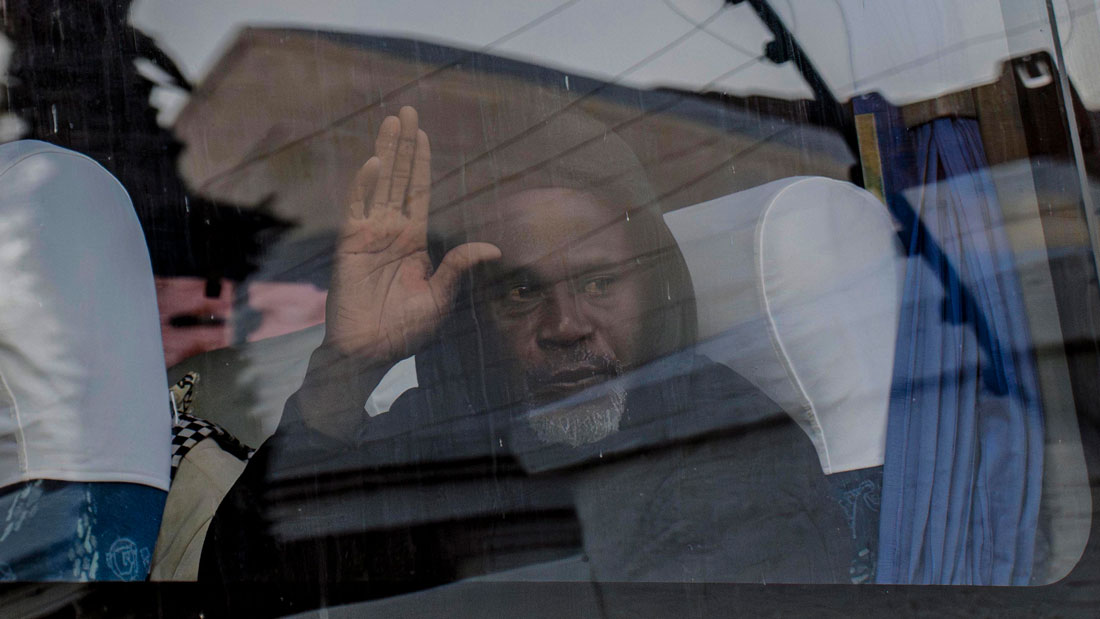
The images come back again and again. Shops looted. Groups of men touring popular neighborhoods in search of immigrants. Families hastily packing their bags to return to a country they had left years ago in search of work. This time it has happened again in South Africa, where campaigns against African immigrants have reactivated fear among thousands of people from Zimbabwe, Malawi, Mozambique, Nigeria, Ethiopia and the Democratic Republic of the Congo. But the scenes could belong to many other places and many other moments in recent African history.
When talking about racism or xenophobia, the conversation usually turns to Europe, the United States or the Gulf countries. They are the spaces where millions of Africans emigrate every year and where they frequently suffer discrimination, exploitation or violence. However, there is another reality that is less known and much less discussed: that of Africans who are rejected by other Africans.
It is not a new issue. Nor a marginal phenomenon. It runs through the contemporary history of the continent and appears with disturbing regularity whenever economic crises, political tensions or fights over scarce resources coincide.
Today South Africa represents the most visible example. It is also the most paradoxical. For decades, the country symbolized Pan-African solidarity. Thousands of South African militants found refuge in other African countries during the fight against apartheid. Governments and liberation movements from across the continent contributed, in one way or another, to sustaining that battle. When democracy arrived in 1994, many imagined that the new South Africa would become the heart of an open and inclusive African citizenry.
But South African memory contains an uncomfortable contradiction. Hugh Masekela had already told the other part of the country’s story. In , one of the great African political songs of the 20th century, evoked the trains that arrived at the mines loaded with workers from Mozambique, Angola, Lesotho or Botswana. Those men crossed borders to feed the South African economy with their work. The song serves today as an uncomfortable reminder: many of the foreigners currently accused of taking jobs or consuming resources belong to the same migrant communities that helped build the country’s wealth. The South Africa that sometimes rejects them is, in part, a product of their efforts.
Since the beginning of this century, the country has experienced repeated outbreaks of violence against immigrants from other African countries. In 2008, dozens of people were killed and thousands were displaced. There were new episodes in 2015, 2019 and in subsequent years. The discourses that fuel these campaigns have hardly changed: foreigners “take away jobs”, “collapse public services”, “favor crime” or “take advantage of national resources”.
Anyone who observes these slogans from Europe will find something familiar. They are practically the same ones used by numerous anti-immigration movements. The difference is that here those targeted are not Europeans, Asians or Arabs, but rather Africans from neighboring countries.
The temptation is to present South Africa as an exception. It is not. Today’s foreigner was often yesterday’s host. African history is full of similar episodes. One of the best known occurred in Nigeria in 1983. That year, in the midst of a deep economic crisis caused by the fall in oil revenues, the Government ordered the mass expulsion of immigrants in an irregular situation. Nearly two million people had to leave the country in a few weeks. About half were Ghanaians.
Photographs from those days show long human columns advancing towards the borders loaded with their belongings. Many transported their goods in large checkered plastic bags that would end up becoming a popular symbol. Since then, in several West African countries, these bags are known as “Ghana Must Go.” The expression has survived for decades. What many forget is that the story did not begin in Nigeria.
Fourteen years earlier, in 1969, Ghana had adopted a very similar measure. Kofi Busia’s government enacted the call, which forced hundreds of thousands of African foreigners to leave the country. Among them were numerous Nigerians.
The historical irony is difficult to ignore. First Ghana expelled Nigerians. Then Nigeria expelled Ghanaians. The roles changed, but the mechanism was identical: when the economy deteriorated and social pressure increased, the foreigner became the most accessible culprit.
This pattern repeats itself over and over again. In Côte d’Ivoire, millions of workers from Burkina Faso, Mali and Guinea contributed for decades to the extraordinary growth of the cocoa economy. They were essential to building the country’s prosperity. However, when the economic crisis hit and political competition for power began, many came to be considered suspicious. The ideology of the , developed in the 1990s, established an increasingly rigid border between those considered authentically Ivorians and those who, despite having lived in the country for decades, continued to be seen as foreigners. That logic fueled social and political tensions that ended up contributing to the crisis that led to the civil war.
History repeats itself under different names in other places. Angola has carried out mass expulsions of Congolese. Gabon has periodically organized operations against migrants from West Africa. Kenya has developed campaigns of hostility towards Somali refugees. In Libya, especially after the fall of Muammar Gaddafi, thousands of sub-Saharan workers were persecuted, detained or accused of collective crimes simply because of their origin.
For some time now, the Cameroonian historian and philosopher Achille Mbembe stated that one of the great contradictions of contemporary Africa lies in having inherited colonial borders that, far from disappearing with independence, continue to define who belongs and who does not. Mbembe has argued that the Pan-African ideal promised a freer movement of people and an open political community, but the reality has been the consolidation of States that, in times of crisis, frequently resort to the exclusion of foreigners as a mechanism of national affirmation. Seen from this perspective, the xenophobia that periodically breaks out in South Africa or the mass expulsions that have marked the history of countries such as Ivory Coast, Ghana or Nigeria are not anomalies, but the expression of an unresolved tension between the dream of a united Africa and the logic of nation states built on inherited borders.
Each case has its particularities. None can be explained solely by the word racism. Economic, political, historical and cultural factors intervene. However, they all share a common trait: the construction of the foreigner as a threat.
The interesting thing is that this trend coexists with another apparently opposite reality. Africa is probably the continent where human mobility has been historically most important. Long before the creation of colonial borders, merchants, shepherds, farmers and artisans crossed immense spaces following economic, family or cultural routes. The current borders divided peoples, languages and communities that for centuries had maintained fluid relations.
Even today, in large areas of West Africa, it is common to find families spread across several countries. A trader can be born in Guinea, work in Ivory Coast, have relatives in Mali and send his children to study in Senegal. On many occasions, local, ethnic or religious identities have historically been more relevant than formal nationality.
Precisely for this reason, it is surprising how easily exclusionary discourses emerge when economic difficulties appear. The explanation lies not so much in racism understood as a biological difference but in the logic of scapegoating. When unemployment rises, when prices rise, or when public services stop functioning properly, policymakers find a clear advantage in singling out a vulnerable group. The foreigner usually meets all the necessary conditions: he is visible, has less ability to defend himself and can be presented as someone who enjoys undeserved benefits. It is a strategy as old as it is effective.
In addition, it allows us to hide much deeper problems. It is easier to blame the immigrant than to discuss corruption, poor economic management, inequality or the inability of the State to generate employment. The paradox is that this dynamic comes into direct conflict with one of the great African political ideals: pan-Africanism.
Since the beginning of the 20th century, African intellectuals and leaders defended the need to build a broader political community that transcended the borders inherited from colonialism. Figures such as Kwame Nkrumah, Julius Nyerere and Patrice Lumumba imagined an Africa united by shared interests and a common history of domination. That ideal played a fundamental role during the independence struggles and in the anti-apartheid movements. It generated a powerful narrative of continental solidarity that is still part of the African political imagination today. However, everyday reality is usually less generous than speeches.
National borders, although artificial in many cases, produce their own identities. Citizens expect the State to protect their interests. Political parties seek support. Leaders need to mobilize collective emotions. And when economic tensions arise, nationalism often prevails over Pan-Africanism.
It is not an exclusively African contradiction. Europe offers numerous similar examples. Also Latin America or Asia. But in Africa it acquires an especially striking dimension because it clashes head-on with one of the founding stories of the contemporary continent.
Perhaps that is why these episodes receive so little attention inside and outside Africa. They are uncomfortable. They question a simplified vision that divides the world between discriminating societies and discriminated societies.
The reality is much more complex. Human beings seem to share a universal tendency: to look for blame when opportunities are scarce. Contexts, languages, borders, names and places change, but history repeats itself. In Europe, the foreigner can be an African. In South Africa, a Zimbabwean. In Ghana, a Nigerian. In Nigeria, a Ghanaian. In Ivory Coast, a Burkinabe. The name changes. The logic remains.
That is why perhaps the most important question is not to ask whether xenophobia exists in Africa. The answer is evidently yes, as it exists in practically all human societies. The real question is why we still need foreigners to blame for problems they have rarely created.
Africa has legitimate reasons to demand respect and dignity for its emigrants in Europe, America or the Gulf. But this demand will be stronger and more coherent if it is accompanied by an equally honest reflection on the treatment that millions of Africans receive when they cross the borders of their own continent. Because solidarity is not tested in speeches. It is tested when the foreigner arrives in our neighborhood, looks for work in our market or competes for the same resources as us. And that is when too many societies discover that the African next door can also become a foreigner.
