
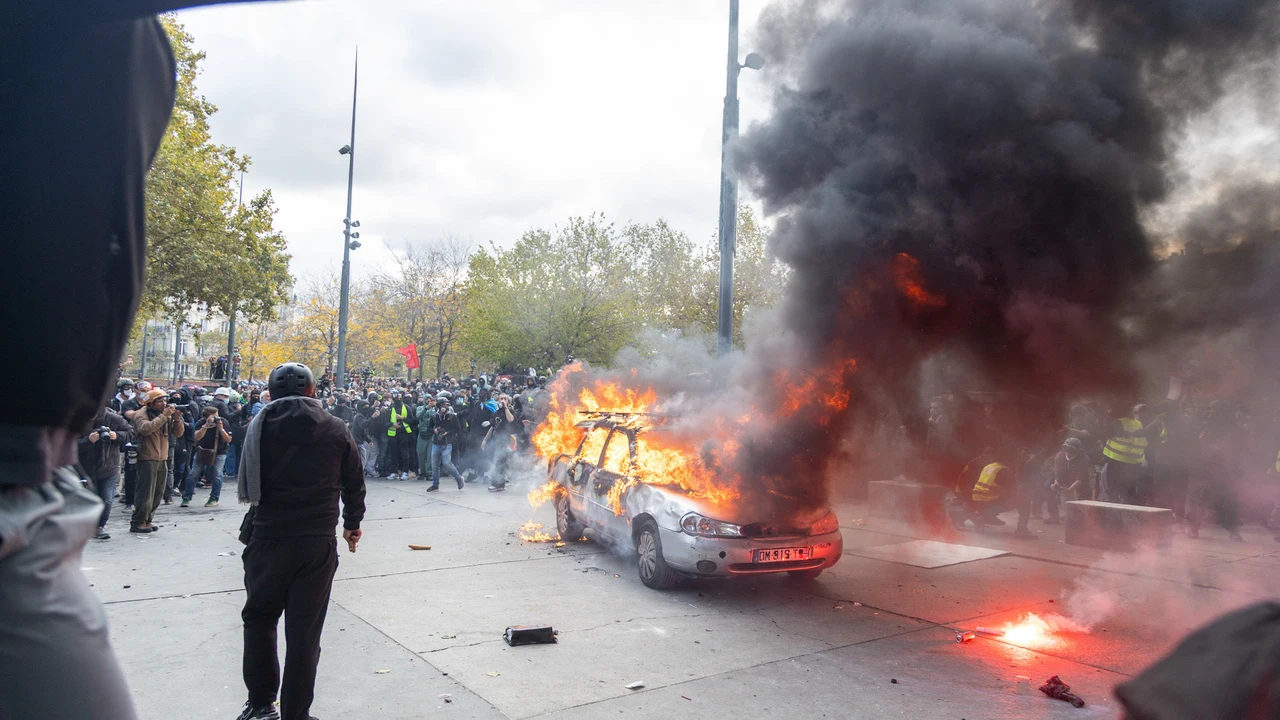
France faces a new day of social tension after the serious disturbances registered in several of its main cities during the mobilizations on Saturday. French President Emmanuel Macron expressed his indignation at the violent acts and called for calm to be restored, while announcing measures to strengthen security and open new avenues of dialogue with dissatisfied sectors.
The provisional balance released by the authorities raises the number of arrests throughout the country to 2,397 and places thousands of security force agents injured during the clashes. In Paris, 720 arrests were recorded, of which 517 resulted in arrests, according to official data. The incidents also left numerous businesses damaged, public buildings attacked, and establishments looted or burned.
The protests, which brought together around 550,000 people according to the French Ministry of the Interior and exceeded 800,000 according to union estimates, spread through cities such as Marseille, Lyon, Bordeaux, Rennes, Strasbourg and Nice. Although a good part of the participants took to the streets to express their social demands, different groups carried out episodes of violence that aggravated the situation.
Social unrest, behind the mobilizations
The demonstrations respond to a set of problems that have fueled discontent among different sectors of the French population. Among the main demands are the rising cost of living, the difficulties faced by public education and complaints about police actions considered abusive.
The economic pressure on households and concern about access to public services have contributed to intensifying criticism against the Executive. Added to these demands is the distrust of citizens towards institutions and security forces, in a context of growing political polarization.
However, the mobilization has been marked by attacks on public facilities and private businesses. The Government has insisted that social demands must be differentiated from criminal acts and has warned that it will not allow violence to condition public life.
Macron announces measures and asks for explanations
In a televised message, Macron expressed his rejection of the events and defended the need to restore order. The president asked the Government, especially the Ministry of the Interior, to review police action during the protests and offer clear explanations about the management of the incidents.
Among the measures announced is the possibility for territorial authorities to prohibit certain concentrations when they consider that there is a risk to the safety of citizens, businesses or public buildings. The Executive has also promised to pursue those responsible for the attacks and reinforce the protection of the most affected areas.
In parallel, the head of state has tasked the prime minister, Sébastien Lecornu, with promoting contacts with political representatives and subsequently bringing together unions, student organizations, local officials and parliamentarians. The objective is to study proposals that allow us to respond to social demands and reduce tension.
Macron defended that differences must be resolved through dialogue and democratic channels. Likewise, he urged political parties to reject violence and prevent confrontation from leading to an escalation of clashes.
New incidents in Paris and damage to public buildings
Despite calls for calm, tension continued this Sunday in the French capital. Nearly a thousand people gathered in the Plaza de la República without prior authorization, and the police intervention included the use of tear gas and water cannons to disperse those present. During the day, new looting in commercial establishments was also reported.
One of the most striking images of the riots came from Limoges, where a fire caused serious damage to the town hall, a historic building whose top and bell tower were destroyed. In response, around 7,000 people participated in a march to show their support for public institutions and condemn violent acts.
The Association of Mayors of France has called rallies in front of town halls to reject attacks on municipal buildings and vindicate the role of democratic institutions. The economic damage, which affects numerous businesses and infrastructure, still does not have a definitive assessment.
The opposition questions the president’s response
Macron’s intervention has failed to close the political gap. From the extreme right, Jordan Bardella, leader of the National Rally, criticized the presidential response and accused the Government of lacking the capacity to protect the population. Marine Le Pen, for her part, questioned the authority of the head of state.
From the left, Manuel Bompard, coordinator of La Francia Insumisa, reproached the president for not offering concrete responses to the protesters’ demands. Environmental leader Marine Tondelier also called for political measures that address the social and democratic causes of the conflict, beyond calls to condemn violence.
The criticism reflects the difficulty of the Executive in finding a response that combines the restoration of security with solutions to the problems that have driven the mobilizations.
A challenge for the French Government
The riots represent a new challenge for Macron and his team, who must manage the pressure on public order while still addressing the demands of citizens. The magnitude of the protests and the continuity of the incidents show the depth of the unrest and the risk that the situation will continue to deteriorate.
The Government insists that it will prosecute crimes and protect institutions, while trying to open negotiations with the affected groups. The result of these contacts will be decisive in verifying whether the authorities manage to reduce tension and channel the protests towards a political solution.
For now, France remains divided between condemning the looting and attacks and demanding responses to the rising cost of living, the difficulties of public services and reports of police violence. The evolution of the coming days will allow us to measure whether the calls for dialogue manage to stop the crisis.
