
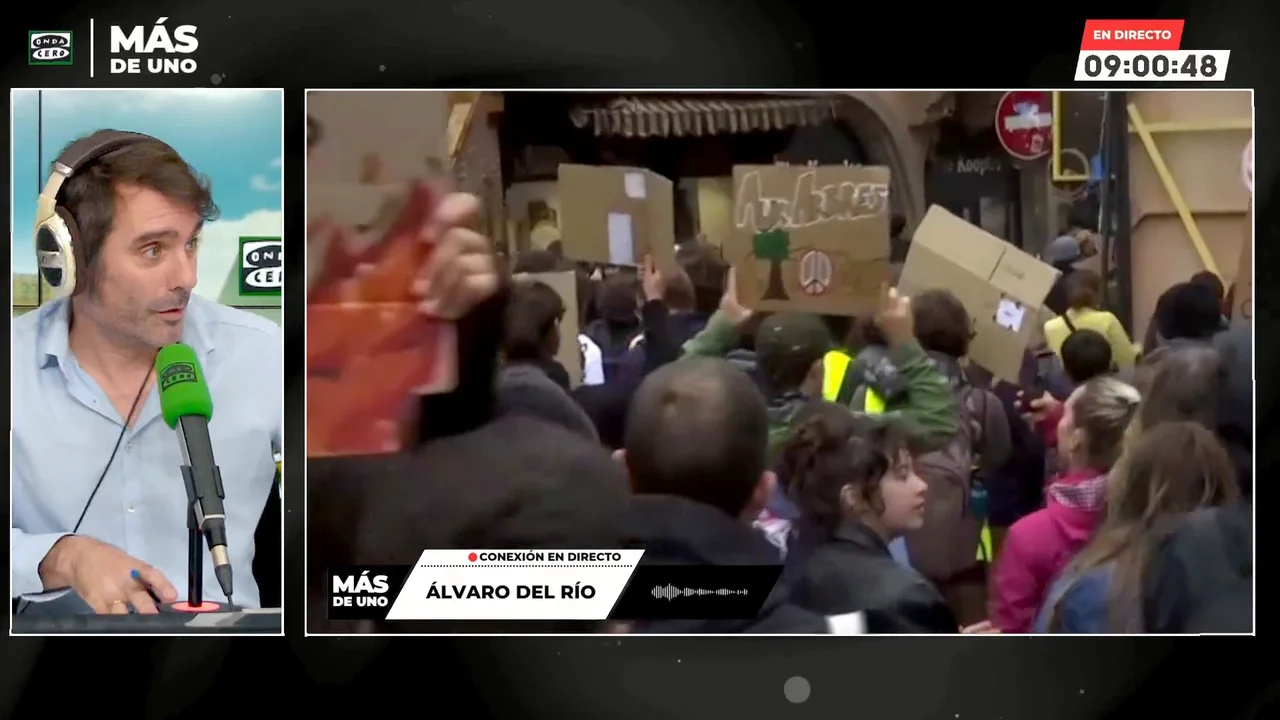
The French crisis has a political dimension that transcends the riots in the streets. Stéphane Vojetta, former deputy of the French National Assembly and former independent member of Emmanuel Macron’s political space, analyzes in More than Onewith Rafa Latorre, a scenario marked by the lack of parliamentary majorities, budget problems and growing polarization.
In his opinion, the inability to promote reforms and the parties’ strategy regarding Macron’s succession fuel a confrontation that benefits the extremes. Vojetta points especially to the radical left of Jean-Luc Mélenchon, to which he attributes a determining role in the deterioration of the political climate and in the electoral strengthening of Marine Le Pen.
A political crisis that weighs down the French economy
Rafa Latorre presents the diagnosis of a France mired in a triple social, political and economic crisis, with exhausted public coffers, a growing debt and a Government without a sufficient majority to face the situation.
Vojetta agrees with this analysis, although he places the origin of the problem in politics. The former deputy recalls that France has been without a clear parliamentary majority for almost two years since Macron’s re-election and maintains that this situation prevents undertaking the necessary reforms.
“More than anything else, it is a political crisis that has translations in terms of economy and security,” he explains.
The interviewee links institutional paralysis with the problems of deficit and public debt, which, according to him, reduce the competitiveness and economic attractiveness of the country. The lack of parliamentary agreements prevents addressing these difficulties while the parties concentrate their efforts on the presidential succession.
Polarization threatens the Republican front
During the conversation, Rafa Latorre remembers that the Republican Front functioned for years as a mechanism to stop Marine Le Pen’s access to the Presidency. However, the journalist points to a change in the French political scene: fear of Jean-Luc Mélenchon and his movement is also gaining weight among voters.
Vojetta attributes part of this change to Marine Le Pen’s strategy, which, according to her analysis, manages to distance her party from some of the most rejected elements of its past, such as racism, anti-Semitism and threats to institutions.
At the same time, the former deputy accuses the radical left of occupying that space of institutional confrontation. “His parliamentary group in the Assembly does not respect any rules,” he says, referring to Mélenchon’s political environment.
Vojetta also criticizes the statements of representatives of that political current about the protests and violence. As an example, he mentions the mayor of Saint-Ouen, according to the transcript, who justified certain violent episodes in front of a burning school.
The protests strengthen Marine Le Pen electorally
The former deputy’s analysis leads to an electoral warning. In his opinion, the political instrumentalization of the protests and the escalation of the confrontation between the extremes do not necessarily harm the radical right; On the contrary, they contribute to expanding their support.
Vojetta maintains that the polls show a very large lead for Marine Le Pen in a hypothetical second round matchup against Jean-Luc Mélenchon. During the interview, he cites estimates of between 65% and 70% of the vote for the radical right candidate in that scenario.
The former deputy interprets these data as a sign that the left’s polarization strategy may end up favoring its main adversary. Confrontation that seeks to mobilize her own supporters, she argues, can also consolidate support for Le Pen.
Vojetta’s final warning summarizes his diagnosis of the French situation: the political crisis, the lack of reforms and the partisan use of protests fuel a dynamic that can further weaken the republican front.
