
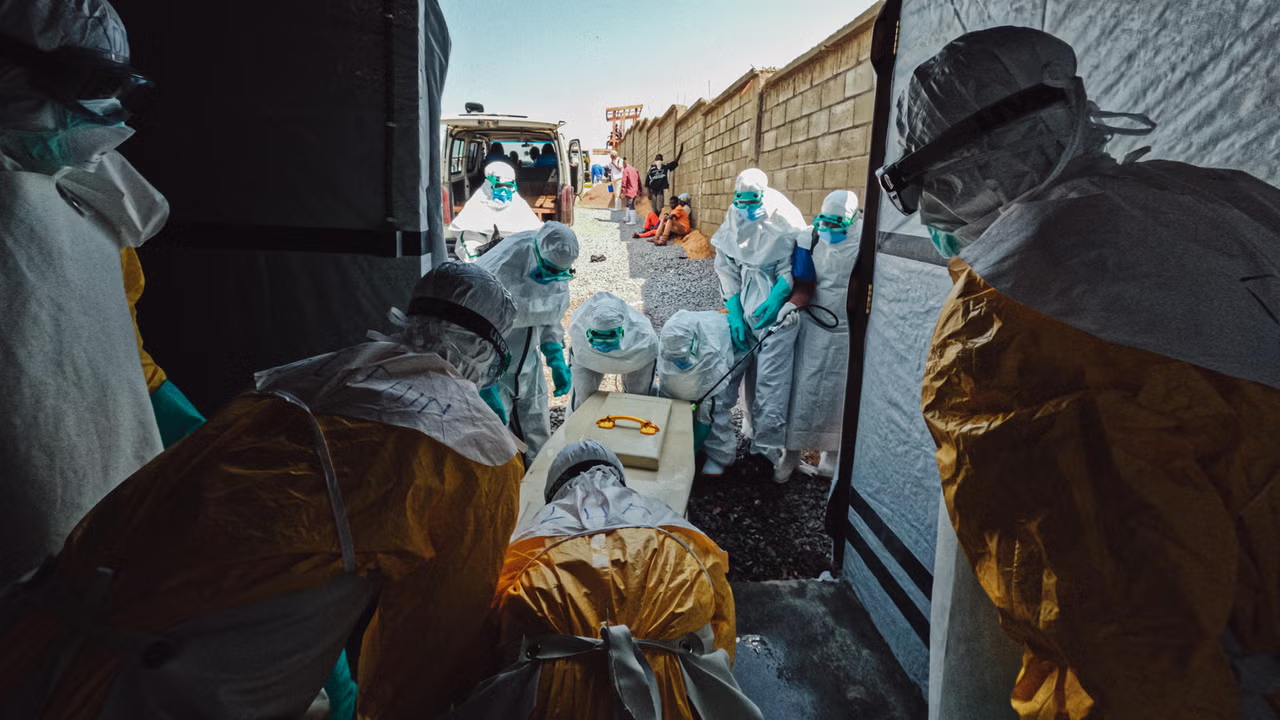
The Ebola outbreak affecting the Democratic Republic of the Congo (DRC) continues to advance at a pace that worries international health authorities. The epidemic now has 4,449 confirmed cases and 2,061 deaths, according to the latest data released by the Congolese authorities and collected by Europa Press.
The director general of the World Health Organization (WHO), Tedros Adhanom Ghebreyesus, has warned that the situation remains especially complicated and has indicated that, if transmission is not stopped in the main outbreaks, the outbreak could last for months.
During a press conference after his recent visit to the DRC, Tedros explained that the epidemic has already become the second largest Ebola outbreak on record and that its speed of expansion raises fears that it could exceed the dimensions reached by the large outbreak in West Africa between 2014 and 2016.
One of the main problems: community transmission
One of the WHO’s main concerns is that a significant portion of deaths continue to occur outside of treatment units, in the affected communities themselves. For the organization, this points to the existence of transmission chains that have not yet been identified.
The strategy involves quickly locating suspected cases, providing them with medical care and exhaustively tracking their contacts. The objective set by the WHO is to achieve at least 95% contact tracing, compared to the approximately 80% that is currently being achieved.
Tedros has also insisted on the importance of communities trusting health teams. Early detection and safe burials are essential elements to avoid new infections, but their effectiveness depends, according to the WHO, on the collaboration of the local population.
Bunia concentrates one of the main focuses of the epidemic
The director of Health Operations, Emergencies, Alert and Response of the WHO, Abdirahman Mahamud, has warned that there is no single behavior of the epidemic throughout the territory. While some areas are beginning to register a decrease in infections, others have not yet reached the peak.
Among them, the metropolitan area of Bunia stands out, which the WHO considers the main focus that must be controlled. Mahamud has warned that, as long as transmission is not stopped in this area, new waves of cases could occur.
Health authorities are trying to prevent the outbreak from reaching a duration similar to the previous major Ebola episode in the region, which lasted more than two years. The scenario currently managed by the WHO is that the epidemic can be contained in the next six months, although there is a less favorable possibility in which it could extend between nine and 12 months.
The WHO asks for more beds and health personnel
To accelerate the response, the organization intends to significantly expand healthcare capacity. The goal is to reach 3,000 beds within 12 weeks and have three health workers for each patient.
The magnitude of the effort is considerable: the WHO estimates that thousands of additional professionals would be necessary. So far, more than 21,000 health workers have been trained and treatment centres, safe burial teams, laboratories and community engagement programs are now operating in the affected provinces.
Tedros has acknowledged that there has been important progress, but has warned that the challenge now is to apply these measures at a scale and speed sufficient to stay ahead of the virus.
Vaccines and treatments advance in trials
The health response is also supported by the development of vaccines and specific treatments. So far, 886 people have recovered, despite the fact that there are still no vaccines or therapies specifically designed against the Bundibugyo virus, responsible for this outbreak.
Two vaccines developed against this virus have begun phase one safety trials in humans. In parallel, other animal studies of a vaccine directed against the Zaire Ebola virus have offered promising results and have shown signs of protection against different variants.
The WHO has recommended moving towards a phase three clinical trial, while the treatment trial known as “partners”, sponsored by the organization itself, has already reached 100 patients.
Another obstacle: financing
The response capacity is also conditioned by the economic resources available. The Continental Preparedness and Response Plan needs 518 million dollars, around 449 million euros, of which 264 million dollars, around 229 million euros, have been disbursed so far.
Tedros has called for funding that arrives on time and is sufficient to maintain operations on the ground. Added to this is the need to guarantee access and safety of health teams in the affected areas, conditions that are considered essential to contain the outbreak.
