
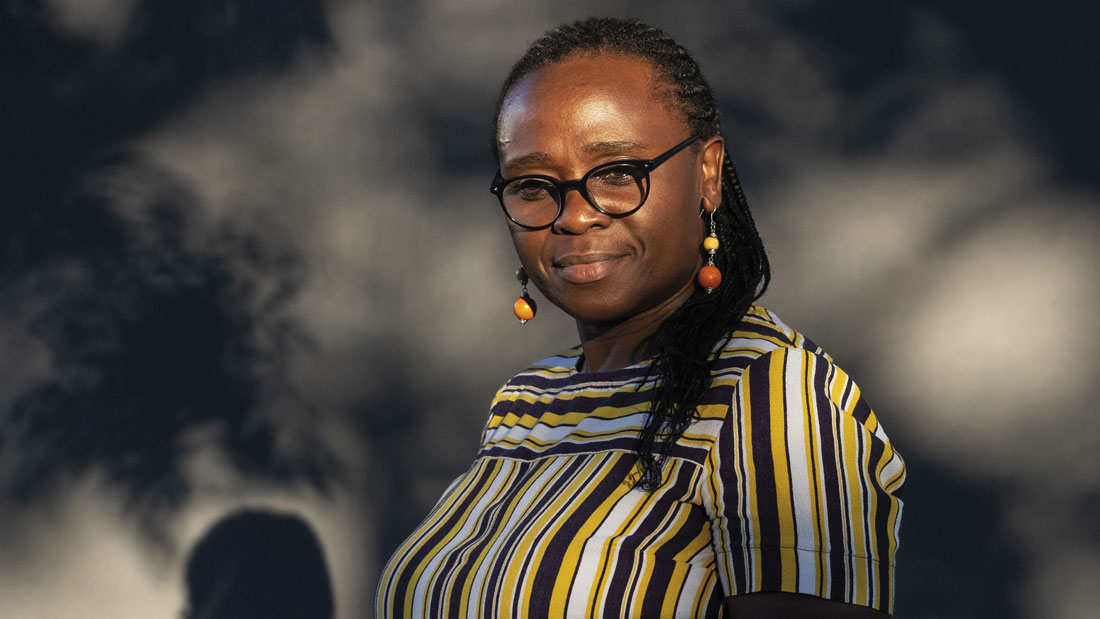
Jennifer Nansubuga Makumbi, writer
By Soraya Aybar Laafou
The Ugandan writer Jennifer Nansubuga Makumbi has presented her first novel translated into Spanish in Spain, The first woman, edited by Deleste. During his time in Madrid he has answered MUNDO NEGRO’s questions.
Jennifer Nansubuga Makumbi is absorbed when she enters the Balqis bookstore in Madrid. “How wonderful,” he mutters. You can see the twinkle in her eyes, which are searching for the names of her fellow writers from the African continent. Suddenly, he meets The first woman, his latest book, translated into Spanish by Deleste. “How exciting!” he says as he opens and closes the pages.
Although the writer, of Ugandan origin, currently lives in the United Kingdom, she emphasizes the importance of remaining connected to her origins, her country and her traditions. “I write fiction, but fiction designed in dialogue with Ugandan readers,” he points out. She studied and obtained a PhD in Creative Writing at Lancaster University, where she now works as a teacher. «For a long time, our (African) literature has been told from outside. “I try to write as if the whole world were Ugandan and African,” he adds.
In the story of Kirabo, the protagonist of your novel, who is the first woman?
In all cultures where there is a settled society there are figures of the first woman and the first man. In the Ganda tradition, that woman is Nnambi, Daughter of Heaven, who descends through the rainbow and meets the first man, who emerges from the earth. But personally I had never considered who “my” first wife would be. From a scientific perspective, there is no defined beginning: humanity has been constantly transforming. There is no concretely shaped first woman in my mind.
And in your personal experience? Any female figure that works as an origin?
If I think about it from a familiar perspective, I would have to go back a long way, even beyond my grandmothers. I remember an ancestor from my mother’s family: she was the first woman to leave her marriage to dedicate herself to her community. He built his house next to a river in which many people died trying to cross it. He welcomed families who arrived with their dead, offering them food, shelter and care. That woman is very present in my imagination.
What was the most difficult and most satisfying part of writing? The first woman? Are there autobiographical elements?
When you write, you are not always aware of how much of your life is present. Kirabo’s grandfather has a lot of my own grandfather, but other characters, like Nsuuta, are completely imaginary. The most satisfying thing was building the relationship between the two grandmothers. The most difficult thing was to humanize certain male characters without turning them into monsters, but rather into weak and complex men. It was also very hard to write some breakups and painful scenes. And, of course, making difficult narrative decisions, such as the death of certain characters, necessary for women to start seeing each other, instead of revolving around a man.
You talk about mwenkanonkanoAfrican feminism, as a current prior to the European one. Is Europe ready to understand that Africa can be a pioneer in something?
No, it’s not. Europe has grown up with an idea of superiority and with the image of Africa as a backward, poor and dependent continent. Accepting that Africa has been a pioneer in some aspects means dismantling that story. Even today it is difficult for many to relate Africa to Egypt or to accept that African civilizations built great works such as the pyramids. We know that there are more pyramids in Sudan than in Egypt, that the kingdom of Kush was earlier, that one of the first universities in the world existed in Timbuktu…, but all this calls into question what has been taught for centuries. That story was necessary to justify slavery and colonization. To oppress a people, you must first consider them inferior. That discourse is changing little by little, and we writers have the responsibility to point it out, carefully, but clearly.
How are stereotypes of the African continent represented in the West?
Mainly in the media and in cinema. For years the image of the white woman who comes to save the African woman has been repeated. That is changing thanks to the presence of Africans in the global cultural industry, who are telling their own stories. There is also racism on social networks and in pseudoscientific discourses. But there has been progress: when I arrived in the UK, people openly said things like “I have no problem with black people, but Africa is something else.” Today that is no longer said like that. The important thing is to understand that Africa is not emerging now, but has always had potential. What happens is that it has been held back for a long time.
What lessons can Western feminism learn from the African?
First, not all men are the enemy. In Africa, many men have supported women without defining themselves as feminists. We also understand that patriarchy affects men and women. Sometimes it oppresses men in different ways. And something very important: women are not perfect. Feminism must recognize contradictions, corruption or failures within women themselves, especially in relation to social class. Feminism has advanced mainly with middle-class women, while working women have been left on the margins. That tension is essential.
Let’s go back to mwenkanonkano. The book includes a large cast of female protagonists. Is it intentional?
Yes. I wanted to show that there is no single way to be a woman or to resist. In my context, women fight in less visible ways: they negotiate, they push back, they persuade, they adapt. They do not always march or demand frontally as in the West. That’s why I present different characters: the radical, the traditional, the one who negotiates, the one who rebels… They are all surviving. And that is the message: we should not judge any woman for the decisions she makes.
What is the current situation of middle class women in Uganda?
It is a very changing reality. In Uganda, social classes are not fixed, they depend on the political context. Families that were once aristocratic can fall into poverty in one generation. It happened, for example, during the Idi Amin regime. Today the middle class is growing, and there are highly educated women who are redefining their relationship with marriage and motherhood.
The protagonist, Kirabo, is a curious and intelligent young woman who defies the expectations that her environment places on her. Is this the path young Ugandan women should follow to challenge patriarchy in the country?
I don’t like to prescribe a single path. Women are conditioned by their circumstances. But I do believe that feminism should be transmitted between generations. It is not about rejecting our mothers or grandmothers, but about understanding their contexts. Each generation must take that knowledge, adapt it and build on it. The problem is when generations confront each other instead of dialogue.
In the novel, the presence of Idi Amin and his dictatorial regime functions as a backdrop. Today, with Museveni’s presidency since 1986, what is the social situation of the country and what limits do the mwenkanonkanoor other social movements?
It’s complex. The system itself has promoted important advances for women, such as access to education and political representation. But, at the same time, that same system generates new contradictions. Today in Uganda it is not that women are oppressed as women: everyone, men and women, is affected by the political context.
Nsuuta tells Kirabo that stories are essential, that the moment women fall silent, someone will fill that gap for them. What should we do to avoid falling into silence, especially under dictatorial regimes that violate human rights in various parts of the continent?
Return to the stories of our grandmothers. Many of those stories were codes, forms of resistance against pressure. Over time we have forgotten their meaning, but if we analyze them carefully, we will discover deeply feminist ideas. African oral traditions are our first texts. I can’t go back to Shakespeare, but I can go back to myths, legends and stories. If we return to them with a critical eye, we will find gold.
