
MN Tribune
By Father José Aldo Sierra MorenoComboni missionary, from Pietermaritzburg (South Africa). Originally published on comboni.org.
In South Africa there is a crisis of hatred against foreigners. In particular, the civil movement March and March, Till We Win has been very active in demanding that all undocumented foreigners leave the country before June 30. The protest has generated tensions and many foreigners, especially from other African countries, who fled poverty and tried to start a new life here, are being harassed and forced to leave South Africa. One of the provinces that has become a battleground is KwaZulu-Natal. There have been some clashes in which both South Africans and foreigners have attacked each other, causing a significant number of injuries and deaths.
The origins
March and March is not the first movement of its kind in the country. Before, there were others who defended practically the same idea that “illegal foreigners are the cause of poverty and the collapse of public services in South Africa.” Movements such as Operation Dudula (‘expel’, in the Zulu language) or government initiatives such as Shanela (‘sweep’, in Zulu) have been used to attack poor foreigners, who have become victims and scapegoats of the general situation of social and economic collapse in the country.
The strategy of the system, which dominated and governed South Africa between 1948 and 1994, was to isolate black South Africans from the reality of other African countries, especially with regard to liberation movements and the achievements of independence. Isolation was so successful that even now, more than 30 years after the end of the segregation system, black South Africans know very little about the reality and culture of other African countries. This has led to everything that comes from the rest of Africa being considered strange or suspicious, thus laying the foundations for xenophobia or, rather, Afrophobia. This is fueled by the ideas of a small group of extremists with political interests who take advantage of a population that feels exhausted in the country, most of them unemployed and in a situation of serious economic difficulties.
Deadline
June 30 is the deadline set by March and March leaders for undocumented people to permanently leave the country. The movement, led by radical but very popular figures such as Jacinta Ngobese, has generated a kind of promise and expectation that, once the country gets rid of undocumented foreigners, success and development will follow. The reality is that South Africa’s problems are much more complex than the simple challenge posed by migrants who find themselves in an irregular situation in the country.
Since the African National Congress (ANC) took power in 1994 by freedom fighters, with Mandela at the forefront of change, the promise of a prosperous, multiracial nation has been nothing more than a dream. The reality is that, over these more than 30 years, that same promise has vanished in a sea of administrative confusion, poor economic management, corruption and a practice of criminal control in the management of the State that has placed South Africa in a very delicate position in the international economic context, with the flight of numerous companies and investments, which aggravates the internal unemployment crisis (with a rate of 32% it is one of the highest in the world).
As journalist Allister Sparks mentions in his memoirs, this whole situation has created a system so unequal – with a large poor population and a small privileged rich class – that the country can be compared to “a double-decker bus occupied by two classes with no stairs separating them.”
The escalation of the March and March protest
Although the protest raises legitimate demands, such as the lack of measures by the Government to address illegal immigration and criticism of the corruption of border officials, March and March, like previous similar initiatives, has been politically manipulated and used to exacerbate, through hate speech, the negative attitude towards foreigners – especially those from other African countries – to the point that the hatred that has been spread, not to mention the violent and righteous attitude, has become unbearable and irrational in some corners of the country. The situation has reached such a level that not even people in a regular situation in the country have been victims of this hostility: “You, as a foreigner, must leave, since you take away opportunities from South Africans.”
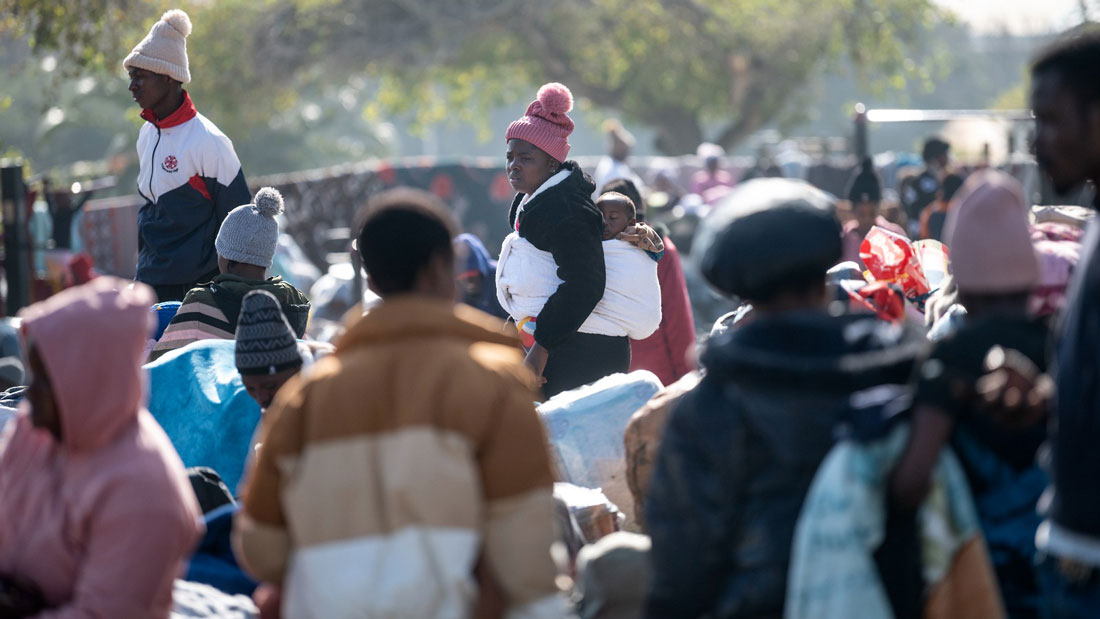
In this context, many foreigners no longer feel safe. Furthermore, they consider South Africa to be an unwelcoming country, which has completely lost sensitivity and humanity towards people just because they come from another country and speak another language. It is heartbreaking to see, for example, people from Malawi forced to leave the country, crowded in camps while they wait, in the cold of these months, for the possibility of returning to their country of origin, where, by the way, they have nothing left to start over. Among these groups are babies and pregnant women who suffer the living conditions in a refugee camp.
The scapegoat
Foreigners will leave, yes, but a serious analysis will show that the problem of inequality and poverty will continue to exist.
Foreigners have now become a scapegoat – a situation that has also been denounced by the Catholic Episcopal Conference of Southern Africa – who pays for the reality created by years of theft and corruption in public administration. Many municipalities in South Africa will remain non-functional, unemployment will remain high, investments will be scarce and the country’s overall social and economic situation, according to analysts, will not improve, at least in the near future.
As June 30 approached, tension has increased. The Government fears another wave of violence and even looting in the country’s main cities. The police presence has already been reinforced, with the support of the Army, to monitor the situation.
In the scholasticate where we live, we are all foreigners. Furthermore, we are surrounded by poor neighborhoods where acts of violence against foreign citizens have already been recorded these days. One of our students, from South Sudan, was recently harassed and attacked and, although everything points to a simple robbery, many take advantage of the protests and confusion of these days as an excuse to commit crimes.
May the Lord bless and protect all vulnerable foreigners and make the local inhabitants and leaders of this great country – in which there are also many people of good will and with a totally different approach to this matter – have hearts full of compassion and patience.
