
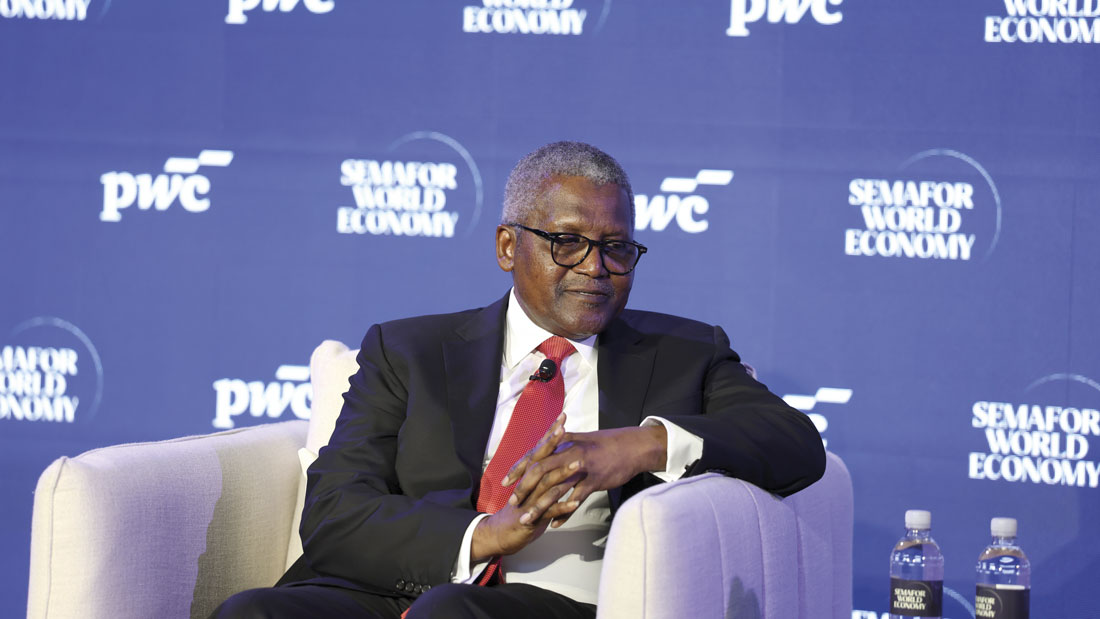
Aliko Dangote, Nigerian businessman.
He is the richest man in Africa and is more fashionable than ever. In the midst of the oil supply crisis due to the closure of the Strait of Hormuz due to the war in Iran, Nigerian businessman Aliko Dangote emerges as a decisive economic actor in the attempt to break the continent’s energy dependence. After inaugurating the largest oil refinery in Africa in Lagos in 2024, it is already planning to build a similar one in Kenya or Tanzania to cover the needs of the eastern region. Born in 1957 in northern Nigeria into a wealthy merchant family, he embodies like few others the old dream of African industrialization.
Money was never a problem for Aliko Dangote. After studying at the Egyptian University of Al-Azhar and being only 20 years old, his uncle gave him three trucks of cement and a loan of just over 500,000 naira to be repaid in two years. Shortly after, the young businessman had become the main cement producer, not only in Nigeria, but in the entire continent. On this solid basis, he launched the import and sale of food products such as sugar and rice and built an entire economic empire. However, he was always clear that the real business was manufacturing and not buying: in the 80s he built his own sugar refinery and a pasta packaging industry.
Whether with a president from the north or the south, with a civilian government or a military junta, he has always gotten along well with the authorities. And this, in Nigeria, is saying a lot. Their competitors claim that a good part of their fortune has been built thanks to almost monopolistic practices, favored treatment and friendships in high places. Nothing very different from the majority of the world’s great businessmen, with whom he also shares a great sense of opportunity and a privileged sense of smell. To his credit is a rich lifestyle, but austere when compared to other fortunes, and little desire to give the grade, an attitude inherited from his parents, fervent Muslims, who make him shy away from media exposure.
In 2007, Dangote made an exception. The magazine Forbes, which had just published its usual list of billionaires, claimed that television presenter and producer Oprah Winfrey was the wealthiest black person in the world. “I’m much, much richer than her,” he then told the media. By then, his fortune far exceeded $10 billion and in the following years it only grew as the businessman diversified his activities and sectors: in 2013 he passed the $20 billion mark and currently it is estimated that he owns around $32,000.
It started with cement, sugar and pasta packaging, but today the Dangote business conglomerate ventures into almost everything, from fertilizers to flour, textiles, salt and the real estate business. Its investments reach around twenty African countries in addition to Nigeria itself, including Cameroon, Ghana, Senegal, Sierra Leone, Ethiopia, South Africa, Zambia, Tanzania and the Republic of the Congo.
The jewel in the crown
However, its star project has been the largest oil and gas refinery in Africa, which is also the seventh in the world. With a risky investment of $23 billion and after 11 years of construction, this industrial complex covering more than 2,500 hectares was inaugurated in 2024 in the Lekki industrial zone, on the outskirts of Lagos. Nigeria has always been a large producer of crude oil, but this refinery, capable of producing 650,000 barrels per day, has generated a double impact: not only have Nigerian oil imports fallen, on which its economy and energy system depended, but Nigeria now exports petroleum products to the world, especially kerosene for airplanes and diesel.
In the few economic forums in which he participates and in the very few interviews he gives, Aliko Dangote always insists on his idea, with which he intends to change the traditional role assigned to Africa in the world economic system as a supplier of raw materials: «We have to build our own nation by ourselves. We have to build our own continent by ourselves, not depending on foreign investment (…). “Africa has been a mere dumping ground for finished products,” and this refinery represents “a critical step in ensuring that Africa has the capacity to refine its own crude oil, thereby creating wealth and prosperity for its huge population.”
Besides business, Aliko Dangote’s other great passion is football. About ten years ago he began to consider the possibility of buying Arsenal, the English club that was then going through a serious economic crisis and of which he is a true hooligan. In 2020 he even set a date for the acquisition. “In a year I will take over the team,” he said. However, the beginning of work on the Lekki refinery made him give up and organize his priorities. “When I was really very focused on buying Arsenal, then I was also faced with the challenge of making sure that the refinery was completed, the fertilizer, the petrochemicals, etc.,” he said in a recent podcast interview with Norges Bank Investment Management.
With his sights already set on building a second refinery in East Africa – initially it could be in Tanzania, but Dangote himself is leaning towards Kenya – this businessman has become a figure admired by young business school students, a kind of hero of the African economy, but also an investor courted by heads of state from across the continent. He is currently in dispute with the state company that is responsible for supplying crude oil to his refinery, but President Bola Tinubu, whom he has known for years, knows well that he cannot take a long shot at Africa’s big business shark.
In the image above, the Nigerian businessman Aliko Dangote during his participation in the Semafor World Economy, held in Washington on April 16. Photograph: Tasos Katopodis/Getty
