
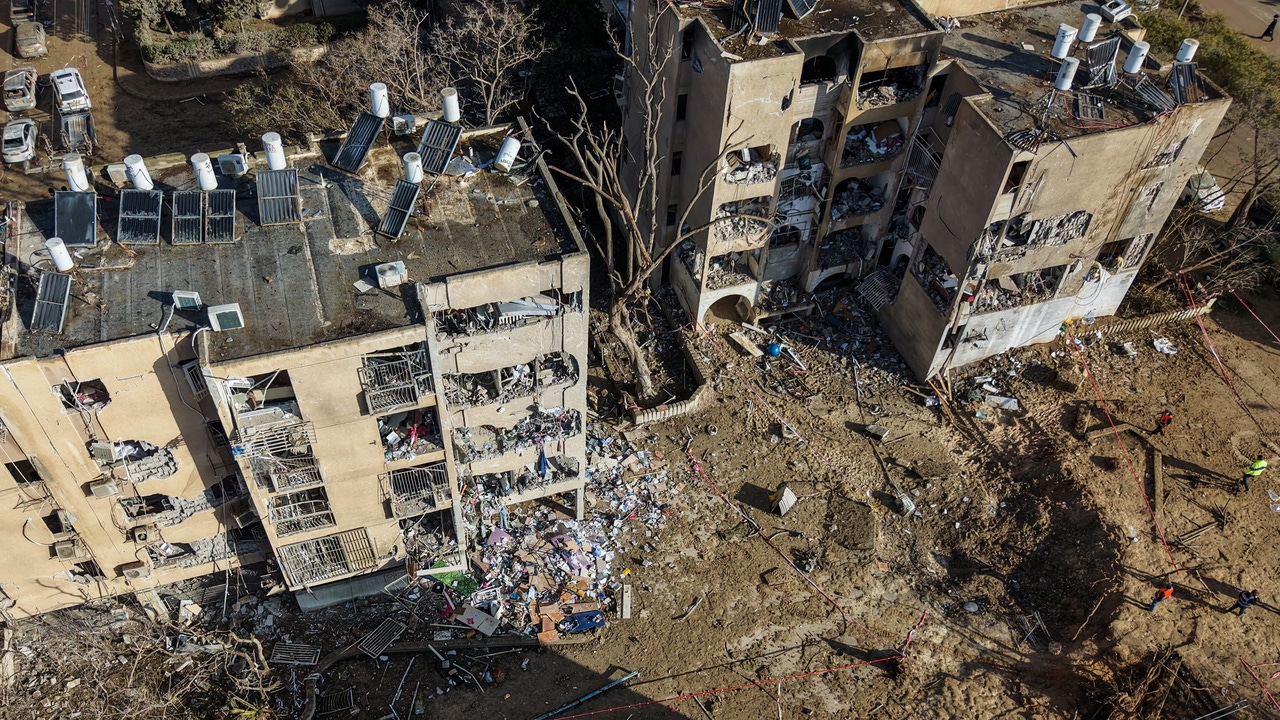
The escalation in Iran continues. To the crossed attacks on energy infrastructures at the beginning of the week, there is a new bombing by Israel and the US against the Iranian uranium enrichment center in Natanz. Then, Donald Trump’s threat to attack and “razed” Iranian power plants if the country does not reopen the Strait of Hormuz within 48 hours.
Although the US president has been saying for several weeks that the war is close to ending, what is certain is that we are going to enter the fourth week of conflict with the red line of attacks on energy targets crossed.
“You can still climb further”
Fernando Arancón and Alba Leiva explain in The World Order of Julia in the wave where the conflict is going, which is very far from over, despite what the American president says: “We see that there is still an escalation. Let us not think that we have reached the limit of violence between both parties, but that it can still escalate further.”
The reason is that, although more and more voices are calling for a de-escalation of tensions, neither Israel nor the United States “have a very clear incentive” to do so: “It is true that if they de-escalated, Iran would follow the path because it reacts a little to the swings, but the pace is set by Israel and the United States.”
Another point is energy. It is true that the barrel of Brent closed on Friday at 112 dollars a barrel and natural gas at 3.10 dollars, and that in recent days we have seen the price peak that we had go down, but that does not mean that there is a de-escalation in the conflict, but rather, “sadly, the market is getting used to what is happening in the Middle East.”
Spain, one of the countries least affected by the energy crisis
European economies are very sensitive to energy swings because Europe does not produce anything with which to cushion it and in the end it is very dependent on fossil fuels. A few days ago, the Financial Times published that Spain and France were the European countries where the energy shock had had the least impact thanks to solar energy and nuclear energy, respectively. However, others like Germany and the United Kingdom were “eating this entire energy crisis whole.”
But it is not advisable to “raise the bell” because the destruction of energy infrastructure can have long-term consequences and that is “dangerous.” They explain that Reuters stated that the attack on Qatar had reduced exports of liquefied natural gas by 17%, especially that going to Asia.
“A long-term reconstruction that cannot be solved in two days”
And this can cause a problem in the medium-long term: “Especially three to five years. This risk of gas or oil infrastructure in Qatar, Arabia, Kuwait or Iran suffering damage implies a long-term reconstruction, it cannot be solved in two days.”
So Europe has a problem because when Russian energy shut down in 2022, the continent pivoted to the Persian Gulf. And now that the conflict is escalating, Europe has to pivot again to find suppliers in areas other than Russia or the Middle East. What could they be? USA, Canada, Nigeria, Azerbaijan, etc.: “They are not the most wonderful,” they acknowledge in The World Order: “We see all the eggs in one basket and now, the second basket, which was the Persian Gulf, has also become complicated.”
