
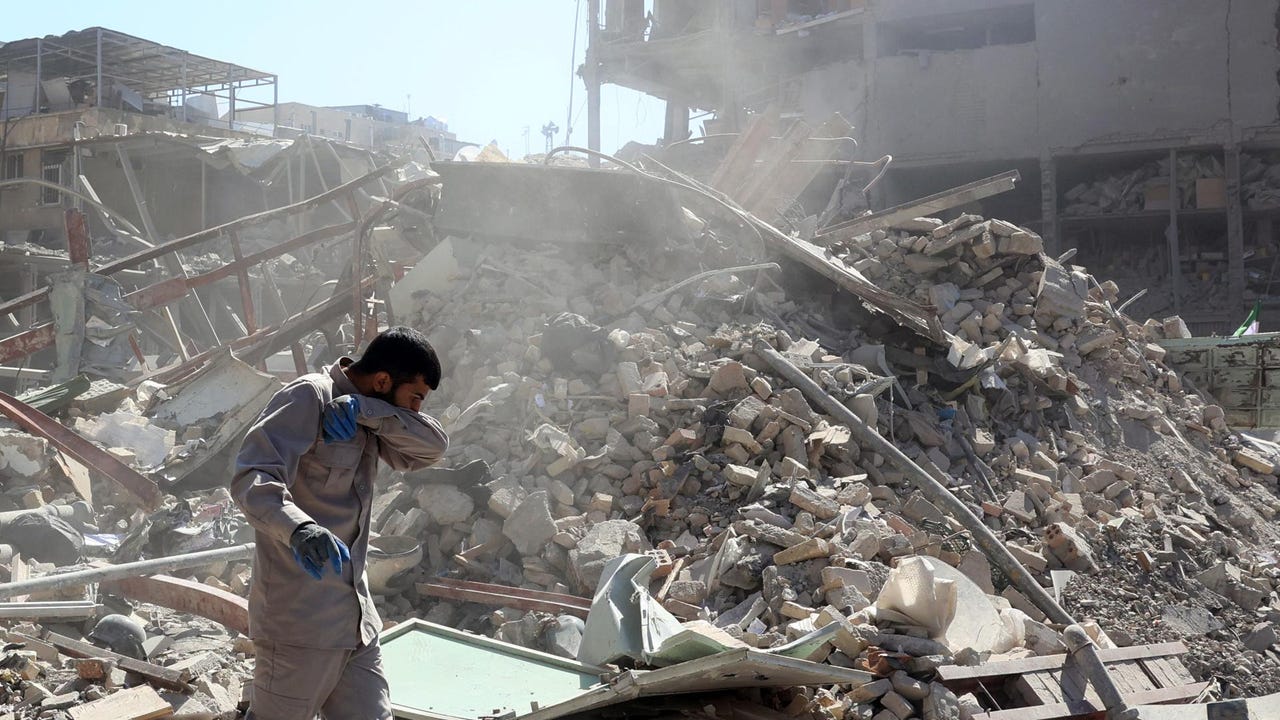
Last Saturday, February 28, the world woke up to a new war. The armed forces of Israel and the United States attacked the Islamic Republic of Iran by surprise and treason. Although surprise is part of military logic, betrayal (they had arranged to meet on Monday, March 2) moves away from the basic norms of elegance and chivalry, two qualities that neither Donald Trump nor Benhamin Nentayahu possess.
The strategy used by Washington does not differ much from that used in Venezuela: hitting and beheading but not physically occupying the territory. However, what Trump and Nentanyahu could never foresee is that Iran is a much more solid military and political state than Venezuela.
While the Caribbean country has a military budget of 4 billion dollars, the Persian country exceeds 23,000. While Venezuelan anti-aircraft defenses are limited to the old Russian S-125 and S-300, Iran has its own technology (Bavar 373 and Karded) with the capacity to detect and shoot down stealth aircraft, such as the B-2, F22 or F-35.
Finally, we must not forget that Iran has a military industry focused on the production of drones and missiles, which makes it extremely dangerous in the event of an attack.
Returning to the actions initiated on February 28, what emerges is that both Jerusalem and Washington are betting on a short war. What the US and Israel did during the first 48 hours was hit anti-aircraft defenses with the intention of controlling Iranian airspace.
Although the data is scarce and confusing, everything indicates that during that time a good part of the Iranian radars and anti-aircraft defenses would have been destroyed.
Iran has a great capacity for resistance
While it is true that Iran has suffered a serious corrective, this does not seem to have affected its ability to resist and, above all, it does not seem to have affected its strategy to do harm abroad. As far as Iran’s capacity for resistance is concerned, the eight years of war with Iraq have strengthened not only its capacity to resist but also its ability to turn the conflict into a war of attrition.
Regarding its strategy to do damage, it must be said that since the offensive began, Iran has not stopped bombing Western military bases abroad, especially American ones, but also military installations in other countries such as the United Kingdom or France. This strategy, which we could call the “martyr strategy”, responds to a clear objective: to prolong the conflict to turn it into a war of attrition.
Tehran’s goal: prolong the conflict
Both the United States and Israel are still states with free and critical public opinions. If the conflict were to extend in time and space, the Trump and Netanyahu governments could receive harsh criticism internally and also from their allies. Therefore, Tehran’s objective seems clear: to prolong the conflict for up to four weeks.
If the conflict continues for that long, crude oil reserves would run out, which would shoot up the price of oil above $100. If this were to happen, we would find ourselves in a scenario of economic recession and, therefore, the American and Israeli governments would see their internal and external support diminished.
Another element that we cannot fail to mention is the resilience of the Iranian regime. Iran is a much more solid political regime than Venezuela. Due to its nature and the ideological basis that supports the Islamic Republic, it is unthinkable to think that someone from within the regime could occupy the role of Delcy Rodríguez.
Therefore, all regime change options are opposed by a significant proportion of the population (10% of the total) who live directly from the coffers of the Islamic Republic. Likewise, the United States has made it clear that, as happened in Venezuela, Washington has no intention of putting American boots on Iran, a fact that limits the options for changing the actions of an opposition that has for years shown itself incapable of overthrowing the ayatollahs.
Nor can we forget the complexity of Iranian society, where we find Azeri, Baloch, Arab, Kurdish, Armenian, Lure or Turkmen minorities. If the regime were to break down as a result of the actions of the United States or Israel, some of these minorities could take advantage of the opportunity to declare themselves independent and even to join neighboring states where there are related ethnic groups.
Possible scenarios?
To conclude, we can propose at least three possible scenarios. The first of them – which seems more unlikely – would be a collapse of the regime accompanied by a change of government led by opposition groups with Reza Pahlavi – crown prince of the Shah of Persia, who currently lives abroad – as liaison with the US.
The second scenario would be a war that lasts up to a year with movements within the regime that seek pragmatic agreements with the United States government.
The third and final scenario could be a longer war (2-3 years) with greater cost and generalized destabilization of the region. If this third scenario occurs, the consequences would be global and unpredictable.
In conclusion, we must affirm that although the ayatollah regime has repeatedly violated human rights and has been the greatest destabilizer of the entire region, the actions undertaken by Washington and Jerusalem are not going to bring peace to the region. Perhaps it is time to paraphrase the Persian poet Saadi Shirazi: “A pure end does not justify an impure path.”
Alberto Priego, Associate Professor of the Faculty of Law- ICADE, Department of Public Dept. DIP and RRII area, Comillas Pontifical University
This article was originally published on The Conversation. Read the original.
