
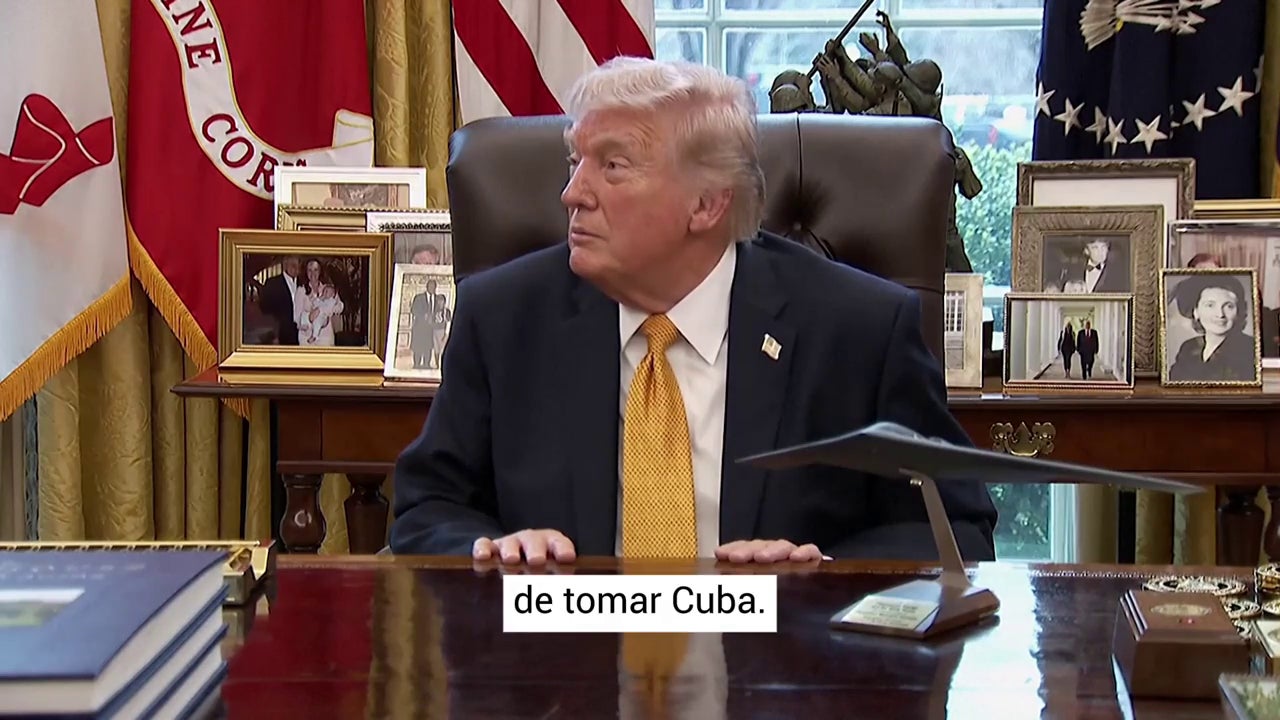
US President Donald Trump has declared that he will be the one who has “the honor” of “taking Cuba” in reference to his intention to force an agreement with the authorities in Havana or, otherwise, promote a more direct intervention.
A journalist asked Trump during an event at the White House if the strategy with Cuba would be similar to that applied in Venezuela or Iran. “I can’t tell you that. They are talking to us. It is a failed nation. They don’t have money, they don’t have oil, they don’t have anything,” he indicated.
Immediately, he assured that “I believe I will have the honor of taking Cuba.” “That would be a great honor,” he said. Another journalist has asked him for more explanations about the expression “take Cuba”: “Take Cuba in some way, whether it’s liberating it or taking it. I think I can do anything I want with it, if you want to know the truth.”
A very weakened nation
Trump has insisted on the weakness of Cuba, of its leadership, and has stressed that it is “a very weakened nation.” However, he highlighted that it is “a beautiful island” with “great people” and recalled that many Cubans who emigrated to the United States have prospered.
“I know many people from Cuba who were treated terribly and are very entrepreneurial people. They came here and became rich,” he noted. “A friend of mine started with nothing and now he is the largest owner of gas stations in the country. He is Cuban,” he said.
Many of those Cubans aspire to return to the island. “His family wants to return to Cuba to visit. They have not returned in 50 years. Many Cubans say they would like to return,” he highlighted.
Blackouts and blocking
This same Monday, Cuba suffered a total blackout of the electrical network. The authorities attribute these difficulties to the energy blockade imposed by the United States, which in January threatened with tariffs on any country that sells or supplies oil to the island.
Before this new “total disconnection” the situation was already critical on the island, with blackouts of about 15 hours a day in Havana and continuous periods without power of up to two days in the provinces.
Economic activity is almost completely paralyzed and social discontent is increasing: in recent days there have been protests in different cities of the country, at least one of which ended violently and with arrests.
Cuba has been going through a deep energy crisis since mid-2024, a situation that has worsened in the last three months with the oil blockade imposed by the US that is completely paralyzing the economy and triggering social unrest.
The structural situation of the SEN is critical due to the frequent breakdowns in the country’s obsolete thermoelectric plants but also because the Cuban Government does not have enough foreign currency to import fuel for generation engines that require diesel or fuel oil.
Cuba seeks dialogue
The president of Cuba, Miguel Díaz-Canel, confirmed on Monday to local media that there are contacts with the US to “seek solutions through dialogue to the differences between both governments”, something that Trump had already advanced, but that the island had denied.
The Trump Administration has raised the possibility of the Cuban president leaving power in the framework of contacts between officials from both countries about the future of the island, according to The New York Times.
According to two officials cited on anonymity by The New York Times, US representatives have indicated to Cuban negotiators that the president should resign, although they have left the subsequent steps in the hands of the Cuban authorities.
The proposal would involve removing Díaz-Canel, but not necessarily modifying the structure of the current political system, according to the newspaper.
The cited sources added that, for now, Washington is not pressing for measures to be taken against members of Fidel Castro’s family, who continue to be influential figures within the country’s power apparatus.
Some US officials believe that the departure of the head of state could facilitate structural economic changes that, in their opinion, Díaz-Canel would be unlikely to support.
