
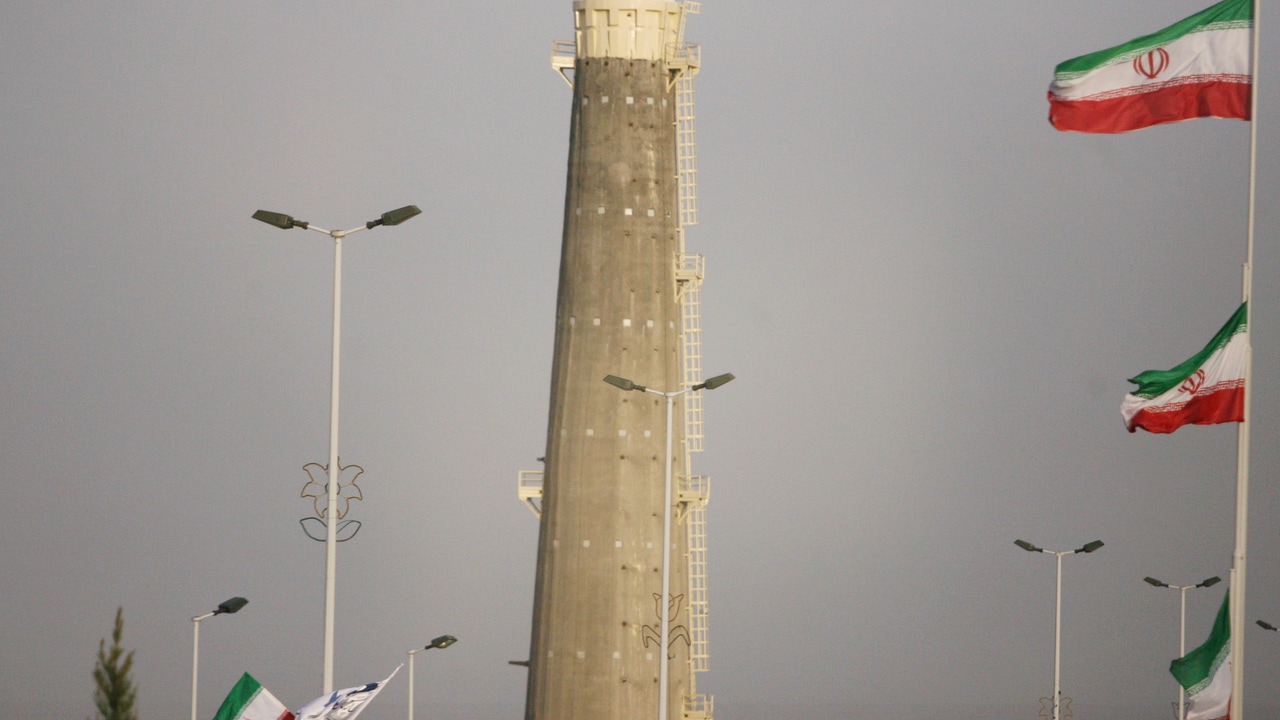
Operation Epic Fury has once again put the conflict between Iran-Israel and the US on the global stage. In June 2025, in the context of this confrontation, the centrifuges installed in Natanz and Fordow, which were used to enrich uranium, were bombed.
The reason for attacking these hot spots is that, with these centrifuges, Iran would be closer to obtaining a nuclear weapon.
The term reminds us of the washing machine, and the truth is that the operation is the same: a container that rotates at high speed, to separate the water from the clothes in our case. But when we talk about nuclear centrifuges, what we do is separate two elements that are mixed and that differ very, very little from each other.
Uranium, starting point
The uranium (U) obtained from a mine is not suitable for nuclear use by itself. The reason is that, on Earth, naturally, there is a mixture of two types of uranium: 235 and 238. With this notation, we refer to the mass number, that is, the number of neutrons and protons in the nucleus.
Considering that uranium has an atomic number of 82 (protons in the nucleus), we can easily deduce that, between U-235 and U-238, the difference is in the number of neutrons and is very small, only 3 neutrons with respect to each other.
Of these two isotopes, only U-235 is used to make fuels and bombs. A wealth of 90% is needed to have the uranium necessary to prepare nuclear weapons. Furthermore, to make it even more complex, U-235 is the least abundant – it represents only 0.7% of natural uranium.
Separate the one that is used for pumps from the one that is not
There are several ways to separate isotopes. One is based on diffusion: a gas can escape from a container through an opening in a manner proportional to the kinetic energy of its particles, which in turn depends on their mass. Thus, if we have two gases under pressure, the lighter one will escape first, since its molecules will have greater speed.
Applying this principle, isotopic separation can be carried out and, according to the mass of the isotopes mentioned, it is expected that U-235 escapes before U-238. To achieve this, another long chemical process must first be followed.
First of all, we have to convert the uranium to a gaseous state: we achieve this by converting it into uranium hexafluoride (UF6), after reacting it with the always reactive fluorine. The gas mixture will have U(235)F6 and U(238)F6, and when these two compounds are centrifuged, the lighter one will “escape” first.
Another way to separate gases is by centrifugation, that is, spinning. Centrifuges consist of a drum that rotates rapidly, so that the heavier compound containing U-238 is thrown to the outside, while that containing the lighter U-235 accumulates in the central part. The bottom is then heated to generate convection currents that launch U-235 upward, where it is collected, while U-238 accumulates at the bottom.
For this method, we also need uranium in a gaseous state, that is, as UF6.
Atomic washing machines
Nuclear centrifuges must rotate at 1,500 revolutions per second – returning to the initial comparison, let’s think that a spinning washing machine typically rotates at between 500 and 1,300 revolutions per minute. The technical details about these devices are top secret, but it is clear that they will be more effective the greater the speed they achieve and the longer they operate.
Likewise, the materials from which the rotors are made are a great topic of research, since achieving more efficient and faster motors allows the process to be improved.
On the other hand, the use of gaseous centrifugal technology to enrich isotopes reduces energy consumption considerably (between 2 and 2.5%), compared to more conventional techniques – diffusion plants.
After this separation, another procedure is required: to have the uranium as a solid again, which involves separating it from fluorine. Chemically, it is achieved through a reaction called reduction.
A geopolitical danger
The International Atomic Energy Agency (IAEA) indicates that Iran accumulates approximately 275 kilos of uranium enriched to 60% and that the level necessary to manufacture atomic bombs would be 90%, but this data may not be updated.
Since the 1979 revolution, Iran became an Islamic republic and Western nations have feared that the country could use its nuclear program to produce atomic weapons. The 2025 physical missile attack is the most recent, preceded, in January 2010, by a cyberattack on the Natanz centrifuge plant, when a computer virus took control of the machines and ordered them to self-destruct.
Today, Operation Epic Fury has overthrown the country’s religious and political Islamist leader. Still, will the centrifuges continue to spin?
Vanessa Tabernero, Contracted Professor with a PhD / Associate Dean of the Chemistry Degree, University of Alcalá
This article was originally published on The Conversation. Read the original.

