
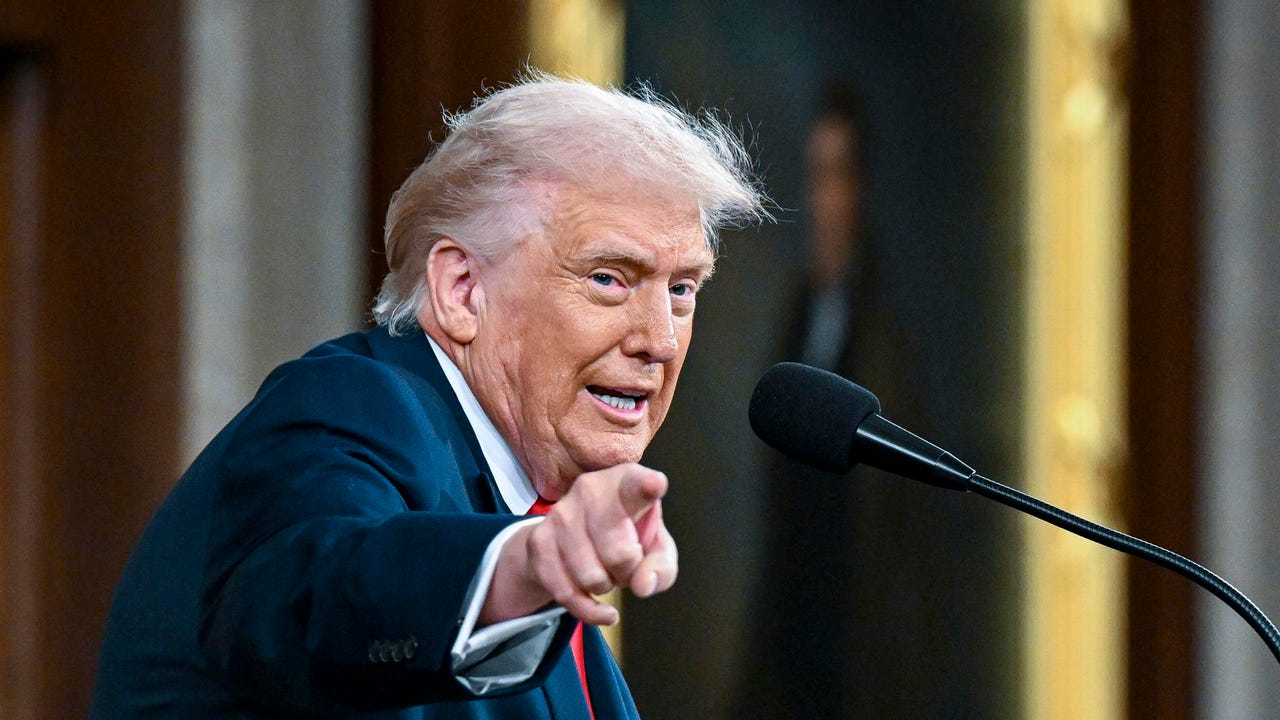
The president of the United States, Donald Trump, turned the debate on the State of the Union into an exercise in political reaffirmation. For 1 hour and 47 minutes — the longest speech before a joint session of Congress — the president reviewed what he considers the great achievements of the first year of his second term and spoke of a “radical change in record time” that, he assured, will be “for posterity.”
Eleven months after returning to the White House, Trump claimed progress in the economy, employment, security and immigration control. He stated that the United States now has “the strongest border” in decades, defended the fall in inflation and gasoline prices, and claimed successes in the fight against drug trafficking and in mediating international conflicts, including the war in Ukraine. He also took note of the country’s economic situation despite the general rise in prices that it is experiencing, and has assured that the United States has become under his leadership “a bigger, better, and richer nation than ever.”
He described the Supreme Court’s latest decision as “unfortunate”
One of the axes of the speech was his trade policy. After the Supreme Court’s setback to his reciprocal tariffs, he described the decision as “unfortunate,” but announced that the new 10% global tax on imports will be permanent and will not require the intervention of Congress, despite legal doubts about that procedure. He even argued that tariff revenue could largely replace the income tax.
The tone was the usual one of Trumpism: criticism of judges, governors and the media, and harsh attacks on Democrats. Congresswomen Ilhan Omar and Rashida Tlaib interrupted him when he was attacking irregular immigration and accused him of “killing Americans,” in one of the moments of greatest tension in the chamber.
Threats to Iran
The president of the United States has stated that Iran still does not renounce a nuclear weapon, something that it will “never” allow, despite reiterating its commitment to diplomatic channels with the Persian country and a negotiated resolution of the conflict in Ukraine. He also alluded to Venezuela and the need for a political transition in the country, within the framework of a broader strategy for Latin America.
With his sights set on the mid-term legislative elections and with popularity ratings around 40%, Trump used the Congressional platform as an electoral platform and as a showcase for a leadership that he claims without nuances.
