
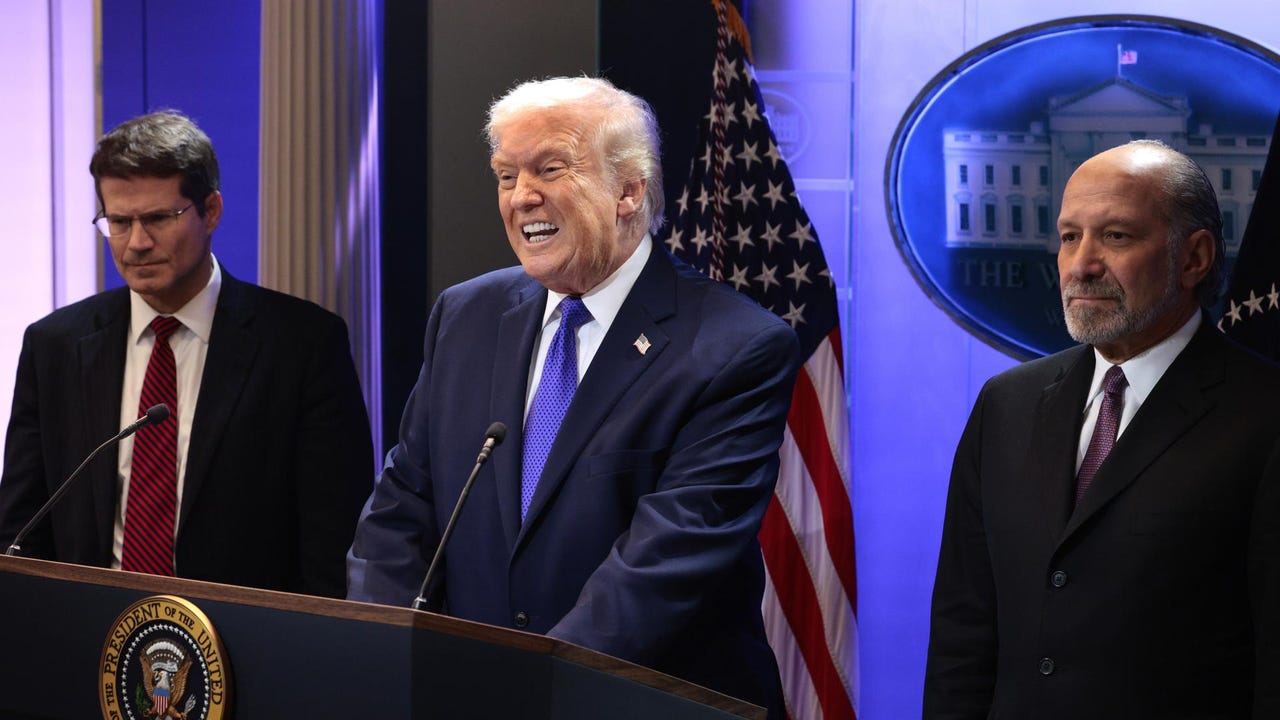
The president of the United States, Donald Trump, announced this Friday that he will impose a global tariff of 10% after learning of the Supreme Court’s decision to partially annul the tariffs and noted that he will do so “within three days” and protected by a 1974 law.
“I will sign an order to impose a 10% global tariff under Section 122 (of the Trade Act of 1974), in addition to the normal tariffs already being charged. We are also launching several investigations under Section 301 and others, to protect our country from the unfair trade practices of other countries and companies,” Trump declared.
The Trade Act of 1974 is a landmark United States law that gives the president the power to impose tariffs of up to 15% for periods of 150 days.
Trump, who assured that he has “very powerful alternatives” to impose tariffs, explained that he is going to resort to three laws that will make the implementation of tariffs more complex, but that will allow him to continue with his economic policy despite the Supreme Court’s decision.
“It’s a slightly longer process. I tried to simplify things, but they didn’t let us do it,” he said in his appearance before the press just three hours after his star measure was partially annulled by the US judiciary.
In addition to the Trade Act of 1974, he also mentioned the Trade Expansion Act of 1962, signed by President JF Kennedy in the middle of the Cold War, and which allowed him to expand presidential authority to negotiate trade agreements and modify tariffs.
He also appealed to the Hawley-Smoot Tariff Act of 1930 (or Smoot-Hawley), a US regulation passed on June 17, 1930, which increased import tariffs to historically high levels, with the purpose of protecting American industries and farmers from foreign competition.
The Supreme Court ruling establishes that the US Government does not have inherent powers in peacetime to impose tariffs on the basis of the International Economic Emergency Powers Act (IEEPA) of 1977 invoked by Trump as a pillar of his trade war, since it considers these levies a tax and therefore require the approval of Congress.
The president, visibly upset by the judicial decision, assured that “the Supreme Court did not annul the tariffs. It simply annulled a particular use of the IEEPA tariffs.”
“I can do whatever I want with the IEEPA, impose a total embargo, but I can’t charge anyone a dollar for it. It’s ridiculous, but it doesn’t matter, because we have other ways, many other ways,” Trump concluded.
His anger with the Supreme Court
The president has also shown his anger with the Supreme Court and has described its decision as “deeply disappointing” accusing the judges who have supported it of being “unpatriotic.”
“The Supreme Court’s ruling on tariffs is deeply disappointing and I am ashamed of some members of the court. I am absolutely ashamed that they did not have the courage to do what is right for our country.”
The Court, with a conservative majority, has voted 6-3 against the tariffs and Trump has branded those six judges as being a “disgrace” to the United States, accusing them of bowing to “foreign interests.”
