
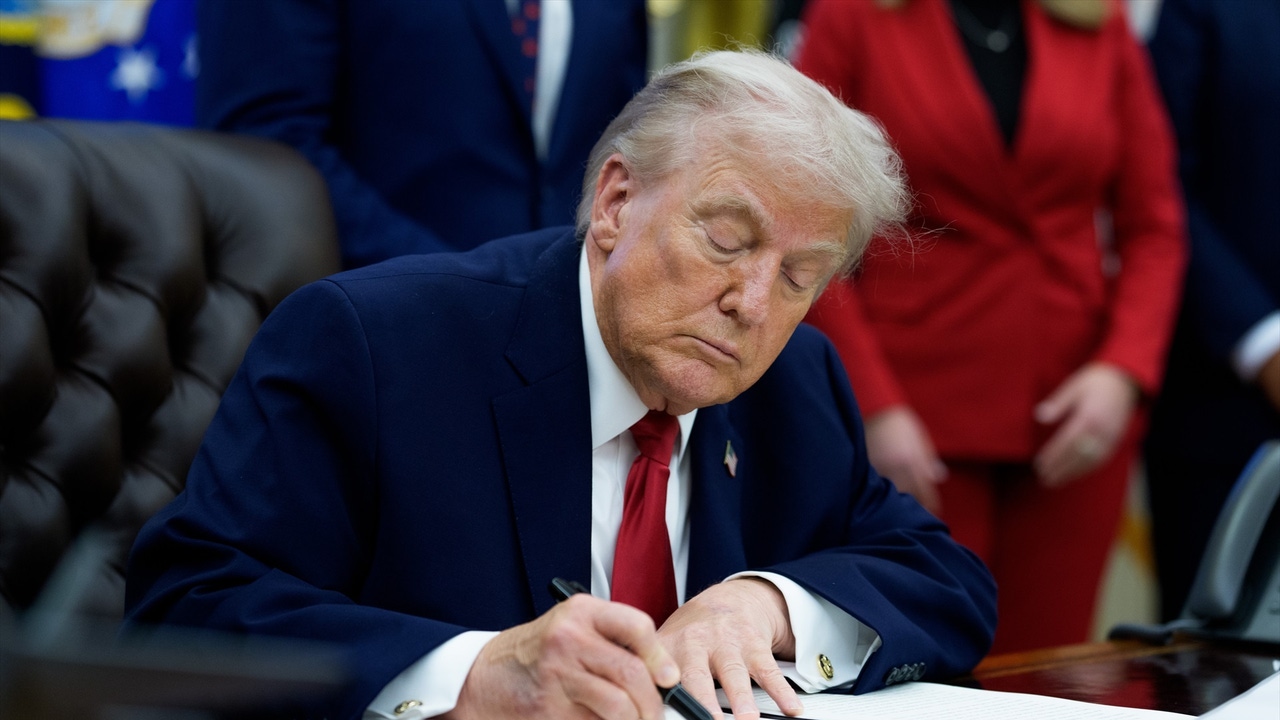
The President of the United States, Donald Trump, condemned this Friday the Supreme Court ruling that invalidates the “reciprocal” tariffs and other fees imposed under emergency powers, and announced that he will respond with a new 10% global tax through another legal framework. The judicial decision represents a severe setback for one of the pillars of its economic and commercial agenda.
In an urgent appearance at the White House, Trump described the High Court’s ruling as “terrible” and assured that the resolution is “deeply disappointing.” The majority of the justices considered that the Executive cannot resort in peacetime to the International Economic Emergency Powers Act (IEEPA) of 1977 to impose tariffs on a general basis.
The ruling was adopted by six votes to three in the United States Supreme Court, which determined that the use of this rule would imply an excessively broad delegation of tax power, a competence that the Constitution reserves to Congress. In the opinion of the majority, tariffs constitute in practice a type of tax that directly affects citizens.
Trump attacked the judges who voted against him and claimed that they were “influenced by foreign interests.” He also maintained that the countries that, in his opinion, “have been scamming” the United States for years celebrate the ruling, which could force the Government to reimburse between 175,000 and 240,000 million dollars collected with the so-called reciprocal levies announced in April 2025.
“The Supreme Court’s ruling on tariffs is deeply disappointing, and I am ashamed of some members of the court. I am absolutely ashamed that they did not have the courage to do what is right for our country,” President Trump said.
The president did thank the dissenting judges for their support, whom he defined as firm defenders of his arguments. As he said, “when reading the dissenting opinions, no one can argue against it.”
Tariffs without legislative approval
The Supreme Court’s resolution directly questions the use of the IEEPA as the basis for the trade war promoted by Trump. For most, allowing that route would be equivalent to granting the president practically unlimited ability to set taxes without the control of the legislative branch.
Despite this, the president insisted that he does not need to work with Congress to impose new rates on the trading partners of the world’s largest economy. “I have the right to impose tariffs and I always have,” he stated, in what was interpreted as a new institutional pulse between the Executive, the Legislative and the Judicial.
The president of the House of Representatives, Republican Mike Johnson, expressed his support for Trump and assured that he will work to find “the best strategy to follow.” In his opinion, the tariff policy has generated “billions of dollars” for public coffers.
In contrast, the Democratic minority in the Senate and House celebrated the ruling as “a victory for the American pocketbook” and called for an end to the trade war, arguing that tariffs have made consumer goods more expensive and strained relations with traditional allies.
New 10% global tariff
Far from moderating his stance, Trump announced that he will sign a new executive order to impose a global 10% tariff under Section 122 of the Trade Act of 1974. That provision allows tariff increases of up to 15% for a maximum period of 150 days, raising questions about how the measure will be articulated beyond that period.
The president assured that he has “very powerful alternatives” and announced that the new taxes could come into effect in just three days. He also warned that rates could be even higher than those currently applied, depending on the evolution of trade negotiations.
Likewise, it announced the opening of investigations under Section 301 and other legal provisions to protect the country from what it considers unfair trade practices.
The Supreme Court’s ruling affects the global base rate of 10%, “reciprocal” taxes and additional tariffs of 25% imposed on Mexico and Canada, as well as increases of up to 50% on Brazil and India. The suspension of the tariff exemption for ‘de minimis’ shipments could also be reversed, with a direct impact on electronic commerce and on packages coming from abroad, especially from China.
