
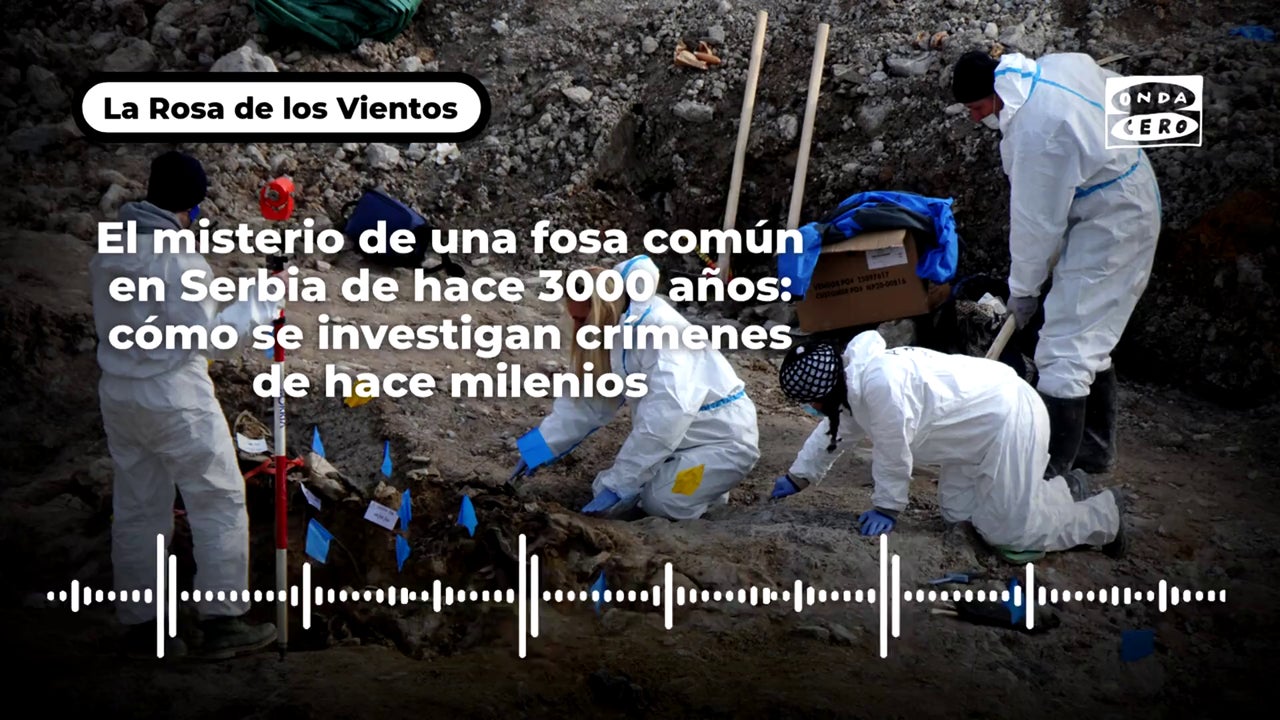
An international team of researchers has shed new light on one of the most disturbing archaeological finds in European prehistory: a mass grave in the Serbian town of Gomolova with dozens of women and children murdered about 3,000 years ago. Thanks to modern genetic analysis techniques and multidisciplinary studies, scientists have been able to reconstruct part of what happened and discard some of the hypotheses that have been around for decades.
The investigation was commented on the program The Rose of the Winds of Onda Cero, hosted by Bruno Cardeñosa and Silvia Casasola, where they had the participation of researcher Miren Iraeta Orbegozo, a genetics specialist at the University of Lausanne (Switzerland).
A discovery that baffled archaeologists
The mass grave was originally excavated in the 1970s in northern Serbia. Dozens of skeletons were found there, dating back to the transition between the Bronze Age and the Iron Age. From the beginning, the find caught the attention of archaeologists. “They already saw that there was a demographic that was not balanced, that there were mostly women and girls and boys, but that adult men were missing,” explains Iraeta Orbegozo during the program.
Given the lack of conclusive evidence, the first hypothesis that was considered was that the victims had died from an epidemic. However, scientific advances in recent decades have made it possible to review the case with new tools. The new study has analyzed ancient DNA from human remains and combined this data with physical anthropology studies, isotope analysis and radiocarbon dating.
The researcher explains that “in the study we have not only worked on genetics, but it is a multidisciplinary work,” explained the researcher. “There are specialists in anthropology, in isotope analysis, radiocarbon dating, people who work in metallurgy and archaeologists who know the context very well.”
Genetics reveals a violent death
The results rule out the disease theory, since the remains present injuries compatible with a violent death. “What we see is a situation of asymmetry,” explained Iraeta Orbegozo. “Many of the injuries are concentrated in the back or top of the skull and this suggests that some victims may have been on their backs, running away or kneeling.”
Demographic analysis has confirmed that the victims were adult women, girls and boys. For investigators, this points to a possible deliberate killing with a specific objective. “Attacking women and children does not seem like a side effect, but rather a way of damaging the continuity of the rival group,” said the scientist. “This way you end their biological reproduction, but also their care networks and their social cohesion.” In other words, it could be an attempt to completely destroy a rival community.
Another aspect that has caught the attention of researchers and contrasts with the theory of violent death is the burial of the bodies: most of the corpses were buried “carefully”, something unusual in mass graves. “In many mass graves we see that the bodies are thrown away without respect, but here we see something very different,” explained the researcher. “The way the bodies are deposited is quite orderly, even with ceramics, metal objects or animal remains.”
For this reason, an important question has arisen, since it is not known if the people who buried the victims were the same people who killed them or if they belonged to their own community. This would fit with the lack of adult men among the corps.
A place of memory to mark that there were people buried
Iraeta Orbegozo explains that “we have found evidence that there was something built that could be seen from quite a distance. It was used as a memory site or to indicate that there were people buried there.” The discovery opens a window to the violence and social tensions that may have existed in Europe three millennia ago, at a time of profound cultural and economic changes.
Although there are still many unanswered questions, scientists agree that this type of study demonstrates the extent to which current technology can reconstruct dramatic episodes from the past. “Today we are in a very interesting moment for archaeology, because methods from other sciences such as biology or physics are joining it and allowing us to obtain data that were impossible decades ago.”
