
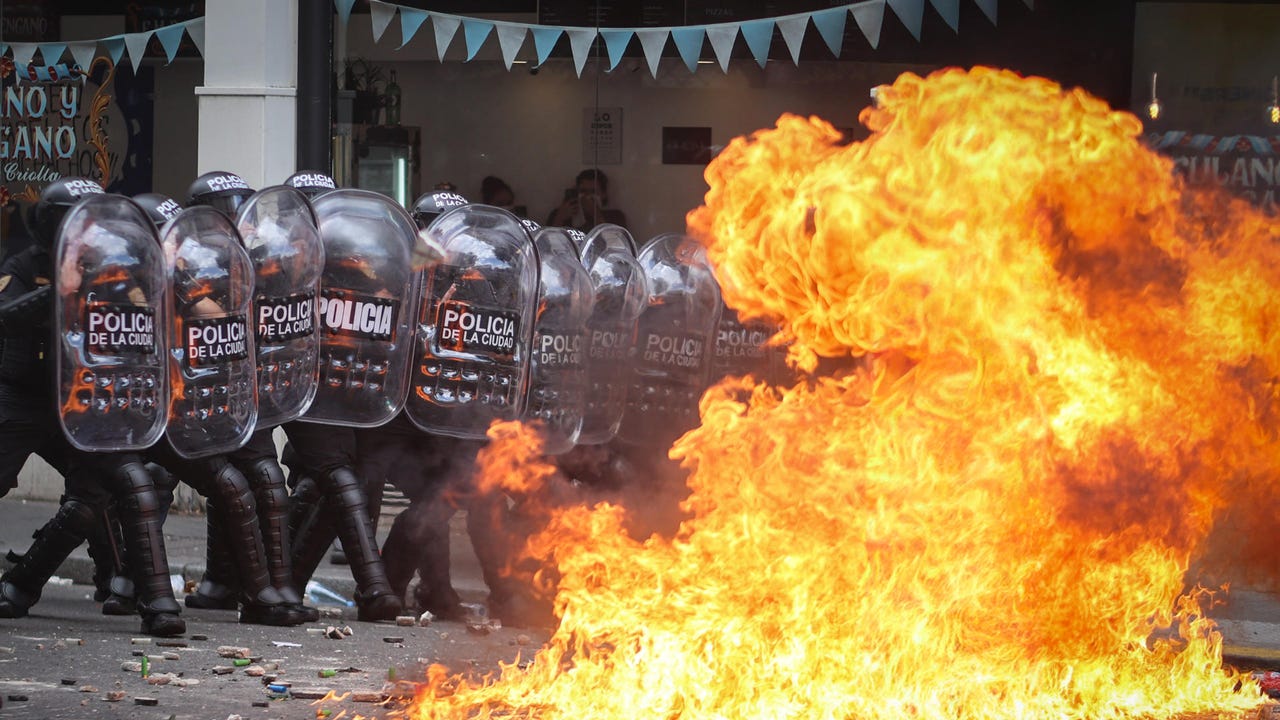
The Argentine Senate has approved Javier Milei’s controversial labor reform, a law that will radically change the country’s working conditions and that has caused strong protests in Buenos Aires, resulting in several police officers injured and protesters arrested.
Tension inside and outside the Senate
At noon, the debate on the Labor Modernization Law began in the Senate, which, among other issues, proposed 12-hour days, cheaper layoffs, or limits on strikes. Therefore, in a country as unionized and with a long history of workers’ struggle as Argentina, the protests were immediate.
Several groups of hooded men and saboteurs – described as such by some union members – cut the wires of the fences that protected the Congress building and caused part of the structure to fall. Police action then began with the launching of gases, jets of pressurized water and rubber projectiles. The protesters responded with stones that they ripped from the sidewalks, built with the typical cobblestones of Buenos Aires avenues. That’s where what could have been a peaceful protest ended.
In the midst of the chaos, a group of rioters made an improvised Molotov cocktail and threw it at a police water-powered truck. At least another explosive of this type exploded in front of Congress. This is how the surrounding streets were filled with motorized police who fired rubber bullets and pepper spray at those in their path.
The tension grew and the surroundings of Congress became a pitched battle. Security forces dispersed protesters from the square. It was the moment when several columns of federal police burst into the square again, after emerging from behind the fences that protect the Legislature, and launched themselves into the arrest of protesters without objective criteria: they dragged or carried an undetermined number of people away, as EFE was able to verify in the same place.
The keys to the reform
The reason for such heated protests? The labor reform promoted by President Javier Milei that, after being approved, will radically change the working conditions of Argentines. These are the keys to the controversial law.
Severance pay
- Calculation of compensation: the reform modifies the basis for calculating severance payments and excludes bonuses, vacations, bonuses and other concepts that are not a regular monthly payment from the calculation, which reduces the final amount compared to the current system.
- Judicial sentences: companies will be able to pay judicial sentences in installments: up to six payments for large companies and twelve for SMEs.
- Labor Assistance Fund (FAL): the FAL will be created, which will allow employers to make monthly contributions to cover eventual layoffs.
Vacations, sick leave and overtime
- Fractional vacations: vacations may be divided into periods of no less than seven days and may be rotated. The worker will have at least one period during the summer season, coinciding with school holidays, every three years.
- Non-work accident or illness: if unrelated to work, the employee will receive 50% of their basic salary for three months if they do not have dependents and six months if they do, when the reason for the leave is due to a voluntary act or action that poses a risk to their health.
- Accident or occupational illness: if the disability does not result from a voluntary and risky action, the worker will receive 75% of his salary in the same terms.
- Chronic diseases: licenses in the case of relapses due to chronic diseases will only be renewed if more than two years elapse between episodes.
- Overtime: the reform creates an “hour bank”, which enables extra hours worked to be compensated with days off or reduction of hours, and the overtime compensation scheme may be agreed upon between the worker and the employer.
- Day of up to 12 hours: this overtime system opens the door for the working day to be extended up to 12 hours.
Right to strike
The law will expand the list of sectors considered essential: no less than 75% of the service can be provided in the event of a strike.
To those already planned—health, drinking water, electricity, gas and air traffic control—are added telecommunications, aeronautics, trade, port, customs and immigration services, and education, with the exception of universities. And the security forces must guarantee 100% of their provision.
The category “services of transcendental importance” would be created, which should ensure at least 50% of its operation, including passenger and cargo transportation, pharmaceutical industry, banking, agriculture, mining, steel, construction, media, electronic commerce and hospitality.
Union representation
The initiative modifies the Law of Trade Union Associations and establishes that workers’ assemblies and congresses of delegates may not affect the normal functioning of the company and must have authorization from the employer.
It classifies blockades or seizures of establishments and actions that affect the freedom of work of those who do not adhere to a measure of force as “very serious” infractions.
And it enables the possibility of granting union status to company unions when they have more members than the pre-existing union for at least six months.
Collective agreements
The new law eliminates the principle that a collective agreement remains in force after its expiration until a new one is signed. If approved, the agreements will lose validity upon expiration of the term, except in relation to working conditions.
It provides that agreements of a smaller scope, such as company ones, will prevail over those of greater scope, that is, sectoral ones.
The repeal of the statutes and special regimes will come into force 180 days after the enactment of the law.
