
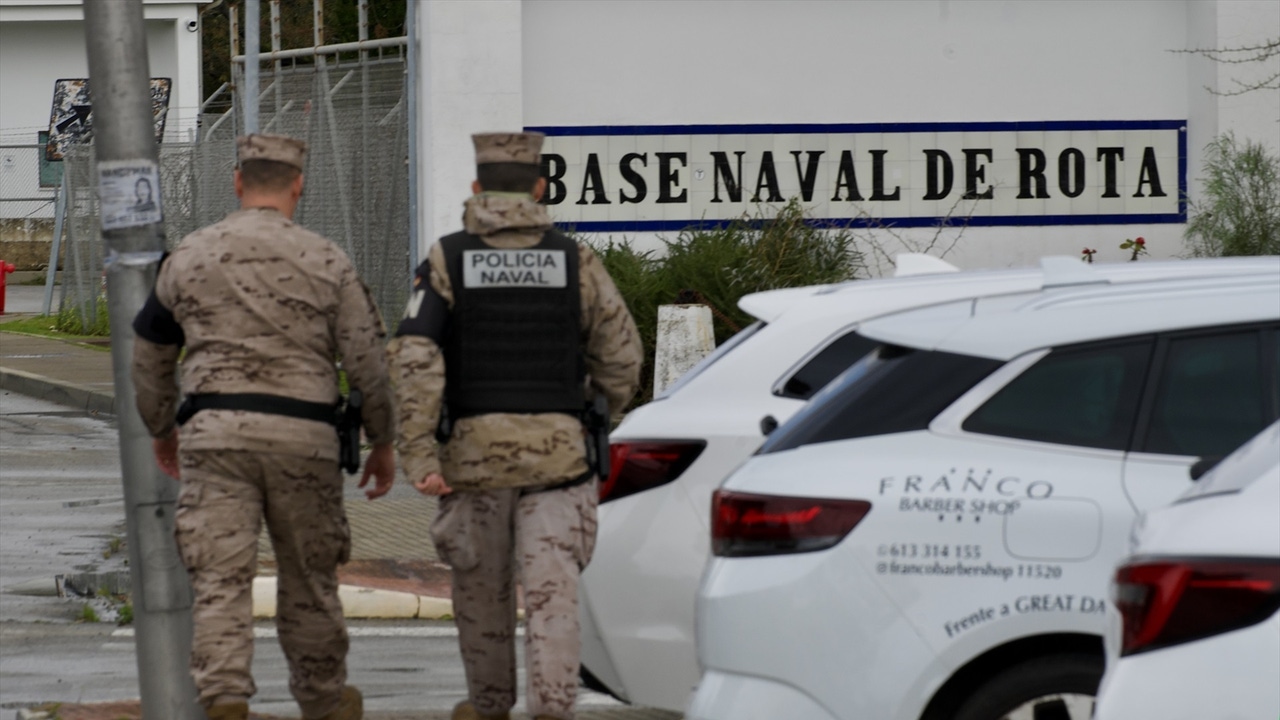
Relations between Spain and the United States have suffered in recent weeks after the outbreak of the war in Iran that affects several countries in the Middle East, especially after the Government of Pedro Sánchez did not authorize the Trump Administration to use the military bases of Morón and Rota within the framework of this offensive.
Sánchez became strong in his ‘No to war’ stance, which ignited a Donald Trump who has not hesitated to attack Spain in recent days and even threaten to break all types of commercial relations with our country.
The American president went so far as to say that Spain “has absolutely nothing that we need” and went so far as to describe it as a “terrible ally” within NATO. Even important voices within the Republican Party in the United States, such as Senator Lindsay Graham, publicly called for moving military bases out of Spain.
Would this be possible? Is the United States going to move its bases to other countries? What implications could such a decision have for Spain, Europe and NATO?
A renewable agreement every year
The Defense Cooperation Agreement between Spain and the United States was signed in 1988 and is modified when military conditions change. Since 2021, it is automatically extended each year, unless either country wants to include changes related, for example, to the number of troops, deployed units, base infrastructure or authorized missions.
The current agreement expires next May and observing the tensions between both governments after the latest military operations led by the Trump Administration, it would not be surprising if there could be some type of review in the coming months.
“It is not a closed agreement, it is always open for the parties to request renewals or modifications. Amendments or annexes can be added as new needs arise,” he explains to Zero WaveSonia Sánchez, professor of International Relations at the Francisco de Vitoria University.
In this sense, what Sánchez calls an abandonment-drag dilemma now arises that affects both countries: Spain, as the weakest State in the Alliance, provides access to its territory, but fears being dragged into a conflict that is not in its interest; while the United States, as a strong State, also fears the lack of reliability of its ally or losing control of a strategic area like Rota.
Rota, a strategic pivot of vital importance
The Rota Naval Base is considered a unique logistics base in Europe due to its location and for having the particularity of being both a port and an airport, so military material can be transported without the need to leave the base.
And the location of Rota, in the Strait of Gibraltar, makes it of vital importance for the United States. “It connects the Atlantic with the Mediterranean and serves the United States to project power,” explains Sánchez.
It is also important for the US Navy’s Sixth Fleet, in charge of security in Europe and the Mediterranean, and for NATO’s anti-missile shield systems, since many of the destroyers that are part of it pass through the Rota base.
“There are a series of missile launchers at sea, from where they can intercept missiles, which when they rest they do so in Rota, which is a rest and logistical maintenance port,” he explains to Zero WaveJuan Rodríguez Garat, retired admiral.
“Spain within NATO has a very important function simply due to its geographical location and that is not going to change whoever governs in Spain or in the United States. Only that location gives us a capacity for influence that is not insignificant,” says Sánchez, who highlights that this situation is also repeated in countries such as Egypt (Suez Canal), Iran (Strait of Hormuz) or Panama (Panama Canal).
Could the US Army abandon the Rota base?
From the United States there have already been voices that in recent days have advocated abandoning the Spanish bases and moving them to other countries, although today this seems like a more than remote option.
“The United States is not going to do that, it would be very expensive. There may be tension, verbalization… But it is not going to take the Rota base (…) It is very interested in being in the Strait, from there it controls everything that enters and leaves. If it loses it, it loses a first-level strategic position,” explains Sonia Sánchez.
Precisely within the framework of the importance of being present in the Strait of Gibraltar, the name of Morocco has emerged as a possible new destination. “It is an important ally, but it is not a member of NATO. There is not the same interoperability that there is with Spain, that is not easily replaceable,” says Sánchez.
In any case, experts warn that a hypothetical withdrawal of the US bases in Rota or Morón “would have very serious repercussions” for the three parties: Spain, the United States and NATO.
“It is as if it were an orchestra in which the instruments have to be played in a rhythmic manner and each one fulfilling its function (…) Although there are tensions, Spain hosts very important NATO bases or systems. They are not easily replaceable, it would involve a very high cost and there are not many alternatives,” explains Sonia Sánchez.
