
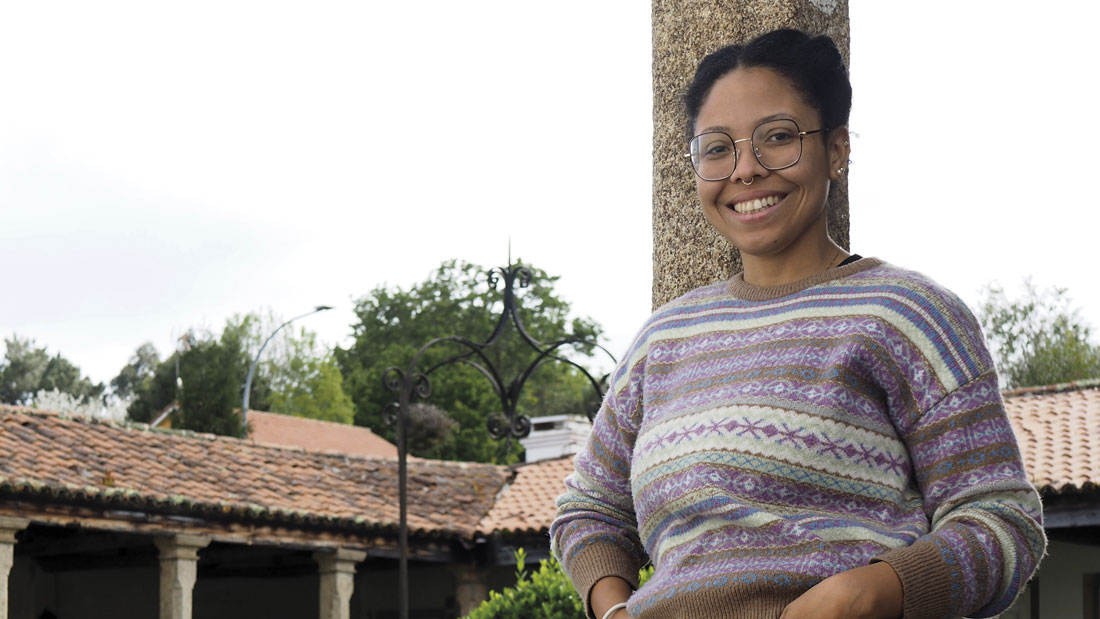
Zinthia Álvarez Palomino, writer and activist
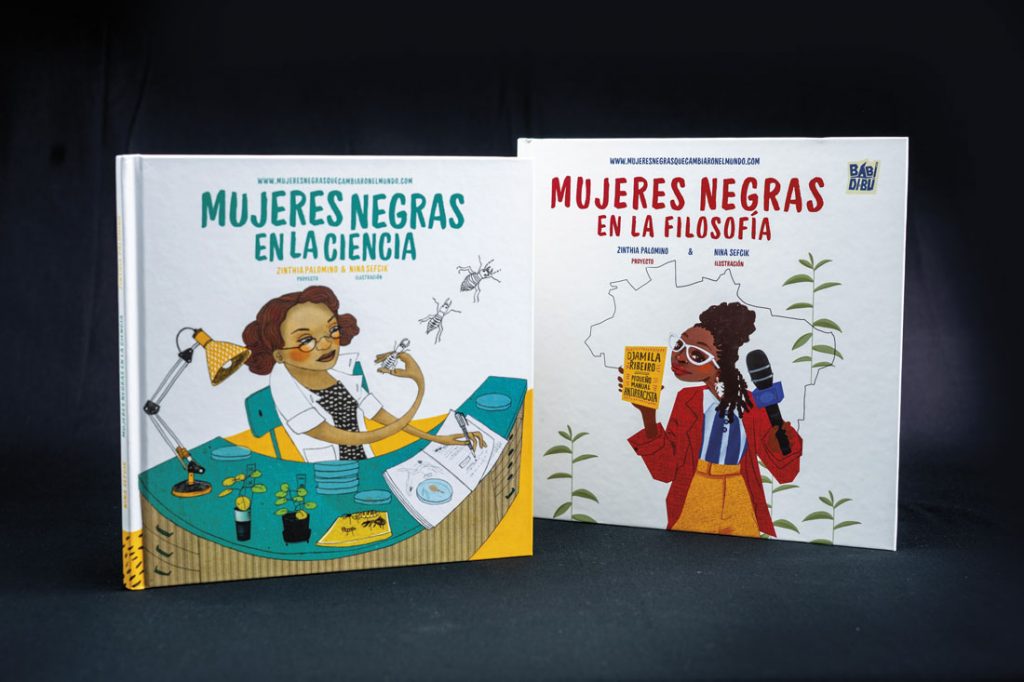
The Venezuelan Zinthia Álvarez Palomino (Maracaibo, 1988), co-founder of Afrogalegas, has published Black women in science and Black women in philosophy, two books with which she seeks to change the image of black women in society.
Introduce us to the Afro-Venezuelan world.
The reality of the Afro movement is based on the situation of vulnerability, exploitation and legacy of transatlantic trafficking. There is structural racism. It seems that coexistence and integration between people is horizontal, but the bodies of non-white people are at certain levels of society, such as in the back of a restaurant or in certain neighborhoods on the outskirts of the city. You can see it in the language, with certain expressions that are reproduced in a very repetitive way. History has marked us and will continue to mark us, but in Venezuela this is not yet being reflected on at a deeper level. We are not reconsidering the idea of whether or not we are being racist. We are at the beginning of a fairly long road.
How did the Black Women Who Changed the World project come about?
In Venezuela I was not read as a black person. I noticed racism in Spain, where I had the need to rethink my identity, because it was a very big shock. In this context I became aware of the stereotypes associated with black and Afro-descendant people and I wanted to displace that false image that is associated with them in this society. It was affecting me on a daily basis and it was a way of saying “believe what you want, but I’m going to give you tools so you can see that this is not the case.” From there I co-founded the Afrogalegas movement and decided to develop the project.
What is the main objective?
Displace the image we have of black women with a much more diverse one. At one school, a boy in the middle of a book presentation said to me, “Why black women? Why not women and that’s it? And I asked her: «Can you find me a book in the library where the female protagonists are black? If you find it, you get a prize. The goal is for them to have one in the library. If you don’t want to approach this book or other information from your place of comfort, that will depend on you. But at least there are options.
Besides the books, what does the project consist of?
There is an awareness part through talks and workshops. A struggle that I have more and more in mind is to enter universities with training, since fascism is increasingly capturing young people. But what brings it all together is political advocacy, being very in touch with the movement, trying to be part of any struggle that arises, any space in which it may be, supporting ourselves.
Why did you focus on publishing children’s books?
Because I want the reference to come from the little ones. In order for the books to be read by them, they have to be accompanied by an adult and in this educational process a complete exercise is done. The adult is going to read the book, receive the information and then transmit it. It is an illustrated children’s book, but in reality it is aimed at anyone who does not know the history of the women who are there. It is not a story, it is written as a microbiography. It includes a lot of data and the contributions made by the women themselves. Whoever reads it and explains it to the child will be able to keep the most relevant data, but also has the possibility of reading the entire life of that woman in a non-childish tone.
What challenges did you encounter in the process?
Within this capitalist system that exploits bodies, especially of non-white people, the challenges are economic and time-related. At the same time that you are doing your work, studying and trying to help your family in another country, you have to develop your project with the greatest dignity possible. I want people to buy the book because they see that the quality is good, not because it is a social project and they want to lend a hand. But all this requires an economic investment and dedication. There are certain people who have the privilege of being able to sit down and think, but when you are in a precarious situation and you are moonlighting, sitting down and thinking is revolutionary. In this process you also contribute your body: today you go to bed later or wake up earlier to be able to write, research, read…, whatever. At a material level, epistemic violence has made a lot of knowledge and information invisible, so I had to continue the research process in English because I found little in Spanish. It helps to have a support network, because society doubts you for being a woman and black, and without it it is possible that I would have stayed there or the project would have taken longer to come out.
What impact have books had on new generations?
I give you a couple of examples. A friend gave the book to his niece, an adopted black girl. When she saw the cover she looked happy and said to her mother: “Look, like me.” This is part of what I am looking for, that they can be represented in books. There is also the case that I mentioned before in the library, when you can tell a child that there is a book where the protagonists are black women. Other ways to see the impact were when I spoke with master’s students at the Carlos III University about epistemicide, the production of knowledge and the invisibilization of knowledge that is not Eurocentric. One person was trying to find arguments to say that the scientific method validates everything and I started to explain to him that all people agreed with the scientific method, but who were those people? From where was the scientific method rethought? Afterwards he came up to me and thanked me for the class, which was making him think, that he came from medical parents and that in his house medicine and science are the truth. You don’t know what conclusion he’s going to come to, but it’s interesting to see those little details. For me, more than general impacts, I care about the small details, because I am a small ant in a huge wave. It’s interesting when you go out a little beyond your closest circle of friends and someone who doesn’t think the same as you tells you: “I think I’m less racist since we’ve been talking.”
What is the position of educational centers and teachers regarding their workshops?
There is still little awareness of the need to include an ethnic-racially diverse and anti-racist perspective within the centers. They still do not believe in the need to include it. When they contact me it is because there is a person within the center who is sensitive to the issue and it almost always has to do with being close to a person who is not white. Among my requests is that one or two people have to stay with me, because this training is not aimed only at the little ones, but at those who are constantly educating these groups of children. Furthermore, they often call from educational centers where there is a majority of the population with ethnic-racial diversity or after a racist incident. Okay, but this should be the norm and not an exception. We should demand that anti-racist discourse be transversal.
What is the importance of spaces like Afrogalegas or Afroféminas?
They are fundamental in two lines. For society in general, to try to dismantle stereotypes, make other realities visible and position black and Afro-descendant people from another vision. But also for the Afro-descendant community itself, because it is a refuge. If we had not made Afrogalegas, I would be much more alone in this society. Black women have been denied care and affection for a long time, so those small cozy spaces of safety where we take care of ourselves are vindictive.
What was the experience of participating in the book like? I, migrant woman?
It is a choral work of 11 women guided by Quinny Martínez, journalist and editor who promotes Filmig, the Traveling Migrant Book Fair. Everything that was woven before the book was a space of total care in which many of us told what had crossed us and hurt us, how we experienced the migratory processes. The result was a book to dismantle that idea of non-intellectuality of black women.
What stereotypes persist about black and Afro-descendant migrant women?
I try to disassociate myself from that victimization. It seems tiring to me to have to remember all those stereotypes and the need to express them. But if there is a stereotype that runs through everything, it is the lack of intellectuality. From there the idea of poverty is associated, wanting to have many children and many other clichés. Also that of the objectification of the body, which is present in many stereotypes that cross black and Afro-descendant women, an idea that is also linked to the lack of intellectuality.
How do you see the future for the new generations of Afro-descendants?
The movement is being strong and visible, but I am very afraid that the capitalist system will appropriate it and empty it. I don’t think it will happen, but I do think it could slow it down. There have been numerous changes, but it will be much more difficult if the capitalist system leads us to try to be number one within the community. This system individualizes us and that would end up dissolving a collective movement like this.
Do you have any plans for how the Black Women project will continue?
In the middle of the year we will publish Black women in the fight for climate justice and the defense of territories, which is based on the concept of racial capitalism.
