
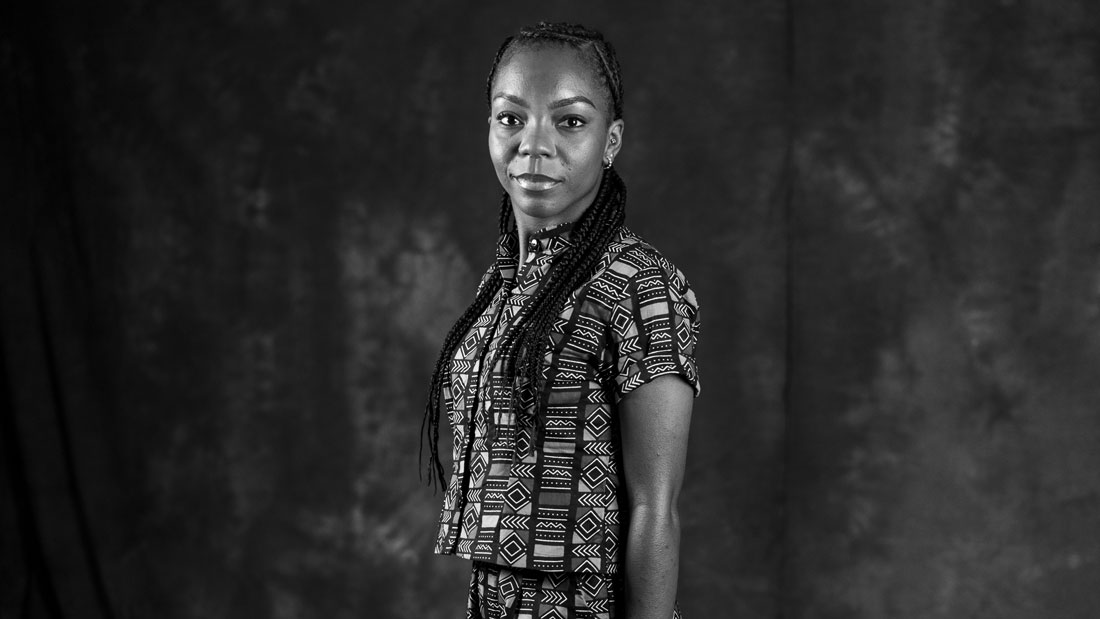
Tatiana Ndombasi Bokuy, social worker
«I am a young Afro-Spanish woman of 23 years old. I was born in Madrid, although I have Equatoguinean and Congolese (DRC) origins. I have a degree in Social Work and I am specializing in the field of gender violence. In addition, I coordinate the Afrodictionary association.
When did you become interested in social justice and human rights?
My concern comes from my context. I am the daughter of migrant parents who have had to live through certain circumstances in which I have been involved. That made me wonder why my father, my mother and other people around me suffered things that other people did not. I was anxious to know why. The Internet was already very developed since I was born and I began to learn on my own about topics such as gender, sexuality or racism by watching informative videos. From my university years onwards I met more politically conscious people.
What did you question about what your parents and people who migrate experienced?
The loss of people. You stop having a social network in the country you are in and that means a lot, because what cushions you from falls or precariousness is the people around you, your mother helping you with the children, your aunt recommending a job, having your lifelong friend to guide you and advise you. I noticed that the people around me had their grandparents, their uncles, a very wide network. However, I only had my sisters, my parents and a small circle. I also saw that in the work environment they always had obstacles, very specific types of jobs in which one could not grow much economically, even though my parents had always had the intention of growing up. That situation they experienced began to break down starting with my generation. I grow up with things that they didn’t have.
When you were studying in high school you gave talks in the courtyard to other students about these topics that interested you.
My best friend at that time was like me, she had many concerns, she always wanted to know, she always listened to the conversations of the elders. When we met, we talked about these topics, but we wanted it not to stay just between us. We were lucky that the management of our center was quite open. We formed a small group of girls who were interested in topics such as feminism and we spent recess time presenting to other younger girls what we had prepared. We created a space in which the girls could tell us the concerns and conflicts they had and we tried to advise them. Consent problems, insults… We tried to advise them and, when we saw it necessary, we turned to the teachers.
Did you decide to study Social Work at university because of this experience?
It totally aligned with what I was looking for, with my personality and my qualities, and from the beginning I opted for the field of gender violence. As a black person, upon investigating I realized that in the African migrant community there is a lot of violence that is very naturalized, culturally justified and that is not addressed with the necessary rigor. There are often very marked gender roles, a very traditional vision that can sometimes go in our favor, but often against us. I can understand that this happens in certain generations, but I think we have to start reflecting and breaking certain patterns.
What type of violence?
Talking to family members and acquaintances, stories of violence are often repeated a lot, understood in a very broad way. It can be verbal or physical. It may also be due to absence, for example of the father figure. And it is not something that people are surprised by, that they feel like something distant. You see in many experiences patterns that are repeated and not questioned, a lot of violence in the family nucleus, normally directed towards women. It is a barrier, both for the women who suffer from it and for the following generations who grow up with this normalized under the label of something cultural and tend to reproduce it. I think we have to address it in some way, starting by opening a debate in our community.
In this time that you have been working on gender violence, do you see progress?
In our community I feel that the generations that have already grown up here, my age or slightly older, are quite aware, in part because they move in educational environments and in places where different positions are debated that promote changes in mentality. Men of these ages are in a process of rethinking where they act from. In any case, it is also true that within the African continent there has been feminism for a long time, various forms of vindication, struggle and empowerment of women. Africa is always seen as something backward, and in some cases it may be, but in many others it could be taken as an example.
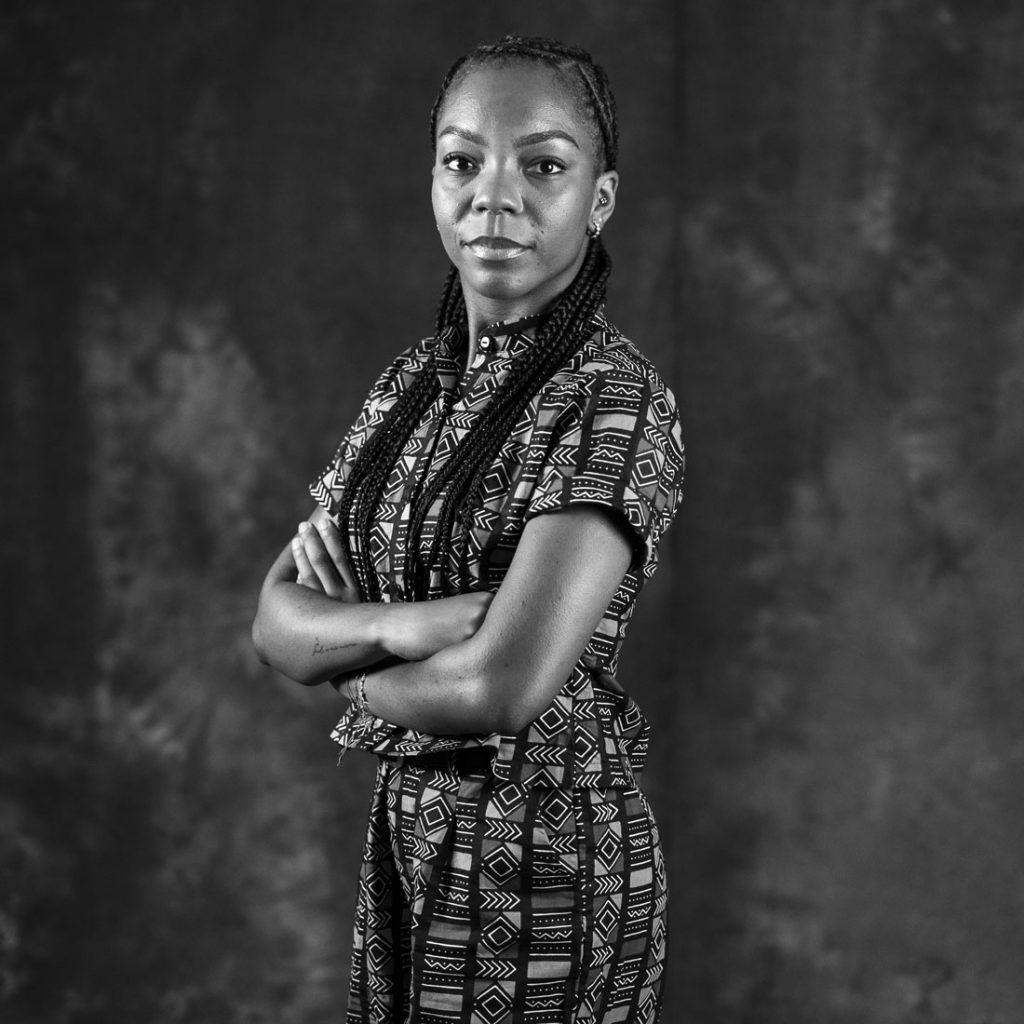
While you were studying Social Work you were part of the Afro-descendant university association Kwanzaa, of which you were even president. Now it’s 10 years old. How was your experience there?
It was a key period in my life, as an activist and as a person. I consider it a very necessary space for several reasons. Black people often have the experience of being the only black people in educational spaces, but Kwanzaa serves as a small house where community is generated. At the same time, it is a space where knowledge is generated, ideas and vital experiences are exchanged with a critical point. Sometimes it seems that just because you are a black person you are already deconstructed and have an anti-racist approach, but it doesn’t have to. Kwanzaa acted as a window for me from which I could explore and observe realities I was not aware of. It is a very enriching place, where there are people with very diverse origins. Some of us were born here, others were born on the African continent, in different countries. We have common experiences and other very different ones. There needs to be a new generation in Spain full of Afro-descendant professionals with a clear anti-racist perspective that needs to be brought to our future workplaces and other spaces in life.
You are currently part of the collective, Afrodiccionario. What are you working on?
Afrodiccionario is a social and educational entity that works with language as a transformative tool against racism to prevent violence. We are focusing on raising awareness in the stages of ESO and Baccalaureate, key stages in our training, the moment in which your mind is most open to listening, to understanding. It is an important moment to lay the groundwork, because your self-concept is being formed and you care a lot about what your group says or doesn’t say. We raise awareness through reflection on language, the impact that our words and our silences have. Also about the importance of creating terms that express existing realities, such as the existence of the word “Afro-descendant” or the word “Afro-Spanish.” But the most innovative thing and what I am most proud of is the involvement of the teaching staff. We must work not only to raise awareness among the victims, but also with those people who are in a position of power, such as teachers, who are often the role models for the kids and play a very important part in prevention. It is essential that they have tools, which is what they ask us for in the workshops we give, to manage situations that they encounter on a daily basis.
Do you generally find interest on the part of teachers to learn how to manage situations of racism in the classrooms?
When we arrive, they tell us: “I needed this,” and they tell you about their experiences and concerns. We try to make it understood that racism does not concern only those who suffer it, but the entire society. At Afrodiccionario we approach it with students and teachers in a didactic, enjoyable way, which is not understood as something theoretical, but as something that can affect us all, whether as victims, as friends, as colleagues or as aggressors. The sooner you talk, the better, because that is how this violence is prevented. In the end, no matter how much you teach language or mathematics, a student is not going to learn adequately if he is later insulted in the playground for being black. You need your students to be in a safe context and that is what we try at Afrodictionary, to offer tools to ensure that classrooms are safe for everyone. This also offers families peace of mind, knowing that their sons and daughters are in more aware, more open environments. It is essential that all students are prepared to function in the diverse world in which they are, not only those who are prone to suffer this type of violence, but everyone, so that later, when they go to buy bread or in the future they are at work, they know how to face that diversity. In the end, it is a social commitment to make a more just world.
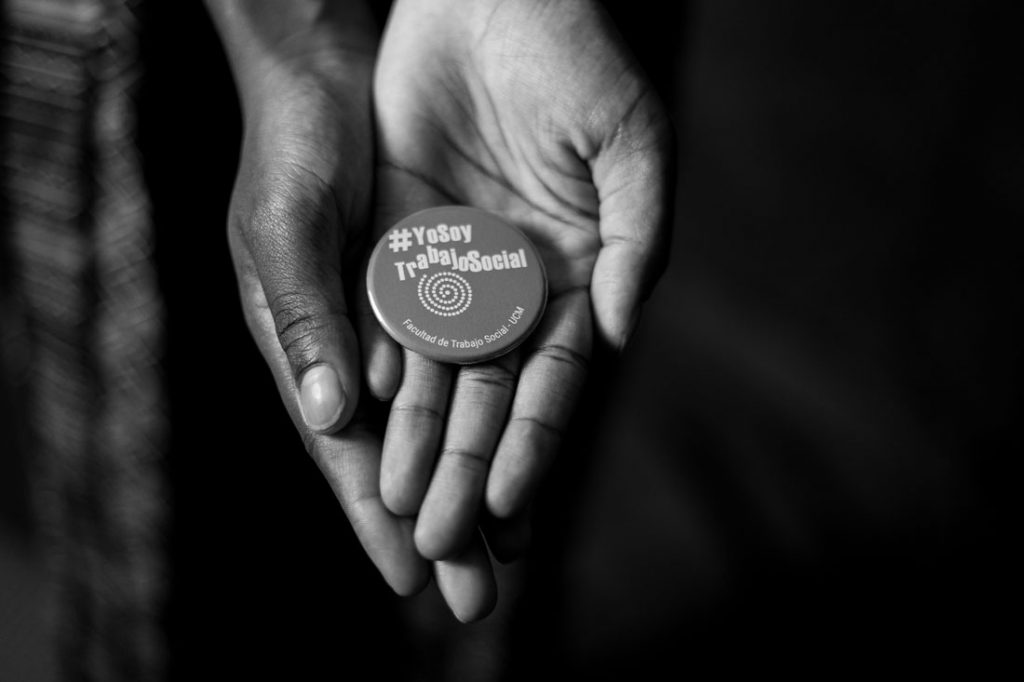
with her
«For me, the key word on this badge is “I am”. Social Work is something that is very integrated into me and from there it is how I walk through the world. This is a profession that cannot be separated from the human part, from values, from social justice. I don’t just take it as a job, but as my philosophy of life.”.
