
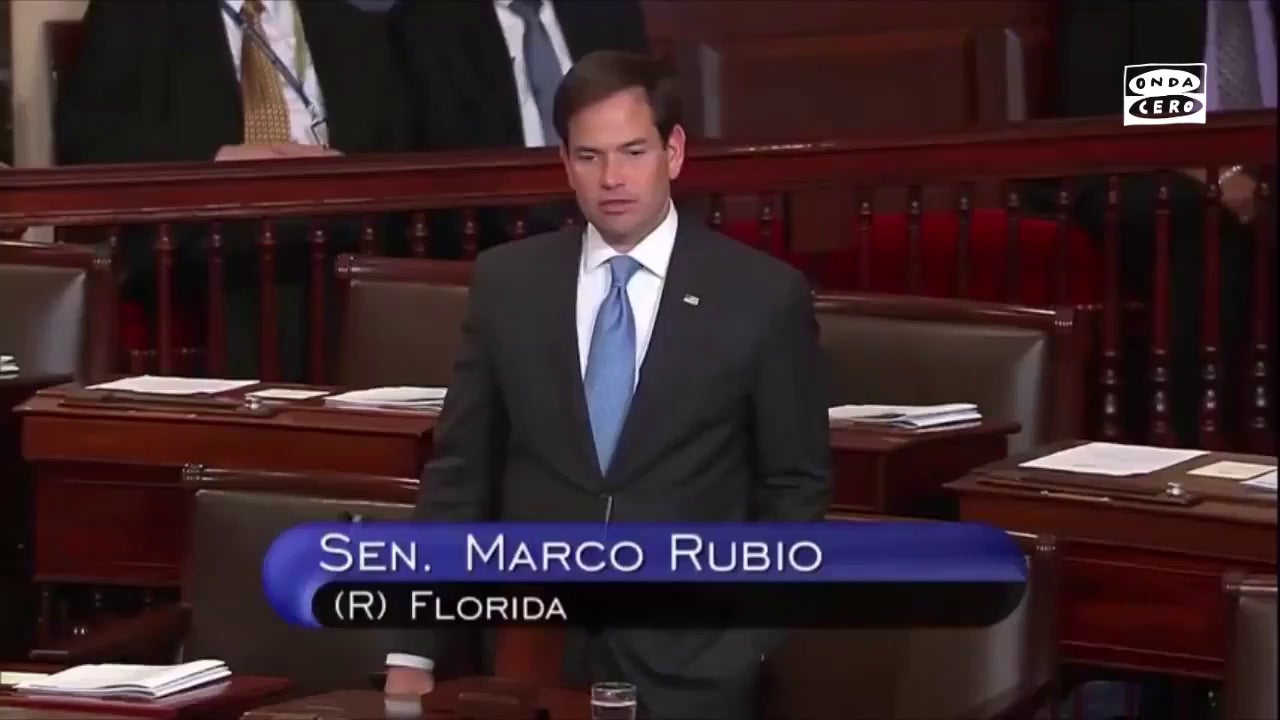
In 2015, in the middle of the debate on the nuclear deal with Iran promoted by the Barack Obama Administration, the then Republican Senator Marco Rubio left a warning that has been recovered today because it could be a speech by the current Trump administration.
“I want it to go on record, for the sake of history,” he said from the Upper House, before adding: “History will condemn us for not having done what should be done at this critical moment in the history of the world.”
Rubio intervened after learning of the memorandum signed by Obama to begin preparations for the lifting of sanctions on Tehran, within the framework of the pact reached in July of that year between Iran and the so-called G5+1 (United States, United Kingdom, Russia, China, France and Germany).
What was the 2015 agreement with Iran?
The agreement sought to limit Iran’s nuclear program in exchange for easing international sanctions that were suffocating its economy. Obama himself stressed that the effective lifting of sanctions would be conditional on verification, by the Secretary of State, that Iran was complying with the commitments made.
The Republican majority strongly opposed the pact, although it did not obtain the necessary votes in Congress to block it. Rubio was one of the harshest voices against the agreement. In his speech, he warned that the money released after the end of sanctions would be used by Iran to strengthen its conventional military capabilities and expand its regional influence.
“Iran will immediately use the money it receives from the lifting of sanctions to strengthen its conventional military capabilities,” he said. In his view, Tehran aspired to become the dominant military power in the Middle East, outside the United States, developing systems to prevent access to the region, missiles capable of destroying aircraft carriers and naval tactics such as swarm attacks against American assets.
Rubio also warned that the Iranian regime would intensify its support for armed groups in the region to attack the US military, increasing the cost of Washington’s presence in the Middle East until attempting to expel it completely. “They may or may not deny their involvement, but they will attack us,” he said.
One of the central axes of his intervention was the Iranian ballistic missile program. According to him, the agreement did not affect this development and would allow Iran to continue advancing in long-range missiles “capable of reaching the United States.” In his opinion, the pact only delayed—but did not prevent—the manufacture of a nuclear weapon. “At some point in the near future, when they consider it appropriate, they will build a nuclear weapon,” he warned, arguing that by then the cost of attacking their program would be too high.
The example of North Korea
To illustrate his fear, he turned to the example of North Korea. “This is not an imagination. It exists in the world today. It is called North Korea,” he said, referring to the fact that a regime with nuclear weapons becomes practically immune to military intervention due to the risk of massive retaliation.
The senator went further by defining the Iranian leadership as a regime guided by a religious and apocalyptic vision. “Iran is led by a supreme leader who is a radical Shiite cleric with an apocalyptic vision of the future,” he said.
In the final part of his speech, Rubio appealed to the political future of the United States. He recalled that, unlike Iran, the country had a republic and the possibility of electing new leaders. “I pray that, on your first day in office, you will reverse this agreement and reinstate the sanctions, backing them with a credible military threat,” he said.
His conclusion was blunt: if the agreement went ahead, the United States would be leaving its children a more dangerous world. And if course was not corrected, he warned, “history will condemn us.”
