
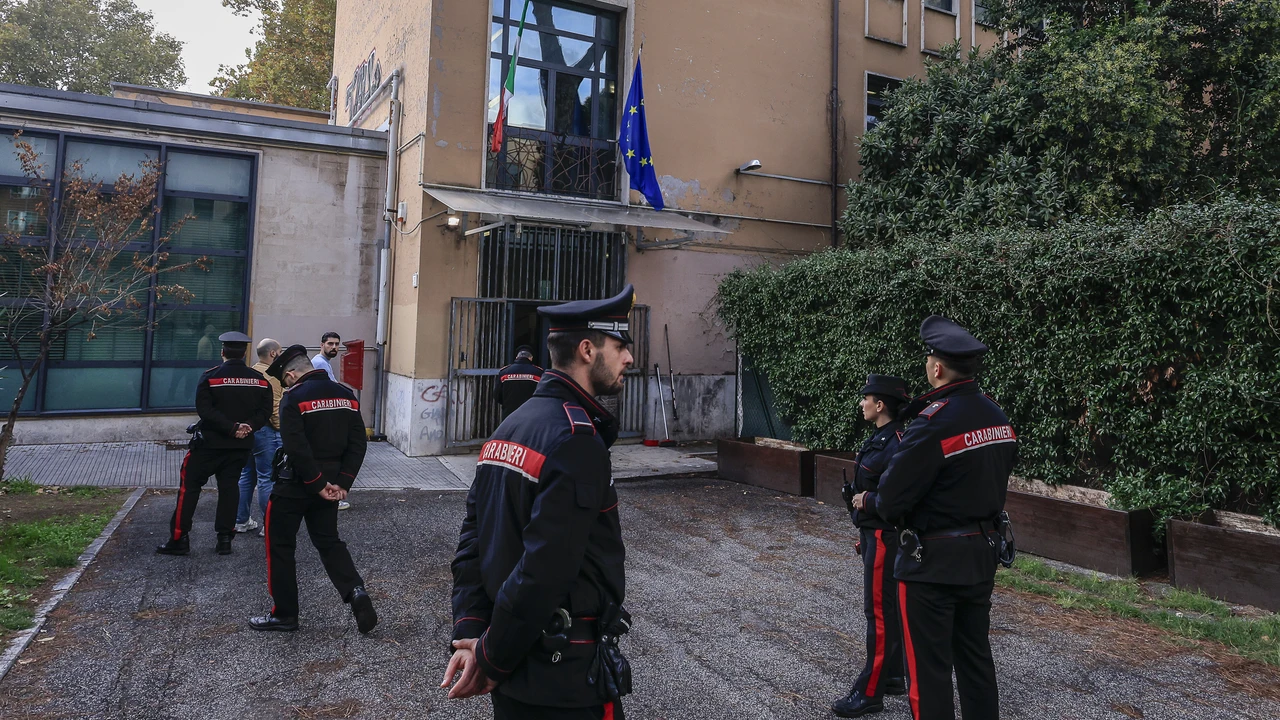
Many educational centers in different Italian regions received emails with bomb warnings this Thursday, just 24 hours after a first wave that affected some 6,000 schools.
For the second consecutive day, different educational centers throughout the country have received emails with false alerts of explosives, which have forced the evacuation of some facilities and caused new interventions by the security forces.
The notices have been registered in regions such as Veneto, Friuli-Venezia-Julia, Liguria, Sicily, Campania and Molise, in addition to around thirty educational centers in Rome, according to local media. Sources from the Italian Government have confirmed to EFE this new mail bombing operation, that is, mass sending of emails, to the school addresses of the Ministry of Education, although they have not yet specified how many centers have been affected.
An email also threatens Meloni
The new batch of messages is once again signed by an alleged sender called ‘Mikhail Andropov’, who already appeared in the emails sent on Wednesday. However, this time the messages have been sent from an address with a Filipino domain, instead of the Taiwanese one used in the first wave, according to Italian media.
In addition, the Executive has received another email with a bomb threat addressed to the Chigi Palace, headquarters of the Government in Rome, accompanied by a request for the resignation of the Prime Minister, Giorgia Meloni. However, the authorities have not activated the security controls considering that this is a repetition of an unfounded alarm.
Italy prepares a protocol to avoid new evacuations
Given the repetition of these episodes, the Italian Government has summoned the technicians of the Interministerial Committee for the Security of the Republic (CISR) this afternoon, with the aim of establishing a common protocol to manage the alerts.
The intention is to extend to educational centers the procedure that is already applied in the Public Administration: not to evacuate buildings simply by receiving a mass email if there are no concrete signs of danger.
In this way, decisions about possible evictions would not remain exclusively in the hands of the school directors, but would depend on the Government delegates in each territory, who would assess whether there are sufficient reasons to order an evacuation.
Meloni herself spoke out on Wednesday about this situation and assured that the school calendar of Italian students will not depend on computer attacks or bomb threats. The prime minister maintained that this strategy is not intended to directly hit the country, but rather “to sow fear, distrust and chaos.”
For his part, the Italian Foreign Minister, Antonio Tajani, has attributed these episodes to a possible “hybrid war.” The head of Italian diplomacy has also denounced that a group of pro-Russian hackers is searching for and disseminating his personal data on the Internet.
However, the authorship of the threats remains under investigation and, for the moment, the authorities have not confirmed that there is a direct link with Russia.
