
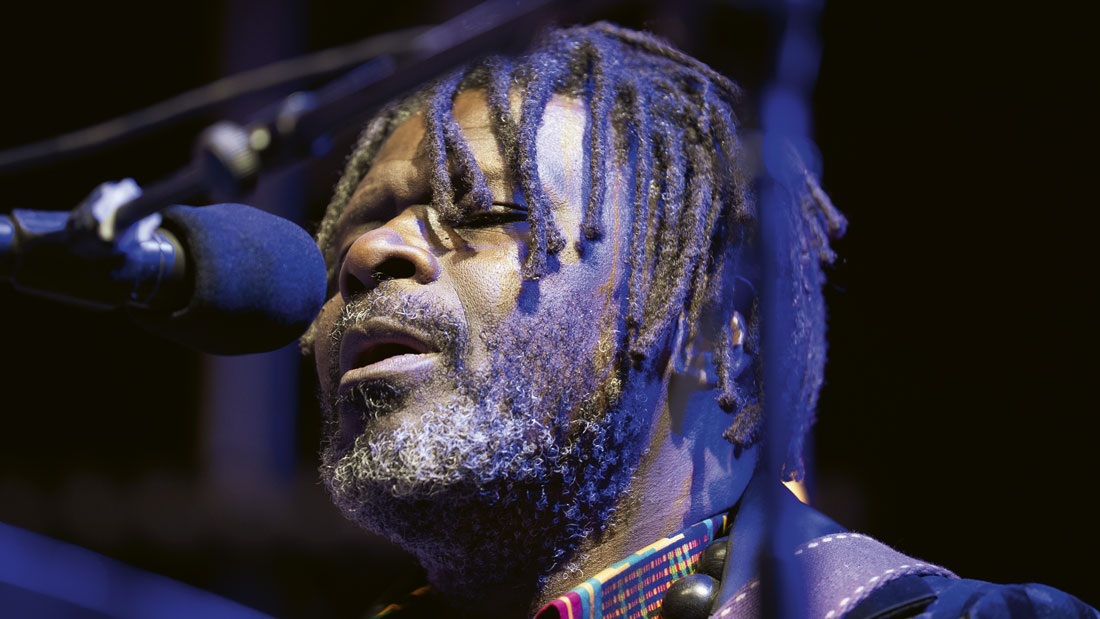
Emmanuel Pi Djob, Cameroonian singer.
By Analia Iglesias from M’hamid El Ghizlaine (Morocco)
Cameroonian musician Emmanuel Pi Djob leads a ensemble musical that cultivates gospel, a style that was born African-American but that today is universal. In this interview he explains why he believes it is valid and how it allows those who remained in Africa to feel what their ancestors knew firsthand.
A man with an Egyptian cross around his neck walks slowly over the dunes of a desert that does not seem like his natural habitat. His name is Emmanuel Pi Djob, he is Cameroonian and he has the grace that only calm people exhibit, confident in themselves, we could say. On his chest the cross called anj (the hieroglyph about the power of mortal and eternal life), as a symbol that refers to the union of physical and spiritual strength and that covers the resonance box of a deep but malleable voice.
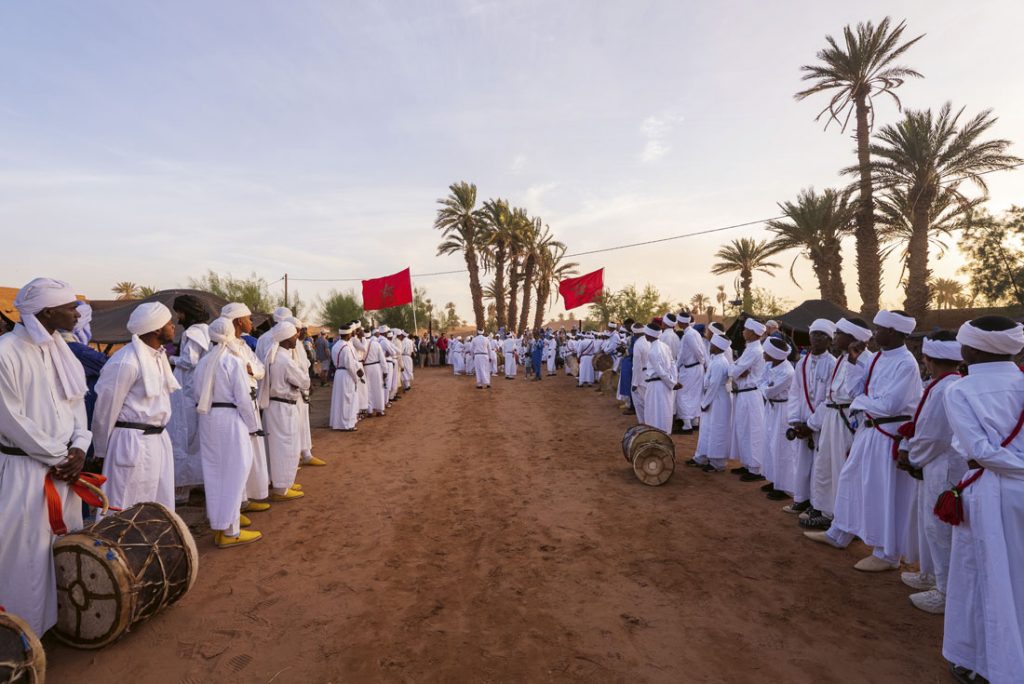
We learn about that vocal plasticity when Djob sings, because he takes us far away, to unexpected places from which he brings us back. He does it in Bassa and in French. Sometimes in English. It is impossible not to pay attention to that deep voice during his performances within the framework of the fourth edition of the Zamane Festival, which is held every year, at the end of autumn, in the oasis of M’hamid El Guizlaine, in the southeast of Morocco. There we discovered it.
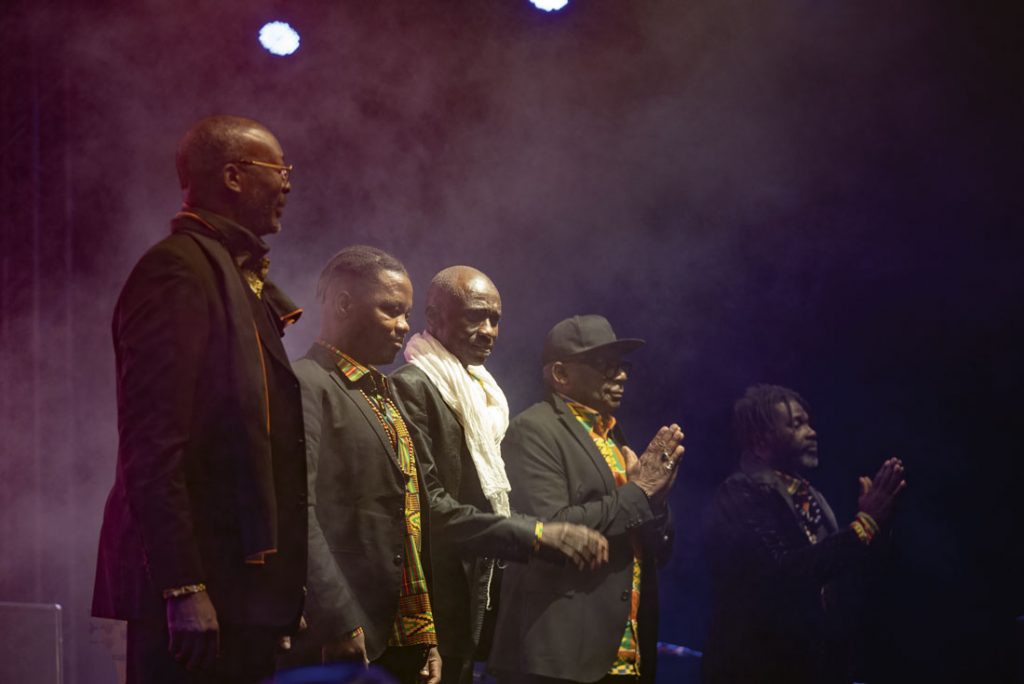
Up on stage, he acts as the undisputed leader of a group of experienced companions – some compatriots – who smile together with each vocal antics, between the strings of the baritones, the bass and the tenors (they are Jocelyn Balu Lelo, Augustin Dikongué, Bénilde Foko, Mike Louvila, Benny Point Owono and Sega Seck). In some song, three giant men become funny children, dancing in an equatorial forest, even though they are among the dunes of the Sahara. In that geographical and human framework, halfway between the lush greenery of their place of origin and the neat asphalt of the French land in which they reside, these African gospel musicians have sought artistic fusions with local musicians and invited several singers from the music school managed by the Joudour Sahara association to take the stage. To the usual counterpoint of voices and languages of their mestizo repertoire they add, on this occasion, Hassania Arabic.
A bassa prince
In all fairness, Djob (Yaoundé, 1963) is a virtuoso musician. He lives in Montpellier (France), but was born a prince within the Ndogsul ethnic group, in the Bassa family which, in turn, belongs to the great Bantu people of central Africa. A few years ago he decided to accept the challenge of succeeding his father, king of a small town in his region. He assures that, fortunately, he can combine the responsibilities that the population of that place gave him – he travels there every three or four months – with his commitments as leader of his ensemble vocal. She explains to us that the role of queen is played by a woman in the family. In her case, that role is played by her sister, who resides permanently in Cameroon and can take care of the day-to-day life of a full-fledged sovereign.
Thus, Djob can be lavished at festivals like this one in M’hamid, which explores and makes known the ancient music and traditions of the Draa River Valley region, accompanied by guests from the rest of the continent. This is where we interview the Cameroonian singer, under the thick dark fabrics of a Saharan tent, with the sand covered by rugs (and taking off his shoes, as he should). Then, he tells us that he studied Law and Economics in Yaoundé (Cameroon) and at the University of Montpellier (France), but that music is the only profession he practiced after finishing his studies: “It was what I was passionate about and what made me feel who I am, being part of my history.”
Pi Djob did not need a family of musicians to know that the voice was his manifestation and the musical instrument that best allowed him to express himself. He was self-taught: “You know: in Africa you learn to play alone, by ear, listening to the radio, because in Cameroon there was no television until the early 1980s.” This reporter’s question about the influence of MTV stops making sense.
Why gospel? Isn’t that too American style?
Gospel is very present in Cameroon, since our country was evangelized by American missionaries. They brought this style between the 19th century and the beginning of the 20th century. And there was the radio, which broadcast The Voice of America and covered much of the African continent. We also paid a lot of attention to the older people who played. That’s how we learned, watching others rehearse.
Do you think gospel needs to be updated or updated to make it contemporary?
Gospel is already contemporary. It is the only trend-setting music in the United States. New music, even techno, comes from gospel.
Maybe some of the skills of the beatbox (create sounds that imitate instruments only through the mouth) have to do with those vocal explorations…
It is innovative music also in terms of composition. A style that has always been ahead of its time. That’s why all the great African-American artists come from there… And so do the others, whether they are white or black, whether they are Johnny Cash, Aretha Franklin, Sam Cooke, Luther Vandross or Whitney Houston.
Where does gospel find its audience today?
After the United States, Brazil has become a great gospel country and then a bit of all of Africa, because it has globalized. In France there are gospel choirs in every city. In Spain I myself have contributed to developing it, since I have worked, above all, in Catalonia, where I have been going for about 20 years to teach courses. Barcelona has become one of the capitals of gospel.
With the word gospel the air exudes that vibrates in pioneer songs, which we imagine were born in the old plantations in North America, with enslaved people who were in charge of the hardest work of cultivation and harvesting. When we hear those sets of voices we think of African American references, of the descendants of people who were enslaved.
It is a story that moves me because our ancestors remember the people who came to capture people to take them away. Those stories have remained in our territory and that is why we all know that there is a place called the sea, even if we do not live on the shores of the Atlantic, and we know that the people who go there never return. That feeling is present among us, that is why we are afraid of the sea. We are very aware of this awareness of our ancestors and that is the reason why this music is very personal to me, even the one that speaks of a good part of my history. I don’t see it as something foreign.
Are they stories of stories of stories that come from other generations?
When people tell stories, there are some that we know are legends. Then there are those that really narrate the historical trajectory of the town, and we know how to differentiate between the two. We know this because, for example, the first time I saw the sea, something happened to me and I kept that feeling. As if my DNA had recorded it. It is something that goes beyond what is told. I think scientists have not yet proven it, but DNA travels, that is, if I have an ancestor who was taken to Latin America or the United States and his DNA continued in his descendants, I have traces of that genetic material. The temptation to talk about certain mystical or supernatural traits that make up the cosmogony of some peoples in central and western Africa is powerful when we meet cultured people who highlight their roots and can enlighten us about it. What it is about is investigating the bond that these citizens of such a globalized world maintain with their ancestors, in respect for the traditions that come to them from afar and they try to maintain, as well as in the family and community commitment that guides much of their actions.
Some Yoruba traditions explain that they do not venerate revenants (living dead) because, as they postulate, we all inhabit the same world. Just as there is the idea of a consciousness that survives us, do you think there could be a collective unconscious that links us to those who are no longer in this world?
Indeed, our dead are not revenants (or ghosts), live in another dimension of life. My ancestors are still there. I talk to them and they talk to me. I am in contact with the ancestors who stayed on the African continent – my father, my mother, my grandparents. But, actually, it is a very good question, because I do contact those who crossed the sea only when I sing. By making music I communicate directly with them, but not in everyday life.
What themes do you compose on?
About life and death. One of the last songs I wrote was about my mother’s death. But I also write about the struggle we must wage as Africans, to free ourselves, first of all, from ourselves, from our minds. I mean knowing how to distinguish, for example, between what we have learned from the West – the language, the way of thinking and even the way of writing music – and what really comes from our roots. It’s something I practice and I get closer to my roots every time.
Question of links
Are there common roots between Moroccan gnawa and African American gospel? Without hesitation, in the answer we should mention the restrictions to which enslaved people in Africa and America were subjected, linked to the profuse percussion made of metals – one day it was chains – and clapping – the possibility of making one’s own body sound to accompany the voice. Although there are notable harmonic and melodic distances to explore. Still, is the merger possible? Yes, any Cameroonian or North African musician would enthusiastically answer.
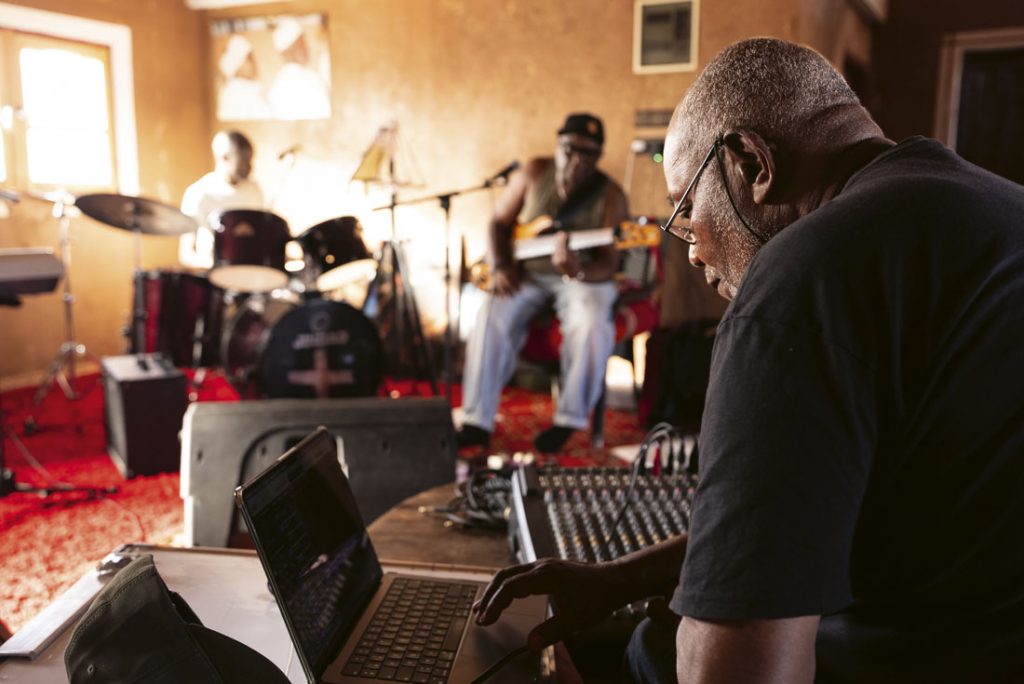
Hence arises the musical residency Sur les traces des origines (‘In the footsteps of the origins’), a multi-year program that, between April 17 and 24, 2026, will celebrate its third edition – with the artistic direction of Emmanuel Pi Djob. This time, the training and exchange sessions will be dedicated to gnawa and gospel, two expressions of African heritage that carry an indisputable spiritual dimension and the collective energy of fraternity. The objective is the creation of an educational space and the enhancement of intangible heritage, precisely in a territory like that of Drâa-Tafilet, in Morocco, a mestizo area that, since ancient times, has been the unavoidable landscape of the markets opened by caravans, en route between North Africa and the sub-Saharan region.
