The Mandinka tradition in the city of Mindelo (Cape Verde)
Every Sunday from the beginning of the year until the arrival of Lent, the Mandingo groups of Mindelo (Cape Verde) liven up their streets with a tradition that began in the 1940s and that cannot be separated from Carnival. Although in its origins it was related to the most humble classes of the city, today it is a festival in which the entire Mindelense society participates.
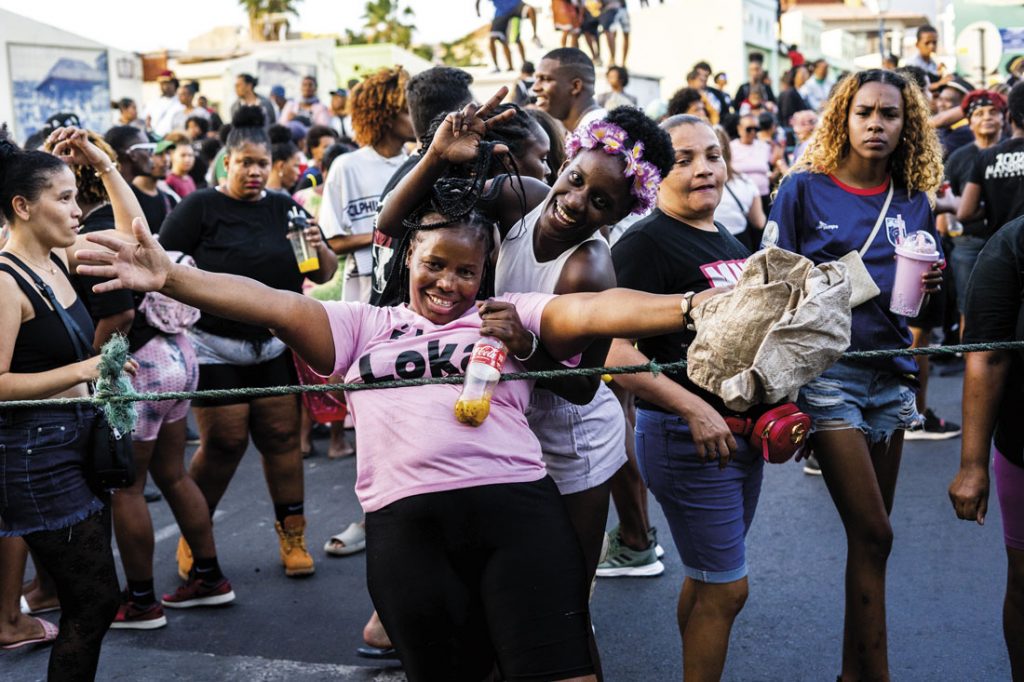
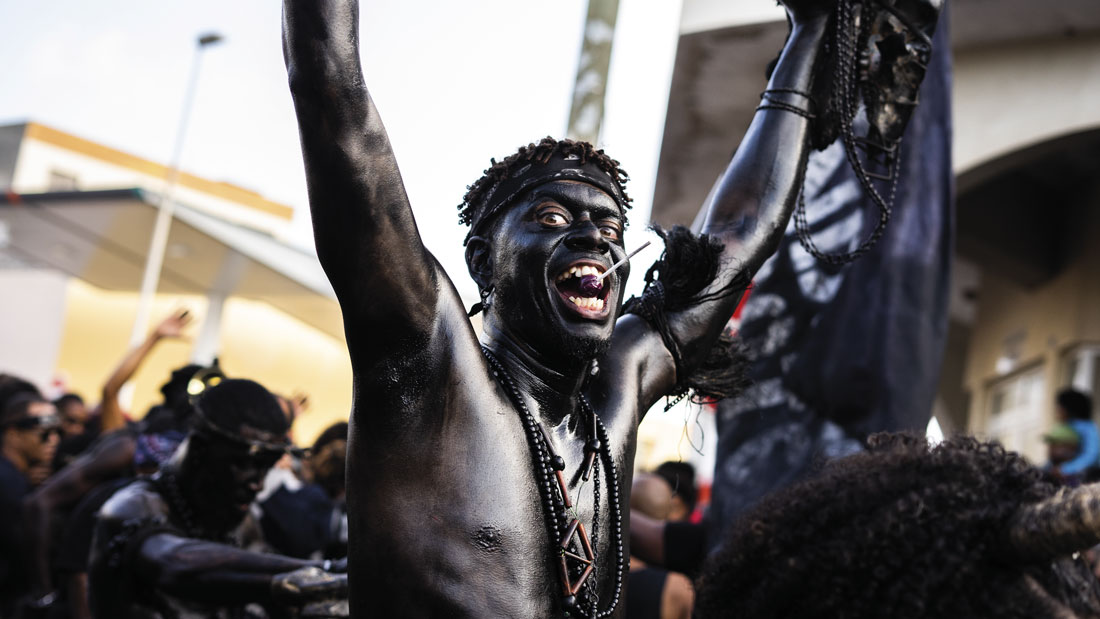
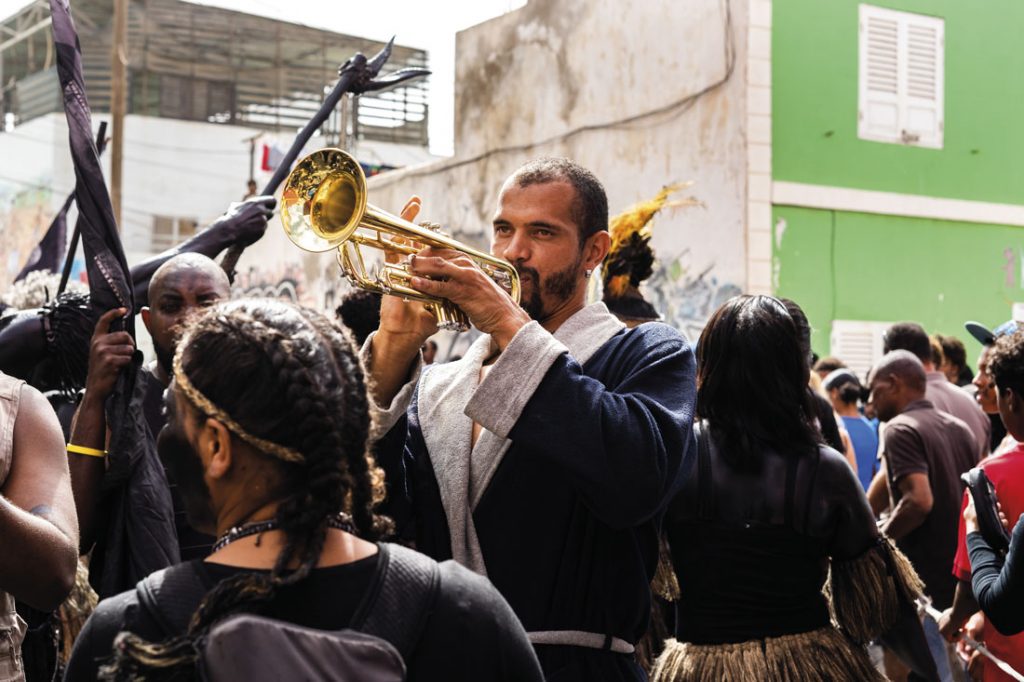
Color. Especially a shiny black. But also colors. All. Screams of those who know what to shout and those who cannot remain silent. Music. A trumpeter who plays in a housecoat and plastic flip-flops. Crowd. The one who dances and the one who hugs her. The batucada. The clueless The one who dances and the one who hugs him. Lack of control. Everything resonates. Crowd –did we already say it?–. The one who gets noticed. Children who add to this story. Those who get tired and sit down. “What do they drink?” Grogue. They tarnish you shiny black even if you want not to be shiny black. They stick out their tongues for the photo. The Mandinka pride flag. Another flag pride. The one who looks The one who observes. Who doesn’t laugh? One who imitates another. All. Order –yes, also order–. But with disorder. You take a photo looking for someone who sticks out their tongue. It comes out moving. You delete it. Around the corner. You look back. An infinite secular procession. The push. Another hug. The neighborhood you don’t know. The crowd. Another Mandingo group at the end of the street. More noise. All noise. The trumpeter is still wearing his robe. “I can’t hear you.” The batucada does not rest. Aria!!! “What does it mean?” you shout, asking. You sense something. You ask yelling. They shout at you to respond. Or vice versa. You think you sense that it is something like ‘standing’, ‘firm’. Something like that.
It’s Sunday. The Mandinkas of Ribeira Bote are on the street.
But let’s stop. Let’s recap. Let’s try to bring some sanity and some order.
The origins
José Moreno was a baker. He worked at the Favorite Factory in Mindelo (Cape Verde), today converted into a kind of archaeological site with remains from the mid-20th century that preserves, after what was that factory, the collective memory of a good part of the city’s inhabitants. But back to the man. Discreet in the daily life of his profession, Capote, as he was known for much of his life, transformed a few days a year into another person. The mutation took place at a very specific time: between Epiphany and the beginning of Lent. Every Sunday during that time period he painted his body black with the smut from the pots and pans. With a sword in his hand and a collection of threatening gestures and dances, he went out into the street shouting Ariaáa, ariaáa, ariaáa!!! Large and heterogeneous groups of Mindelenses supported Capote, the quiet man who from Monday to Saturday dedicated himself to daily bread, but who on Sundays substituted flour for soot.
Capote, like Djunga or Escoq, his son, gave shine to a tradition that began to be forged by chance in 1940 and that could have been no more than an anecdotal note in the history of that Portuguese island colony. It is not usual, but from dictatorships, even if by chance, sometimes things emerge worthy of lasting (sorry for the spoiling).
Once upon a time in 1940, the Salazar Government organized the Portuguese World Exhibition in Lisbon. With the regime at its peak, that event was intended to show the greatness of the Iberian country. To do this, he recreated communities – architecturally and sociologically – from colonial territories, in the manner of the well-known human zoos of Leopold II of Belgium or the previous Universal Exhibition of 1878 in Paris, in which people from Senegal were shown in the so-called “black villages.” As Mami Estrela, professor of Pedagogy at the Mindelo campus of the University of Cape Verde, summarizes, “it is not a pretty story. “The Portuguese brought people from various African communities to the Exposition as if it were a circus, to show ethnic diversity as a strength of the Portuguese Empire.” One of them was a bijagó community (Guinea-Bissau), which, on its way to Lisbon, stopped at Porto Grande on the island of São Vicente in the days when the city was preparing for the celebration of Carnival (see MN. 715, pp. 40-44).
In the old Sokol area, very close to the bay, that group took advantage of the technical stop to perform a “hunting dance”, as documented by Moacyr Rodrigues, one of the great experts on the Mindelense Carnival. The eternal tide of novelties that the Atlantic proposed, with different people, cultures, languages and ways of life every day of the year, that day brought something unknown that the islanders fell in love with. They were trapped by a cultural manifestation that they made their own from the following year. They began to replicate it in their streets, especially in the most marginal neighborhoods of Mindelo, such as Ribeira Bote, its eternal periphery (see MN 716, pp. 38-43). Although much more democratized, broad, plural and popular today, the oldest ones do not forget that the participants of the Mandinka groups were for a long time linked to the lowest social strata of the city. In fact, it was common for them to be known as rotten face (rotten face) or tin face.
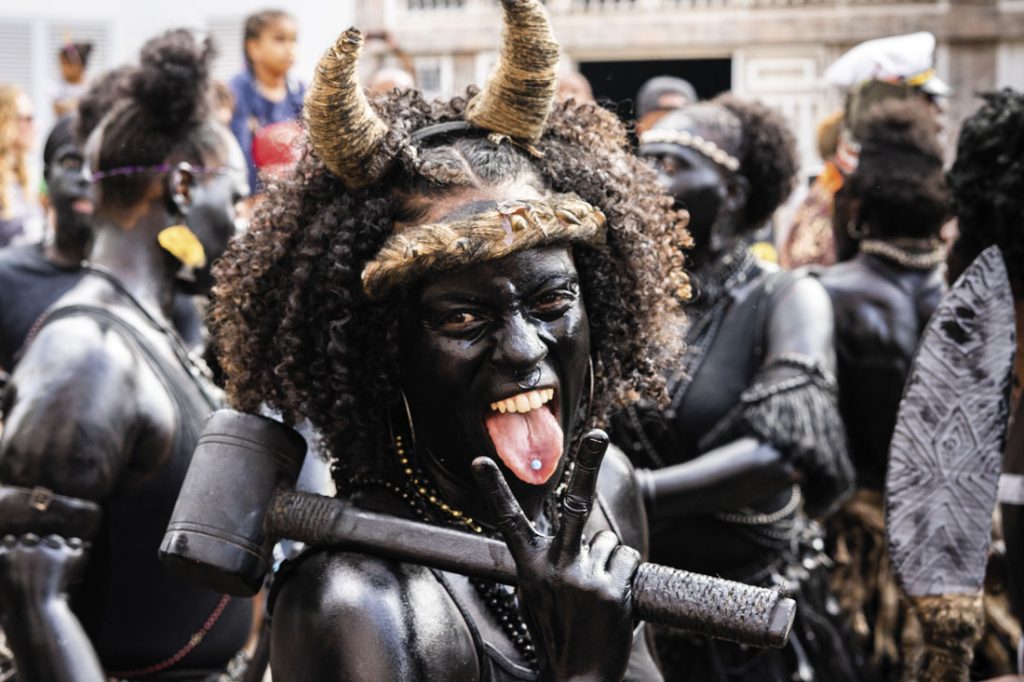
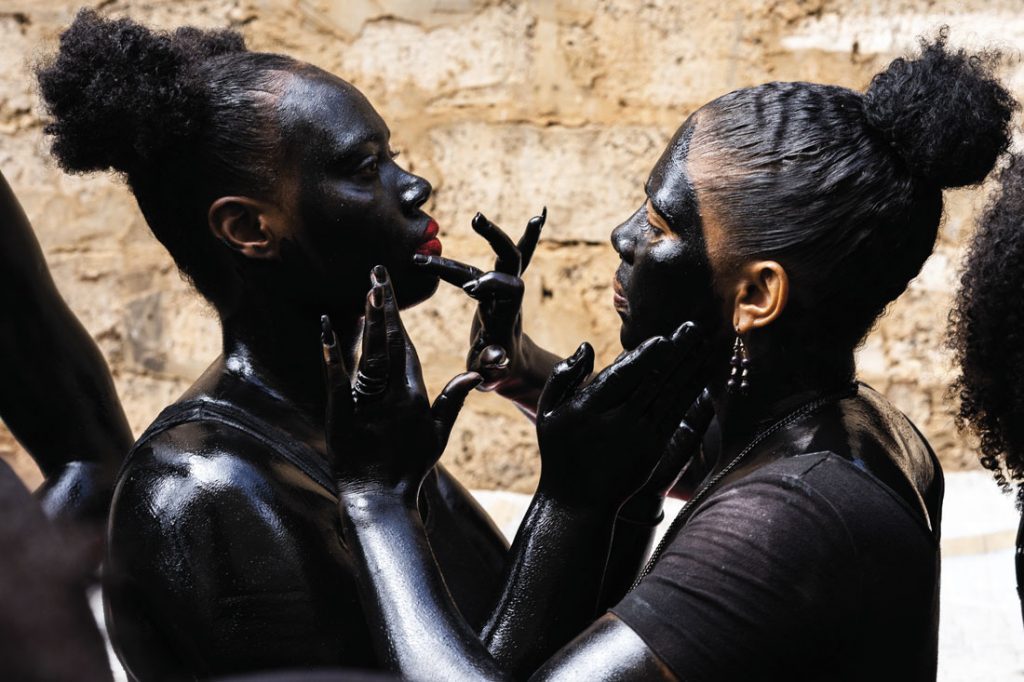
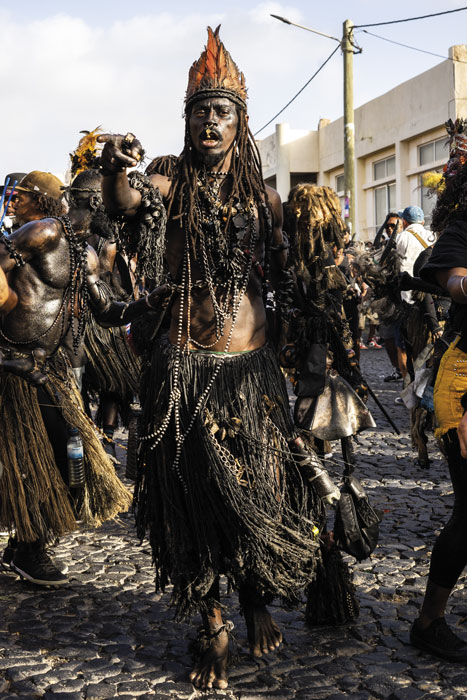
In the middle of the most mestizo island of the archipelago – “In Mindelo there is a symbiosis of a culture that was already born native, that did not come from other parts,” explains Estrela -, the clothing, the decorations that they placed on their heads and also the color of the skin of the bijagós were captivating. The impact was such that 12 months after that landing, the people of Mindel began to replicate the skin color of their ancestors Bissauguineans with soot – like Capote – and then with gunpowder mixed with oil or with remains of batteries (nowadays, most groups use products that are more respectful of the skin). They would imitate the color. But also the outfit. To do this they would use sisal skirts, conch shells tied to their ankles and spears in their hands. However, the interest in tracing what they had seen did not translate into rigor when it came to naming that popular movement that had just been born on the island. Although what they intended was to adopt the culture of the bijagós, in Mindelo they would change their name. Yes, its name would be different.
The Mandingas had settled on the windward Cape Verde Islands.
Changes
If the mention of Capote is obligatory, the reference to Djunga is no less fair. The perfection of her makeup, the absence of footwear, the shell decorations on her feet and hands, the crown with animal feathers or the large sword that she hit against the ground causing sparks were some of the attributes that enhanced her figure and, by extension, the fame and popularity of the Mandingas. Djunga’s aura also grew due to the secrecy with which, together with his group, he dressed every Sunday. Their appearance on the streets was a mystery that was renewed every seven days.
Today that suspense has disappeared, just like the use of swords or the presence of the mescrinhaspeople who paraded masked and who were excluded from the party to prevent crimes from being committed protected by the anonymity provided by body dressing. Music has also changed. Now percussion prevails – plus some wind instruments. Originally there were violins, banjos or cavaquinhos. Elements that change and, as we warned, mysteries that disappear. The schedules and itineraries, agreed upon with the City Council and the Local Police, are known. The Mandinka groups also provide their own security system. Although rudimentary – they surround the marchers with a rope – it allows the march to develop normally from noon until six or seven in the afternoon. Around, thousands of people on foot and as many as they can on windows and balconies participate in a catharsis that repeats itself every seven days for a handful of weeks a year. The mild Sunday afternoons of Mindelo become a great entertainment park for its inhabitants and a major coordination and security challenge for the City Council and the Police. In addition to the Ribeira Bote group there are those from Espia, Fonte Filipe, Ribeirinha or Pedreira. You belong to one or the other, you follow one or the other out of closeness, out of affection, out of tradition. By history. Yours or your family’s.
The Mandingas, who open and close the Mindelo Carnival, end their annual cycle with the Mandinga Burial. All the groups in the city, which in the previous weeks have lived with their backs to each other, now come together and make caixões (coffins) that they deliver to the Atlantic from Cachorro beach. It’s time to rest until next year. To close the estaleiros and to abandon the black smut. The Mandinka carnival also ends in the ocean, surrendering to the same waters from which the bijagós arrived in 1940.
Aria!!! We already wrote down what it was. Well, what we actually understood it to be. That’s what they shout. What they will shout again between Epiphany and the beginning of Lent.