
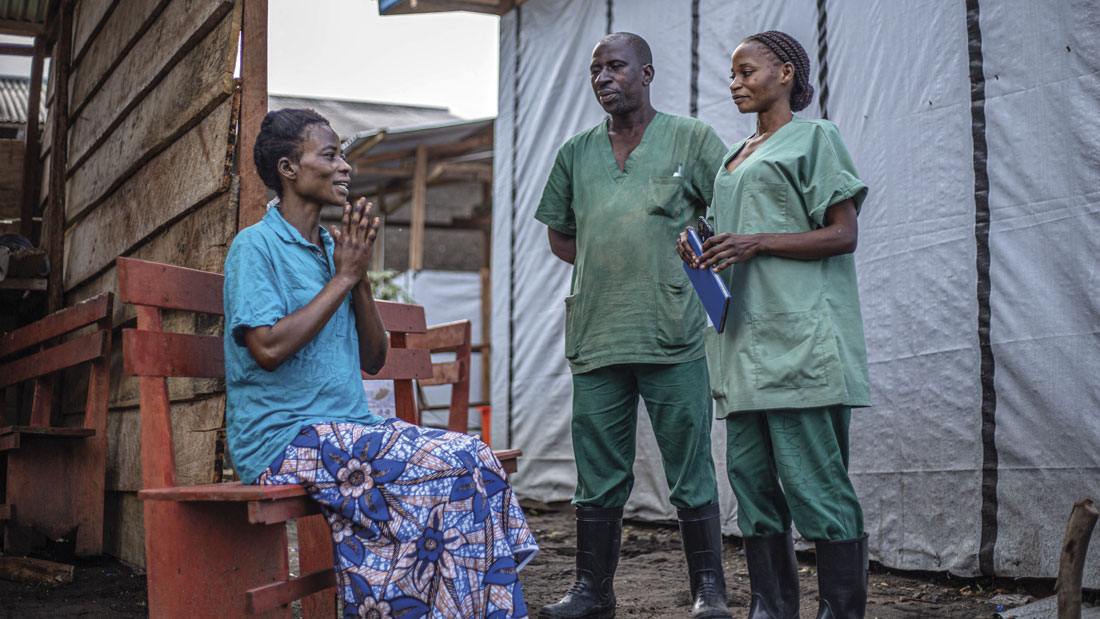
The Ebola virus continues to spread in the DRC, while awareness efforts grow.
Nearly 20 weeks have passed since the Democratic Republic of the Congo (DRC) declared, for the seventeenth time in its history, the appearance of Ebola in its territory (see MN 725, pp. 6-7). It was last May 15. In this case it is a strain of Ugandan origin known as Bundibugyo. Since then, the epidemic has caused more than 3,310 deaths and exceeds 7,000 registered cases, which qualifies it as the deadliest of those recorded in the country. Among the figures that allow us to open a space for hope are those of those who have managed to recover: more than 1,611 patients, according to the National Institute of Public Health (INSP). In Ituri, a province considered the epicenter of the epidemic, health authorities are beginning to perceive encouraging signs in the evolution of the outbreak. On September 15, at a press conference in Bunia, Jean-Jacques Muyembe, general director of the Institut National de Recherche Biomédicale (INRB), stated that “the epidemic is receding here, in Ituri”, according to the Radio Okapi website. Despite this, Muyembe added that “vigilance must be maintained”, especially in the neighboring province of North Kivu, where the circulation of the virus remains active. In Uganda, where 20 cases were confirmed, the Government ended the epidemic on July 28, according to Doctors Without Borders (MSF).
However, the death of a 23-year-old man in a health center in Gwaka, western DRC, opens a new front. The area, bordering the Central African Republic (CAR) and the Republic of the Congo, thus becomes the seventh Congolese province affected by the epidemic. The journey of the deceased man allows us to understand the dimension of the challenge posed by contact tracing. According to the information that MUNDO NEGRO has had access to, the individual left Kamanyola, in South Kivu, and crossed the border into Uganda, passing through Rwanda. From there he reached Bunia, the initial focus of the epidemic, in the east of the DRC. But the journey did not end there. He continued to Kisangani, where he stayed several days. Then, from Tshopo province, he traveled by boat to Lisala in Mongala before reaching Gwaka, where he died. This man’s journey, of more than 2,000 kilometers, explains the contagion capacity of the virus in regions marked by armed conflicts, population displacements and constant mobility through roads, rivers and mining routes.
Sensitization
Fighting rumors and conspiracy theories circulating both online and in affected communities is a long process. At the beginning of the outbreak, part of the population considered Ebola a “mysterious” disease and even suspected that international NGOs were the main beneficiaries of the crisis. Distrust fueled tension between the population and the teams deployed for the response, some of whose facilities and infrastructure have suffered several attacks.
When families who have experienced Ebola do not perceive an effective response, seeking help is no longer the immediate priority. In several of the most affected areas, such as Rwampara, Mongbwalu, Nizi or Beni and their surroundings, fear led many people to delay their arrival at medical centers. This rejection has affected trust in institutions that many communities perceive as distant and whose presence they only notice when an epidemic or any health emergency arises.
However, the evolution of the disease has also raised awareness about the risk posed by the virus. Those known as Nyumba Kumi work on the ground, response teams that carry out awareness-raising tasks together with community leaders. Their proximity to the population and their ability to access areas affected by conflict make them a bridge to rebuild trust.
The testimony of Augustin Kpagbo Ngodonza, mathematics teacher and community health educator, reminds us that the epidemic cannot be reduced to numbers. Behind every statistic there are people who fight, families who cry or remain hopeful, and teams who remain on the ground. Ngodonza acts as a liaison between patients and healthcare staff in Mongbwalu. Their work involves raising awareness in communities, accompanying families and informing them of the death of a loved one. In a video published by MSF, Ngodonza explains that some patients arrive “in a coma and dehydrated.” When they die, he adds, “it is not just about communicating a death, but about doing so in a dignified manner, through initial psychological care and a process that allows family members to come to terms with the news.”
Awareness has also reached schools. In Beni, Justin Kasereka, director of the Groupe Scolaire Savane, explained to France24 that the schools had incorporated nurses and paediatricians at the beginning of the course, whom they did not have before. Other preventive initiatives were added to these measures, such as insisting on frequent hand washing and maintaining a safe distance. The initiative was promoted by the Ministries of Education and Health in collaboration with their international partners.
Regional response
Concern about the outbreak is no longer solely Congolese. The constant movements of refugees and displaced people due to conflicts in the east of the country also raise concern among neighbors. Given this situation, the WHO convened a cross-border consultation in Bangui (CAR) last August. In addition to the host country, the DRC, the Republic of the Congo, South Sudan and Uganda participated in the meeting. The meeting highlighted the need for joint action to strengthen community surveillance and guarantee a rapid exchange of health information. At the end of the meeting, Mohamed Janabi, regional director of WHO Africa, recalled that “viruses know no borders.”
To date, there is no vaccine to stop the Bundibugyo strain. As the outbreak continues, Congolese authorities have requested, according to the WHO and the Africa Centers for Disease Control and Prevention, the release of 70,000 Ervebo vaccines from the global stockpile for use in the country. The WHO recommended that the first 20,000 doses, which were received in August, be used for “a clinical trial” to evaluate whether it can offer some degree of cross-immunity. The remaining 50,000 vials are being allocated to healthcare workers. The Ministry of Health launched this vaccination campaign on August 27, focusing on healthcare workers and front-line workers in the provinces of Tshopo, Bas-Uélé and Haut-Uélé.
The evolution of the epidemic does not overlap another challenge that the country is facing: inclusivity in the “national dialogue for peace, cohesion and refoundation of the State” without the belligerents, as announced by the country’s president, Félix Tshisekedi. Although each new displacement of the population reminds us that, in the face of Ebola, no map is definitive.
