
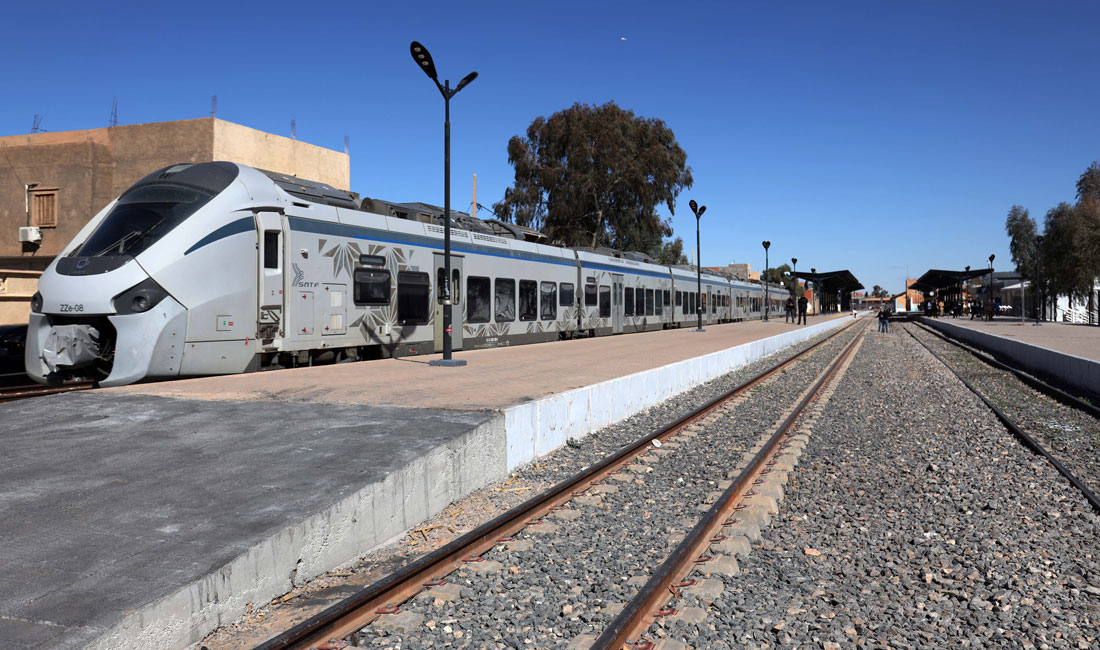
Algeria inaugurates the railway to Gara-Djebilet.
On February 1, the president of Algeria, Abdelmadjid Tebboune, traveled to the city of Béchar, in the west of the country, to inaugurate the railway line that connects that town with Gara-Djebilet, in the province of Tindouf, where the third largest iron mine in the world is located. The railway, which runs through 900 kilometers of desert, was built in less than three years, constituting a milestone in railway infrastructure. From Béchar, the train connects with the existing line to Oran, on the shores of the Mediterranean, on a route that exceeds 1,500 kilometers. In this way, it surpasses another of the great train routes in North Africa, the line that transports Mauritanian iron from the Zouérat mines to Nouadhibou, on the Atlantic coast, on a route of 704 kilometers.
The Algerian iron mine is, however, much larger than the Mauritanian one. It is estimated that it has 3.5 billion tons, of which around 1.7 billion could be exploited. On the African continent, only the Simandou mine, in Guinea (see MN 720, pp. 6-7), is larger than that of Gara-Djebilet. Furthermore, the latter offers a worse quality iron than the Guinean one, since it has 0.8% phosphorus that must be reduced to at least 0.2%. At the moment, it is expected that two million tons will have been extracted by the end of 2026, although the Algerian Government hopes that in 2030 they can reach between four and 12 million tons per year and, by 2040, they will reach 50 million.
The entry into service of this train has been carried out with the collaboration of Chinese companies, which show a particular interest in the project, since several conglomerates from the Asian country manage part of the mining exploitation in southwestern Algeria and the pretreatment of the mineral before being loaded onto the train. The iron is transported to the northern factories, where, with the collaboration of Turkish partners, the Government of Algiers has launched metal refining and steel production industries. This infrastructure could be a turning point for the economy of the North African country, since its exports depend 90% on hydrocarbons, especially gas. Currently, iron exports account for only 1.5% of the total, according to data from the Economic Complexity Observatory. With the exploitation of Gara-Djebilet, it is expected that this percentage will increase considerably and that it will help in the country’s economic diversification plan. In addition, it is also possible that with the income obtained from the sale of iron the trade balance with two of its main suppliers can be balanced: China and Türkiye.
In addition to the economic impact of the initiative, the railway connection will also allow greater integration of a territory that, until now, had poor communications. Along with the mining train, a passenger convoy links Tindouf – about 150 kilometers from Gara-Djebilet – and Béchar. The construction of this railway is part of a broader plan of the Algerian Government, whose objective is to double, by 2033, the kilometers of train tracks that currently exist. Before 2030 they hope to reach 10,000 kilometers of roads and reach 15,000 in 2040.
Photography: Getty
