
In a discreet Orthodox chapel used by the Russian community in Bamako, a priest celebrates the liturgy before a slowly growing congregation. A few years ago, the presence of the Russian Orthodox Church in sub-Saharan Africa was almost non-existent. Historically, most Orthodox churches in sub-Saharan Africa depended on the Greek tradition, specifically the Orthodox Patriarchate of Alexandria, and were linked to the Greek and Greek Cypriot communities. These communities were made up mainly of merchants who had spread across the continent following in the wake of the colonizers. Their churches barely carried out proselytizing work among the local populations. Today, however, Moscow promotes a religious expansion of a missionary nature, aimed at winning converts, and which adds to a strategy aimed at expanding its political, cultural and media influence on the continent. For this reason, in the small chapel you can see some Malians.
Religion, cultural diplomacy, university scholarships and social media campaigns are part of the same network of influence. Added to this set is also the military dimension, visible for years in the activity of the Wagner group and, more recently, in the structure known as Africa Corps, linked to the Russian Ministry of Defense, which supports part of this Russian presence on the continent.
Africa has become a key arena of competition between international powers, and Russia is deploying a strategy that combines soft power instruments with security tools.
The turning point in the expansion of the Russian Orthodox Church in Africa came in 2021, when the Moscow Patriarchate decided to create the so-called Patriarchal Exarchate of Africa. The decision was a direct response to a crisis within the Orthodox world caused by the recognition of the Ukrainian Orthodox Church by the Patriarchate of Alexandria.
For Moscow, that decision represented a serious break. The reaction was to establish its own ecclesiastical jurisdiction on the African continent. Within a few months, dozens of African priests abandoned the authority of Alexandria and became directly dependent on Moscow. Since then, the Russian Orthodox Church has begun to build a growing network of parishes in several African countries. Along with religious activity, the Patriarchate finances the training of African clerics, humanitarian aid and the construction of temples.
Ecclesial expansion also has a symbolic dimension. For Moscow, the Orthodox Church has become a tool of international projection that reinforces the narrative of Russia as a defender of traditional values against Western liberalism, especially on issues such as LGTBI+ rights, divorce or abortion. This discourse finds a certain resonance in African societies, where religious institutions maintain considerable social weight.
Religious expansion is not an isolated phenomenon. It is part of a broader strategy of cultural diplomacy promoted by Russia on the continent.
Russian cultural centers have emerged in several African capitals, organizing language courses, exhibitions and conferences, as well as activities aimed at students and young professionals. These institutions seek to bring Russian culture closer to African societies and create lasting ties with the continent’s new elites.
University scholarships play an important role within this strategy. Every year, thousands of African students receive funding to study at Russian universities, especially in areas such as engineering, medicine or natural sciences. The educational policy is reminiscent of the strategy that the Soviet Union used during the Cold War, when thousands of African students were trained in Soviet institutions. Many of them ended up occupying relevant positions in the politics or administration of their countries. For Russia, these alumni networks can become a long-term tool of influence.
Another key dimension of Russian strategy plays out in the digital space. In recent years, Facebook pages, Telegram accounts and TikTok profiles that spread messages favorable to Russia and critical of Western powers have proliferated in Africa. In some cases, these campaigns involve the participation of local influencers who amplify certain political messages. Narratives often present Russia as an ally against Europe’s colonial past, especially against France in French-speaking Africa. The idea of a “multipolar world” is also spreading in which Africa could choose its international partners more freely. These digital campaigns are usually reinforced with content from Russian state media such as RT, Sputnik or the TASS agency, which in recent years have expanded their presence on the continent and have signed agreements with African television and radio stations.
One of the clearest examples of this hybrid strategy is the Central African Republic. In this country, Russia has built a presence in just a few years that combines security, political influence and media activity. Since 2018, Russian military instructors and contractors linked to the Wagner group — whose structure has been partially absorbed by the so-called Africa Corps — have collaborated with the Central African government on security tasks. In exchange, companies linked to Russia have gained access to mining concessions.
But the Russian presence is not limited to the military sphere. Local radio stations, cultural projects and social media campaigns favorable to Moscow have also emerged in the country. The Russian Orthodox Church has also begun to develop pastoral activity in the country, which reinforces the cultural and symbolic dimension of the bilateral relationship.
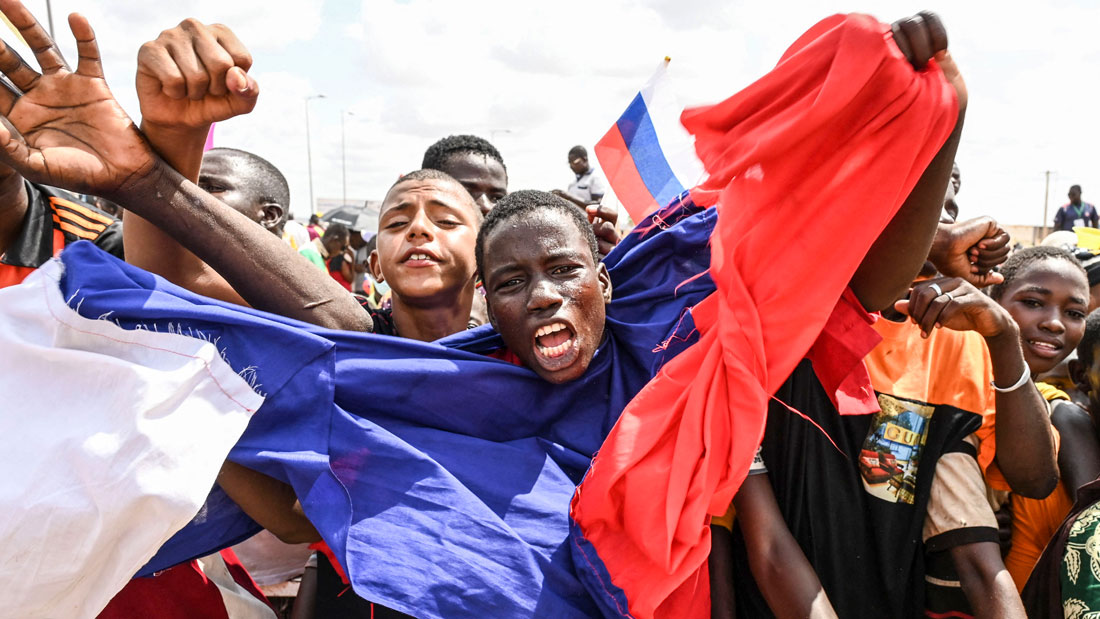
In some Sahel countries, Russia’s advance has occurred in parallel with the deterioration of relations with Western powers. In Mali, the military government that emerged after several coups d’état has strengthened its ties with Moscow after the progressive withdrawal of French forces. Russia has become a key security partner. Thus, Bamako has become one of the main centers of dissemination of pro-Russian narratives in the Sahel, with intense activity on social networks and public demonstrations in support of Moscow.
A similar phenomenon is observed in Burkina Faso, where growing anti-French sentiment has been accompanied by public demonstrations displaying Russian flags and expressing messages favorable to Moscow. Further east, Addis Ababa—headquarters of the African Union—has become another key point for Russia’s diplomatic and media presence on the continent.
In these contexts, social media campaigns and influencer messages have contributed to reinforcing Russia’s image as an alternative ally to the West.
For years, the most visible instrument of the Russian presence in Africa was the Wagner group, a private military company linked to the Kremlin. Wagner operated in several African countries. It provided military training, protection for political leaders and support in operations against insurgent groups. In exchange, he gained access to natural resources and economic contracts. But his role was not limited to security. Journalistic investigations have indicated that Wagner also participated in propaganda campaigns, creation of local media and political influence operations.
Following the death of its leader, Yevgeny Prigozhin, in 2023, many of these activities have been reorganized under structures more directly linked to the Russian state. Among them stands out the so-called Africa Corps, a force associated with the Russian Ministry of Defense intended to maintain Moscow’s presence on the continent.
The growing Russian presence comes at a time when Africa is once again taking center stage in international geopolitics. China has invested billions in infrastructure, Türkiye has expanded its diplomatic and trade network, and the United States and the European Union are trying to strengthen their relations with the continent. In this scenario, Russia is betting on a different strategy, which combines military cooperation, cultural influence, digital networks and religious presence.
The expansion of the Russian Orthodox Church in Africa is just one more piece of this complex mosaic of influence. But its growth illustrates how contemporary foreign policy increasingly uses instruments that go beyond traditional diplomacy.
Religion, culture, education and information have become key tools in the global competition for influence. And in Africa, this fight between powers is just beginning.
