
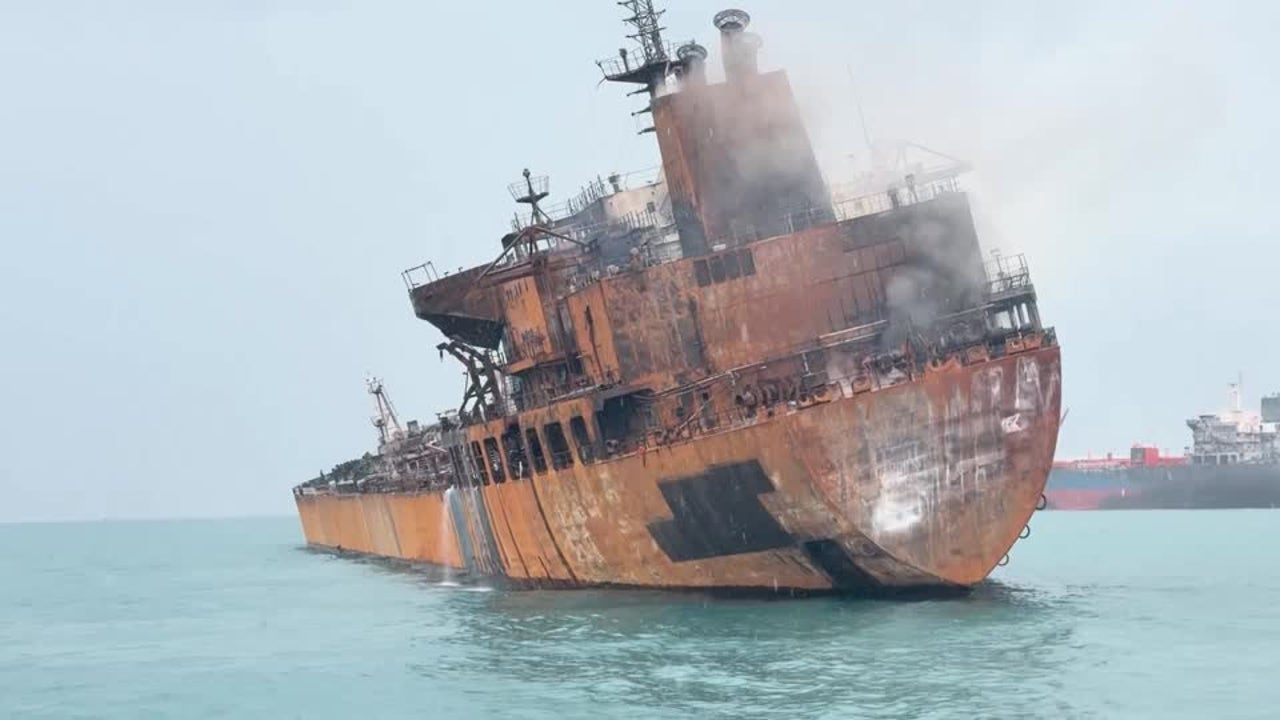
About two weeks after the start of the war in Iran, the Strait of Hormuz is now the most important strategic enclave of the conflict, which even threatens to create a global crisis and an almost unprecedented rise in prices. In the last 48 hours, Iran has already threatened to raise the price of a barrel to $200, which would be a historical record. Donald Trump, for his part, has just authorized the purchase of Russian crude oil to contain inflation, while celebrating the same price increase: “We are going to make a lot of money.”
In the Strait of Hormuz, as we say, everything is at stake and as proof, a button: some 20 million barrels of oil pass through it per day – according to data from the International Energy Agency (IEA) -, in addition to 20% of the liquefied natural gas trade. Thus, the current blockade of this sea route – located between Iran and Oman – has led to up to 32 countries agreeing to the largest release of oil reserves in history. Among them is Spain.
Experts have been warning for days about the serious consequences that all this could entail worldwide and the key is now in “time.” This is how Gonzalo Pérez-Maura, who is the CEO of Grupo Pérez y Cía, a leading company in the shipping and logistics sector, explains it: “There will be a blockage for a period of time and if it is prolonged it will affect the supply chain.”
Devastating consequences for Spain?
Here Pérez-Maura is more cautious and even calls for calm: “There will be no risk of shortages or lack of supply.” This is basically because most of the oil that reaches our country “does not come from the Persian Gulf.”
Although it is true that there may be a shift in the price of oil towards inflation and that even some goods and services may be affected, there is no need to have “any type of fear” – the Director of Pérez y Cía clarifies – because “no one wins in the long term” and “this situation should end sooner rather than later.”
Spain’s reserves
Now, the questions seem necessary: What happens if the conflict drags on? Could Spain run out of oil? If the conflict lasts longer than necessary and the bottleneck continues in the strait, everything depends on those strategic reserves that Spain has. And not only that, our country imports oil from other places. Gonzalo Pérez-Maura has qualified, in this sense, the statements of the third vice president, Sara Aagesen, about the fact that these Spanish reserves would ‘only’ last 92 days:
“There is an agreement that each country has its strategic reserves based on their consumption. In the event of a total shortage, there would be the possibility of drawing on them. But – and this is the important nuance – 92 days is in the event that no oil enters. Today, oil enters from other places, both crude and clean, so there would be no problem.”
“There is an agreement that each country has its strategic reserves based on their consumption”
In the end, he says, everything comes down to a “geopolitical issue,” because “everything related to the West is at risk of being attacked.”
The $200 threat
“If they can afford the price of oil at $200 a barrel, let them continue playing this game.” This is how direct the threat was from the Iranian spokesman, Ebrahim Zolfighari, who is linked to the business arm of the Revolutionary Guard. While the markets and Trump have not been slow to react to these words, Pérez-Maura has been more skeptical, because it is closely linked “to the global economy.” Therefore, it should not be closed for “more than two or three weeks.”
Is this oil liberalization by the IEA, then, excessive? “It is a decision to calm the market, so that everyone is calm and the price levels out,” explains the CEO of Pérez y Cía.
Since 104 million barrels are consumed per day, the release of these 400 million barrels can “cushion the price and prevent the barrel from continuing to rise.”
“It is a decision to calm the market, so that everyone is calm and the price levels out”
The future of declining oil
However, in the midst of such a situation of uncertainty, with the markets and the price of a barrel fluctuating almost every minute and with the world economy in trouble, Donald Trump continues to show his optimism regarding the stabilization of the situation. It’s not just that the United States is going to “make a lot of money” with this crude oil inflation, it’s that it maintains that the price of oil will be cheaper when all this is over.
Let us remember – saving the distance – when gasoline and diesel were above 2 euros, after the Russian invasion of Ukraine. The price, logically, ended up falling, but never returned to pre-crisis levels. The president of the United States goes even further and for Gonzalo Pérez-Maura this “is possible.”
Basically, it can happen because there have been “investments” to increase production, which can cause it to pressure “some of the oil down.” Of course, that curve can be specific. Pérez-Maura does not believe that this drop will be maintained over time because there will always be an “uncertainty” in case the conflict is reactivated: “There will always be a certain increase in prices due to the danger.”
What if the Strait of Hormuz is protected with warships? “It is a possibility,” he says, but we must take into account “the danger of passing the oil and exposing the crews to a possible attack.” This situation, he concludes, will have an early solution because it benefits no one if the Strait of Hormuz “is closed”, because “when the problems draw the attention of all powers they can be solved.”
