
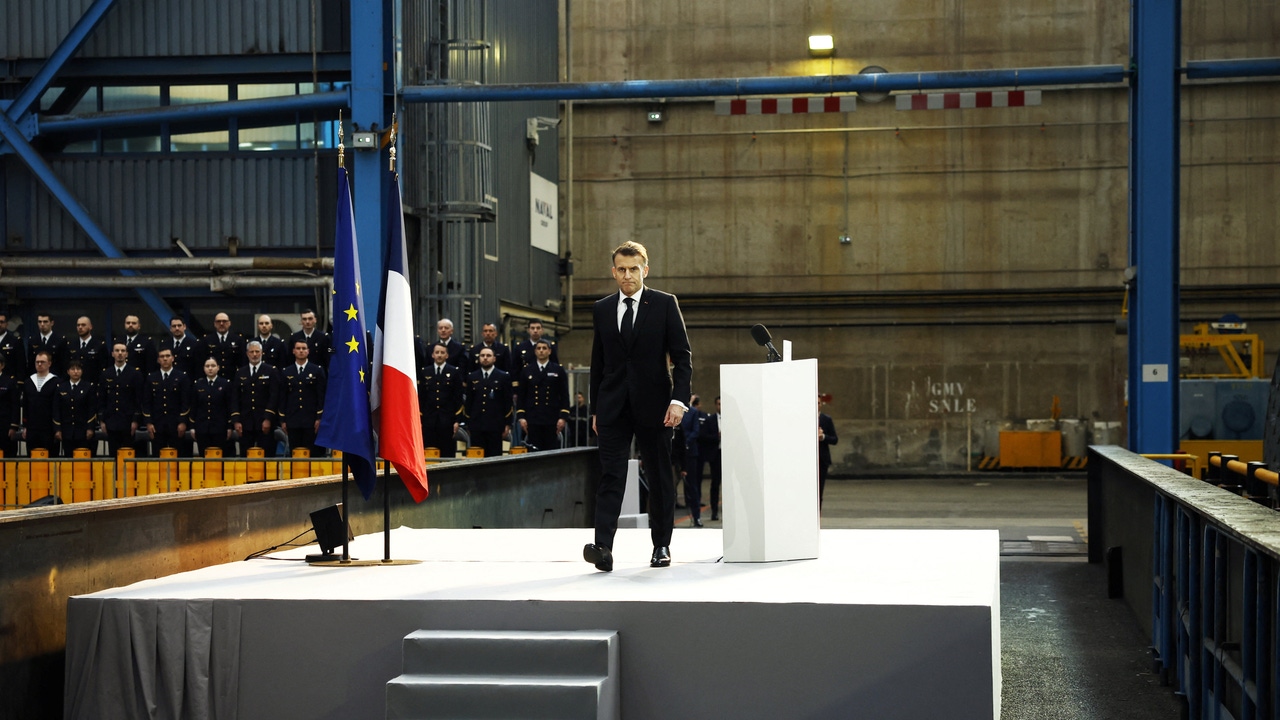
Emmanuel Macron announced last week that France will increase its nuclear arsenal in the midst of the war in Iran. The French president chose the moment of the announcement in an international context of increased proliferation and with a European increase in its nuclear deterrent, when talking about involving partners who want to join the proposal, although without sharing anything about the figures or their use.
How many nuclear warheads do France and the rest of the countries have?
Macron’s decision has several implications for Europe. The first is that France will increase its nuclear arsenal, which currently has 290 nuclear warheads, being the fourth country with the most warheads behind Russia – which has more than 6,000 -, the United States – more than 5,000 – and China – with 350 -.
The president of France did not specify how much the arsenal will increase and they are not going to be transparent, as Alba Leiva points out in El Orden Mundial, in Julia in the wave. “It is a measure against non-proliferation in terms of the number of warheads, but they have not yet taken the step of skipping the entire agreement and sharing those capabilities with other countries,” he says, later underlining that Macron stressed that “they will not share command of their nuclear capabilities.”
Macron’s objective is to preserve the deterrence capacity against an adversary that could consider an attack on France’s “vital” interests. “To be free, you have to be feared. And to be feared, you have to be powerful,” declared Macron, who called Russia a “great risk” for Europe, such as the expansion of the capabilities of Pakistan, India or North Korea, as well as the war in the Middle East.
Thus, Alba Leiva believes that it is a response “to the current times”, where nuclear deterrence “is once again gaining importance”: “Even more so in a context in which the United States is no longer a reliable partner, although we remain within the NATO framework.”
What it means for other European countries
Macron stressed that a threat to the survival of its neighbors would also affect French interests, which is why they cannot limit themselves to their own borders. He spoke especially about the United Kingdom, the other European country that has atomic weapons and with which it has taken more steps towards military coordination.
As for “advanced deterrence,” as Macron called it, this means the involvement of other European countries in their own exercises and strategy reflection, as well as the deployment of French forces in those nations. Germany, Poland, the Netherlands, Belgium, Greece, Sweden and Denmark have also been involved in the dialogues.
With them there will be bilateral bodies to maintain political communication, although France will never share the decision to resort to nuclear weapons or the limit to define the vital interests to which Macron referred. These meetings will be added to the NATO nuclear mission under the US umbrella, in which France does not participate.
