
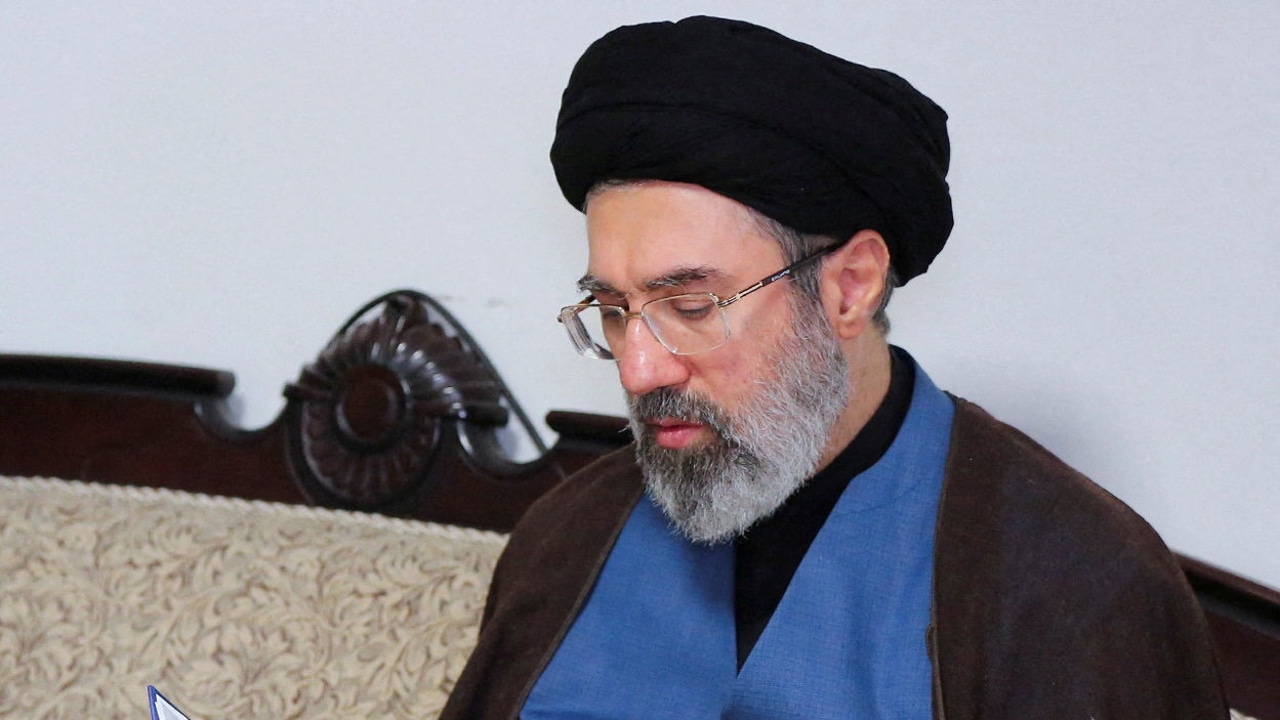
Mokhtaba Khamenei, son of Ayatollah Ali Khamenei, has been chosen by Iran’s Assembly of Experts to succeed his late father as supreme leader. This was revealed this Sunday after the Assembly announced his appointment in Vanak Square in Tehran.
The clerical body named the 56-year-old mid-ranking cleric, who has survived the US-Israeli offensive against Iran, as successor more than a week after Ayatollah Ali Khamenei died following the attacks.
His appointment, as Ayatollah Mohsen Heidari Alekasir stated this Sunday, is based on Khamenei’s directive that Iran’s top leader must be “hated by the enemy.” “Even the Great Satan (America) has mentioned his name,” he said.
Under the command of his father
Khamenei’s successor was accumulating power under the figure of his father as someone at a high level close to the security forces and the business empire they control. The Reuters agency points out that his close ties with the Islamic Revolutionary Guard Corps (IRGC) give him additional influence throughout Iran’s political and security system, cementing his weight behind the scenes as his father’s “sentinel.”
“It has a strong base and support within the IRGC, particularly among the younger radical generations,” said Kasra Aarabi, head of research on the IRGC at United Against Nuclear Iran, a U.S.-based political organization.
The power of the last word
The supreme leader has the final say in matters of state, including foreign policy and Iran’s nuclear program. Western powers want to prevent Tehran from developing nuclear weapons, while Iran claims its nuclear program is for civilian purposes only.
Along these lines, Mojtaba could face opposition from Iranians who have shown their willingness to organize massive protests to demand greater freedoms, despite bloody repressions by the authorities.
A look at the past
He was born in 1969 in the Shiite holy city of Mashhad and grew up while his father helped lead the opposition to the Shah. As a young man, he served in the Iran-Iraq War. He studied with religious conservatives in the seminaries of Qom, the center of Shi’ite theological learning in Iran, and holds the clerical rank of Hojjatoleslam. He has never held a formal position in the government of the Islamic Republic.
His role has long been a source of controversy in Iran; Critics reject any hint of dynastic politics in a country that overthrew a US-backed monarch in 1979.
