
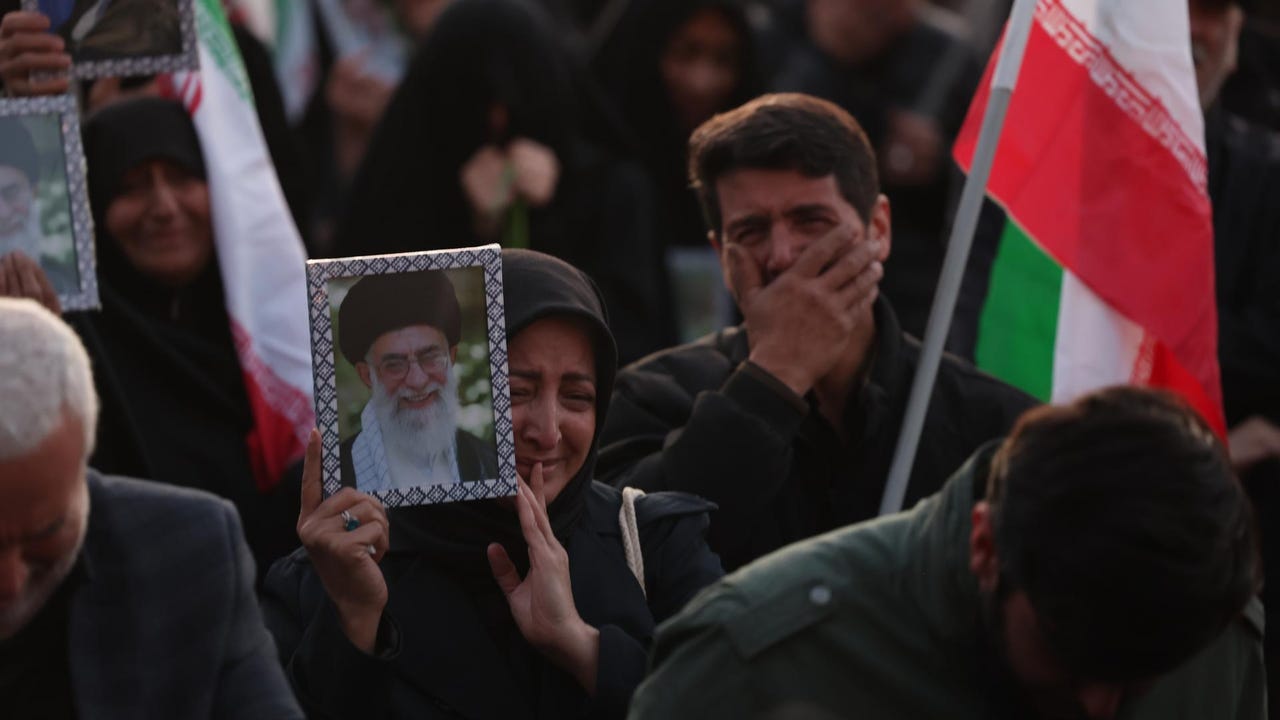
The joint US-Israeli strikes against Iran, which killed Iran’s Supreme Leader Ayatollah Ali Khamenei, followed by Tehran’s retaliatory strikes against Israel and neighboring Arab countries, have plunged the Middle East back into war.
US President Donald Trump and Israeli Prime Minister Benjamin Netanyahu have stated that their goal is to bring about favorable regime change in Iran. The implications this has for Iran, the region and beyond should not be underestimated.
Although Khamenei’s assassination is a severe blow to the Islamic regime, it is not insurmountable. Many Iranian leaders have been assassinated in the past, including Qassem Soleimani, Tehran’s regional security architect, who was assassinated by the United States in January 2020. On those occasions they have been replaced with relative ease, and the Islamic regime has endured.
Khamenei’s death is unlikely to spell the end of the Islamic regime in the short term. He anticipated this eventuality and last week reportedly organized a line of succession for his leadership and that of senior military, security and political leaders in case they were “martyred.”
However, Khamenei was as much a political leader as he was a spiritual one. He has led not only Iran’s devout Shiites, but also many Muslims throughout the region. His murder will prompt some of them to seek revenge, which could trigger a wave of violent extremist actions in the region and beyond.
A regime built to survive
Under a constitutional provision of the Islamic Republic, the Assembly of Experts, the body responsible for appointing and removing the supreme leader, will now meet to appoint a provisional or long-term leader, either from within its own ranks or from outside them.
There are three possible candidates to succeed him:
- Gholam-Hossein Mohseni-Eje’i, head of the judiciary
- Ali Asghar Hejazi, Khamenei’s chief of staff
- Hassan Khomeini, grandson of the founder of the Islamic Republic, Ayatollah Ruhollah Khomeini.
The regime has every incentive to do whatever is necessary to ensure its survival. Throughout the country there are many enforcers and defenders of the regime, led by the Islamic Revolutionary Guard Corps (IRGC) and its subordinate paramilitary group Basij, capable of suppressing any internal uprising and fighting for the durability of the regime, to which its fate is closely linked.
The same is true for a number of Iranian government administrators and bureaucrats, as well as regime sympathizers among ordinary Iranians: they are motivated by a mix of Shiism and fierce nationalism to remain loyal to the regime.
Call to overthrow the regime
Trump and Netanyahu have called on the Iranian people, about 60% of whom are under 30 years old, to overthrow the regime once US and Israeli operations have weakened it.
They want to take advantage of the fact that many are deeply outraged by the theocratic impositions of the regime and the serious economic situation. In fact, they already took to the streets in protest at the end of 2025 and beginning of 2026. The regime then reacted harshly, killing thousands of people.
Could a popular uprising occur now? So far, the coercive and administrative apparatus of the State appears to firmly support the regime. If major fissures do not appear between these figures, particularly the IRGC, the regime will hopefully survive this crisis.
Global economic pain
The regime has demonstrated its ability to respond very quickly to foreign aggression. It has already responded to Israel and US military bases in the Persian Gulf, using advanced short- and long-range ballistic missiles and drones. Although many of the projectiles have been repelled, some have hit their targets, causing serious damage.
The IRGC has also proposed blocking the Strait of Hormuz, the narrow strategic waterway that connects the Persian Gulf with the Gulf of Oman and the Indian Ocean. About 20% of the world’s oil and 25% of liquefied gas flow through the strait daily.
The United States is committed to keeping the strait open, but the IRGC is in a prime position to block traffic. This could have serious consequences for the global energy supply and the broader economy.
Both sides in this conflict have crossed all previous red lines. Now they find themselves in an open war that is affecting the entire region.
Prolonged war seems likely
If Washington and Jerusalem hoped that their attacks would not lead to a regional war, they were wrong: the fight has already begun.
Many countries that have close cooperation agreements with Iran, including China and Russia, have condemned the actions of the United States and Israel. For his part, the Secretary General of the United Nations, António Guterres, has urgently called for a reduction in tension and a return to diplomatic negotiations.
But the chances of being heard seem very slim. The United States and Iran were in the middle of a second round of talks over Tehran’s nuclear program when the attacks occurred. Oman’s foreign minister, who mediated between both sides, publicly declared just a few days ago that “peace was within reach.”
But this was not enough to convince Trump and Netanyahu to let negotiations continue. They considered it the best time to attack the Islamic Republic and destroy not only its nuclear program but also its military capabilities, after Israel weakened some of Tehran’s regional affiliates, such as Hamas and Hezbollah, and expanded its presence in Lebanon and Syria over the past two and a half years.
Everything points to a prolonged conflict
Although it is difficult to determine with certainty where the war will lead, everything points to a prolonged conflict. It may not last days, but weeks. The United States and Israel pursue nothing less than regime change. And the regime is firmly determined to survive.
With this war, Trump’s leadership is also sending a message to its adversaries – particularly China –: that the United States remains the world power par excellence.
It is unfortunate that the Iranian people, the region and the world have to endure the consequences of another avoidable war in the Middle East in an already deeply troubled world.
Amin Saikal, Emeritus Professor of Middle Eastern Studies, Australian National University; The University of Western Australia; Victoria University
This article was originally published on The Conversation. Read the original.
