
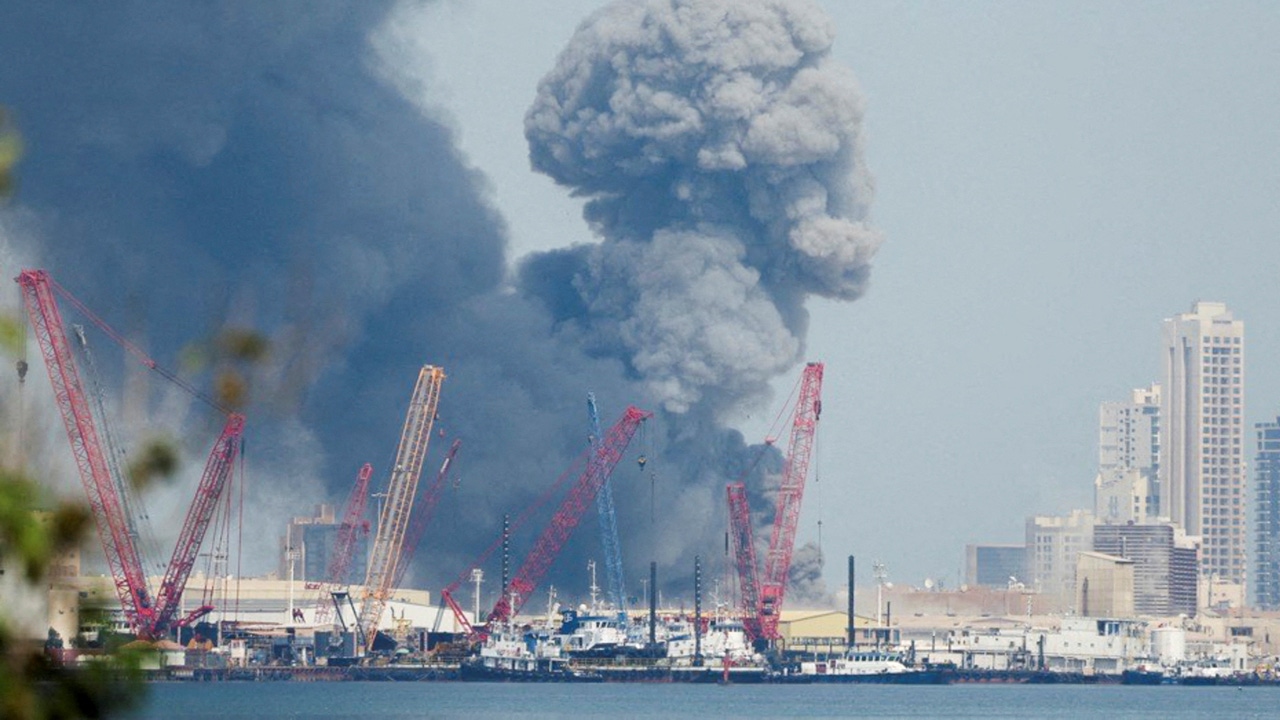
The United States and Israel have attacked Iran. A “preventive strike”, as Israeli Prime Minister Benjamin Netanyahu has described it, although his American counterpart, Donald Trump, has gone further, and has described it as a “massive operation” with the aim of “annihilating” and “destroying” the ayatollahs’ regime.
This is an attack that could be foreseen, taking into account that the United States had mobilized the largest military deployment on Iran since the invasion of Iraq in 2003. Furthermore, in recent weeks, the talks were very tense and the negotiations to limit Iranian nuclear power had not come to a successful conclusion.
It should be remembered that Trump on February 19 issued a 10-day ultimatum to Iran for a nuclear agreement, and assured that the objective is to “annihilate” the ayatollah regime. Meanwhile, Netanyahu has stated that the joint attack has the objective of “eliminating the existential threat” of the Iranian regime, which has responded with missile and drone attacks against Israel and US bases in Qatar, the United Arab Emirates, Bahrain and Kuwait.
A tension that began in 1979
The conflict between the United States, Israel and Iran goes back a long way. Trump, in a speech to his citizens, noted that “for 47 years, the Iranian regime has chanted ‘Death to America’ and carried out a campaign of bloodshed and mass murder against Americans, our allies, and innocent people in many countries.”
It all began in 1979, with the so-called Islamic Revolution and the hostage crisis. On November 4 of that year, several Iranian student activists entered the US embassy in Tehran and captured 52 US diplomats and citizens to protest Washington’s decision to admit the then-ousted Iranian monarch, Mohammad Reza, for medical care. As a consequence, the US broke relations with Iran and the hostages were not released until January 1981.
In the following years, the relationship between both countries went through moments of indirect war, sanctions against Iranian oil and energy sector and brief rapprochements, but never a normal relationship. In addition, the United States began to accuse Iran of supporting terrorist groups such as Hezbollah and Hamas.
Busch called Iran, Iraq and North Korea “the axis of evil”
In 2002, then-US President George Bush, in his address to the nation, called Iran, Iraq and North Korea an “axis of evil,” and accused Iran of possessing weapons of mass destruction and promoting terrorism. During the following years, previously undeclared nuclear sites were discovered in Iran, raising suspicions among the international community that Tehran was seeking nuclear weapons, something Iran has always denied.
In fact, in 2015, Iran signed an agreement with China, France, Germany, Russia, the United Kingdom and the United States to commit to reducing its nuclear activities. However, in 2018 it was broken, because Trump, now in power, reimposed the sanctions that he had withdrawn after signing the agreement.
The 12-day war of June 2025
For its part, Israel has justified its “preventive strike” with the need to eliminate the threat posed by the Iranian nuclear program, a threat that puts the State of Israel at risk. However, the Iranian authorities have always denied that their progress in the nuclear program is aimed at the construction of an atomic bomb.
It should be remembered that in June 2025, Iran and Israel fought a 12-day war. In mid-June, Israel launched an offensive against targets in Iran that ended the direct intervention of the United States, which launched air and sea attacks against the Iranian nuclear facilities of Fordow, Natanz and Isfahan. On June 23, Trump announced the ceasefire.
Israel and Iran also broke relations in 1979 and for years both countries have waged a war in the shadows, with cyberattacks, bombings, selective assassinations… Israel seeks to maintain its military superiority in the East with the support of Washington.
Elections in the United States and Israel coming soon
Furthermore, it should be noted that next October there are elections in Israel, so with this attack, Netanyahu scores a point. Donald Trump also has a lot at stake in the midterm elections next November, in the midst of a loss of reputation due to the explosion of Epstein’s papers, among others.
Both regimes also seek to end the rule of the ayatollahs in Iran and as Trump promised his citizens not to involve his country in another war, he has urged the Iranian population, very dissatisfied with the situation, to take to the streets and take advantage of the regime’s weakness.
